

Dr Dhruv Bagati
bagati.dr@gmail.com
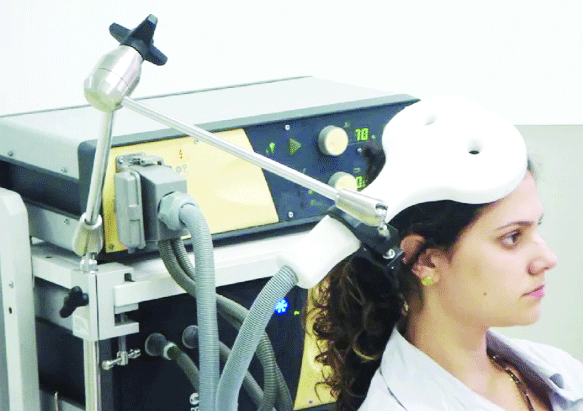
Transcranial Magnetic Stimulation (TMS) is an innovative, non-invasive technique that enables relatively safe and focal brain stimulation. It involves the generation of a time-varying magnetic field through a current pulse delivered via a stimulator coil placed over a specific area of the scalp. The rapid changes in this magnetic field induce an electric current in the underlying brain tissue, resulting in membrane depolarization and neural activation.
Mechanism of Action
TMS produces both short-term and long-term effects on the brain. Short-term effects arise from transient changes in local neurotransmitters, while long-term effects involve alterations in neural circuits and neuromodulation. Research has demonstrated that different frequencies of TMS have varying effects: higher frequencies increase cortical excitability, whereas lower frequencies (around 1 Hz) produce inhibitory changes in the motor cortex.
TMS Machine and Components
A Transcranial Magnetic Stimulation system consists of two main parts:
* Main Unit, which includes:
* Charging circuit
* Energy storage device
* Discharge circuit
* Stimulating Coil, the only component that comes in close proximity or contact with the patient. These coils are available in different shapes, including circular coils, butterfly-shaped coils, and figure-of-eight coils.
Clinical Applications
Depression
Although TMS has been used in research for several decades, its clinical application became significant after its approval by the USFDA in 2008 for the treatment of depression. Since then, it has been widely used across the world, including in India, with encouraging results.
In depression, high-frequency stimulation applied to the left dorsolateral prefrontal cortex-typically administered five sessions per week for two to four weeks-has shown significant benefits.
Patient selection is crucial. TMS is generally recommended as an adjunct to medication, particularly in cases of poor compliance, treatment-resistant depression, or when patients experience intolerable side effects from medication.
However, relapse after discontinuation remains a known challenge. Adverse effects are usually mild and include headache and tingling at the stimulation site. Rarely, hypomania or seizures may occur. The author has reported a case of seizure during TMS, though such events are extremely rare.
Compared to electroconvulsive therapy (ECT), TMS has several advantages: it is non-invasive, does not require anesthesia, and does not cause memory loss. However, its clinical response may not be as robust as ECT.
Obsessive Compulsive Disorder (OCD)
OCD is a chronic anxiety disorder characterized by persistent, intrusive thoughts (obsessions) and repetitive behaviors (compulsions). Common symptoms include excessive cleaning, washing, counting, praying, or repeated checking. These behaviors significantly impair daily functioning and quality of life.
With a prevalence of approximately 2%, OCD often follows a chronic course. For patients who do not respond or only partially respond to pharmacotherapy and counseling, TMS offers a promising alternative and has been approved by the USFDA for this condition. As with depression, careful patient selection is essential.
Schizophrenia and Auditory Hallucinations
Schizophrenia is a chronic and disabling psychiatric disorder with multiple causes, though its exact etiology remains unclear.
Several studies have shown that TMS can reduce auditory hallucinations, one of the core symptoms of schizophrenia. A randomized controlled study by Bagati et al. (2009), published in the Australian & New Zealand Journal of Psychiatry and conducted at the Central Institute of Psychiatry, Ranchi, demonstrated significant improvement using low-frequency (1 Hz) TMS.
However, relapse following discontinuation of therapy remains common.
Other Clinical Applications
TMS is also being explored in the management of several other conditions, including:
” Panic disorder
” Substance dependence
” Mania
” Catatonia
” Parkinsonism
” Stroke
” Migraine
” Tic disorder
” Tremor
” Tinnitus
” Post-traumatic stress disorder (PTSD)
Clinical trials are ongoing worldwide, including in India, for conditions such as autism.
Approved Indications
Currently, TMS has received USFDA approval for the following conditions:
1. Depression
2. Obsessive Compulsive Disorder (OCD)
3. Migraine
4. Nicotine dependence
TMS Devices
Commonly used TMS devices include:
” MagPro
” Magstim
” NeuroStar
Deep TMS
Deep Transcranial Magnetic Stimulation (DTMS) is a recent advancement with greater penetration depth (exceeding 3 cm). It utilizes a specialized H-coil, allowing for deeper and broader stimulation of brain regions.
DTMS has shown advantages in both treatment and research of psychiatric and neurological disorders and has been approved by the USFDA for depression and OCD.
Conclusion
Introduced more than three decades ago, TMS has evolved into a sophisticated tool for neuropsychiatric research and treatment. It is a non-invasive and effective modality with significant potential for both diagnostic and therapeutic use.
Despite its growing availability in India and worldwide, further research is needed to refine treatment protocols, assess safety, evaluate risk-benefit ratios, and determine cost-effectiveness. Its use should currently be limited to approved indications rather than extended indiscriminately to all psychiatric disorders.
Relapse after discontinuation remains a key challenge that requires further well-designed studies.
The author, with over a decade of experience in TMS, has contributed to several national and international PubMed-indexed publications and has received the Zee Healthcare Award for Individual Contribution in TMS. He has also presented research at international forums, including the World Conference of Biological Psychiatry in Paris, and has trained numerous psychiatrists and medical professionals in the use of TMS.
In properly selected patients, with appropriate clinical evaluation and necessary approvals, TMS has demonstrated excellent results. While it is a valuable non-invasive tool, it must be used judiciously and responsibly.
(The author is Neuropsychiatrist & TMS Expert)
 Follow our WhatsApp channel
