

Dr Tasaduk Hussain Itoo
drtasadukitoo@gmail.com
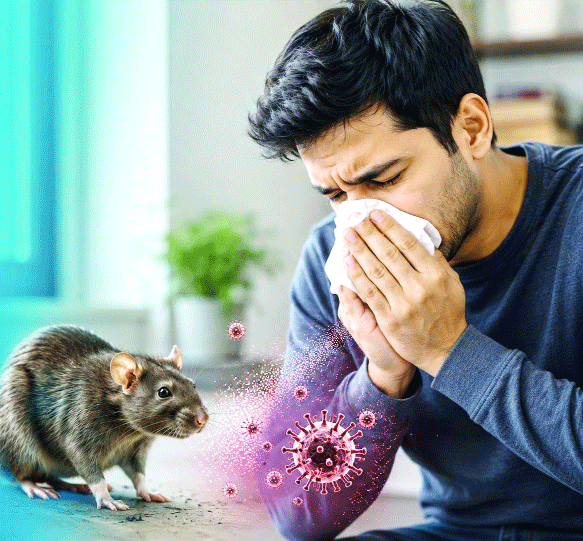
Hantavirus is a potentially deadly viral infection that has drawn increasing attention from scientists and public health experts due to its severe clinical manifestations and zoonotic origin. Although relatively rare compared with influenza, COVID-19, or dengue, hantavirus infections can produce life-threatening disease with remarkably high mortality rates. The virus belongs to the Hantaviridae family and is primarily transmitted to humans through contact with infected rodents, particularly their urine, saliva, or droppings. Human infection usually occurs when contaminated particles become airborne and are inhaled. Since its discovery, hantavirus has remained a subject of intense epidemiological interest because of its ability to cause sudden outbreaks and severe respiratory or renal syndromes.
The disease was first recognized during the Korean War in the early 1950s when thousands of United Nations soldiers developed a mysterious febrile illness characterized by kidney failure and haemorrhage. Researchers later identified the responsible pathogen near the Hantan River in South Korea, which gave the virus its name. Since then, multiple hantavirus strains have been identified across Asia, Europe, and the Americas. Different strains are associated with different rodent hosts and varying disease patterns. In Asia and Europe, hantaviruses mainly cause Haemorrhagic Fever with Renal Syndrome (HFRS), while in North and South America they are more commonly linked to Hantavirus Pulmonary Syndrome (HPS), a severe respiratory illness with a high fatality rate.
One of the most concerning aspects of hantavirus infection is its sudden progression from mild symptoms to critical illness. Early manifestations are often nonspecific and resemble common viral infections. Patients may initially experience fever, headache, muscle pain, fatigue, nausea, chills, and abdominal discomfort. Because these symptoms mimic influenza or other respiratory illnesses, diagnosis may be delayed during the crucial early phase of infection. In Hantavirus Pulmonary Syndrome, respiratory symptoms rapidly worsen over a short period, leading to cough, breathlessness, pulmonary edema, and severe respiratory failure. Many patients require intensive care and mechanical ventilation. Mortality rates for severe HPS can approach 35-40%, making it one of the deadliest viral respiratory diseases known.
The primary reservoir for hantaviruses is rodents. Different hantavirus species are associated with specific rodent hosts. In the United States, the deer mouse is a major carrier of Sin Nombre virus, one of the principal causes of HPS. In Europe and Asia, rats and voles are common reservoirs for strains associated with renal disease. Importantly, infected rodents generally do not become ill themselves, allowing the virus to persist silently in animal populations. Humans are accidental hosts and typically become infected through environmental exposure. Activities such as cleaning barns, entering abandoned buildings, handling grain storage, farming, or camping in rodent-infested areas significantly increase risk.
Despite its severity, hantavirus differs fundamentally from viruses that commonly cause pandemics. Most hantavirus strains do not spread efficiently between humans. Transmission usually requires direct or indirect exposure to infected rodents. This limited human-to-human transmissibility greatly reduces the likelihood of rapid worldwide spread. However, a notable exception exists in South America, where the Andes virus has demonstrated limited person-to-person transmission. Outbreaks involving close-contact spread have been documented in Argentina and Chile. Although these events remain relatively uncommon and restricted, they have raised important scientific concerns about the evolutionary potential of hantaviruses.
The global scientific community monitors hantaviruses closely because zoonotic pathogens have repeatedly demonstrated their capacity to evolve and emerge unexpectedly. The COVID-19 pandemic illustrated how animal-origin viruses can profoundly disrupt societies, economies, and healthcare systems. Climate change, deforestation, urban expansion, and ecological disruption are increasing contact between humans and wildlife reservoirs worldwide. Environmental changes may influence rodent population dynamics, potentially increasing the risk of hantavirus outbreaks. Heavy rainfall, flooding, and warming temperatures can promote rodent breeding and migration, creating favourable conditions for virus transmission to humans.
Another challenge associated with hantavirus is diagnostic difficulty. In many regions, healthcare providers may not initially suspect the disease because of its rarity and nonspecific presentation. Laboratory diagnosis often requires specialized serological or molecular testing. Delayed recognition can hinder timely supportive treatment and outbreak control measures. There is currently no universally approved antiviral therapy specifically targeting hantavirus infection. Management primarily involves aggressive supportive care, including oxygen therapy, fluid balance monitoring, intensive care support, and mechanical ventilation when necessary. Early recognition and prompt hospitalization significantly improve survival outcomes.
Public health prevention strategies focus largely on rodent control and environmental hygiene. Individuals are advised to avoid direct contact with rodent droppings or nesting materials. Contaminated areas should be ventilated before cleaning, and disinfectants should be used instead of dry sweeping, which can aerosolize viral particles. Protective gloves and masks are recommended when cleaning potentially contaminated environments. Proper food storage, waste disposal, and pest control measures are essential preventive interventions, especially in rural and agricultural settings.
Although hantavirus possesses several alarming features – including high mortality and zoonotic potential – most infectious disease experts do not currently consider it the most likely source of the next global pandemic. Viruses capable of efficient airborne human-to-human transmission, such as novel influenza strains or coronaviruses, remain greater pandemic threats. Nevertheless, hantavirus serves as an important reminder of humanity’s vulnerability to emerging zoonotic diseases. Its existence highlights the need for strong surveillance systems, international scientific cooperation, rapid diagnostic capacity, and preparedness for future outbreaks.
In conclusion, hantavirus is a dangerous and scientifically important viral disease that continues to challenge public health systems worldwide. While its current transmission characteristics limit its pandemic potential compared with highly contagious respiratory viruses, ongoing ecological changes and viral evolution mean it cannot be ignored.
 Follow our WhatsApp channel
