

Prof. Shyam Narayan Lal
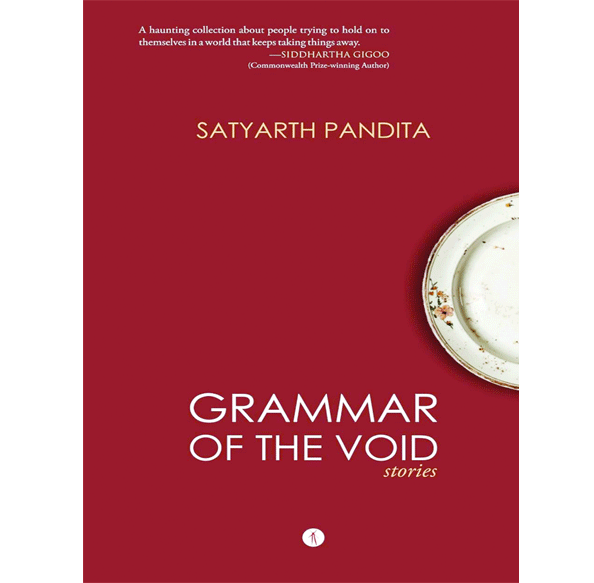
Satyarth Pandita’s Grammar of the Void, a profoundly evocative collection of stories, reads like a haunting cartography of contemporary human existence, mapping the silences, fractures, anxieties, and invisible wounds that quietly inhabit modern life. The title itself is charged with philosophical depth, where the “void” is not simply emptiness, but a dense landscape of memory, guilt, displacement, loneliness, emotional exhaustion, and suppressed despair. With remarkable emotional intelligence and narrative restraint, Pandita transforms ordinary moments into deeply unsettling reflections on the human condition. His stories linger long after they are read, illuminating the fragile spaces between suffering and survival, alienation and belonging, silence and meaning.
One of the most remarkable aspects of the collection is its tonal versatility. The stories move effortlessly between realism, psychological fiction, social satire, speculative imagination, and existential reflection. Yet despite this thematic and stylistic diversity, the collection never loses coherence. A persistent emotional undercurrent binds the narratives together-a sense that beneath the visible structures of society lies an unspoken crisis of meaning.
The opening story, The Birthday Gift, immediately establishes the emotional and political texture of the collection. What begins as the account of a tragic road accident slowly transforms into a powerful indictment of bureaucratic apathy, performative politics, and the mechanisation of public grief. The rain-soaked village, the gossiping villagers, the endless committees, the official condolences, and the evasive state machinery together create a darkly satirical portrait of institutional culture. Yet the story derives its real strength not from satire alone, but from its emotional restraint. The concluding image-the little boy receiving the toy car intended for his birthday from the hands of the police-is profoundly moving precisely because it avoids excessive sentimentality. The tragedy unfolds quietly, and therefore more devastatingly.
If The Birthday Gift exposes the failure of institutions, The Betrayal turns inward and explores the terrifying landscapes of memory and guilt. Set against the backdrop of the Kashmiri Pandit exodus, the story is among the most psychologically accomplished pieces in the collection. Pandita handles trauma here with remarkable sensitivity. Rather than relying upon overt political commentary, he focuses on the invisible afterlife of violence within the human mind. The recurring dreams, the self-mutilation, the repressed memories, and the gradual unveiling of buried guilt give the narrative an almost haunting intensity. The story operates simultaneously as psychological fiction, historical memory, and moral inquiry. Particularly impressive is the manner in which dreams function not as decorative symbols but as narrative devices through which the subconscious slowly forces truth into consciousness.
The title of the collection acquires its fullest meaning only when read alongside the final story. Throughout the volume, the “void” appears in multiple forms. In The Birthday Gift, it is the void created by sudden death and the hollowness of institutional sympathy. In The Betrayal, it emerges as the psychic void produced by guilt, memory, and displacement. In Species of Sufferings, it appears through loneliness, economic helplessness, bodily fragility, and the silent nearness of death. In Synapse, the void becomes civilisational and cognitive-the loss of dreams, imagination, and creative consciousness itself. Thus, each story explores a different grammar of absence: emotional voids, moral voids, political voids, spiritual voids, and existential voids
The concluding story, The Void, occupies a position of immense structural and philosophical significance within Satyarth Pandita’s Grammar of the Void. It is not merely the final narrative in the collection; rather, it functions as the conceptual and emotional culmination of all that precedes it. The earlier stories introduce the reader to different manifestations of absence, rupture, alienation, guilt, grief, institutional failure, displacement, psychological trauma, and existential anxiety. However, it is in The Void that these scattered emotional and philosophical strands converge into a larger meditation on emptiness itself-not as a passive condition, but as an active and shaping force within human existence.
The stylistic brilliance of Grammar of the Void finds one of its most powerful expressions in Species of Sufferings, arguably the most philosophically layered story in the collection. Through interior monologue, quiet observation, and emotionally restrained narration, Pandita transforms an ordinary hospital ward into a haunting metaphor for human existence itself. Crowded with patients, attendants, exhausted nurses, dying old men, bureaucratic indifference, and anonymous grief, the hospital becomes far more than a space of illness; it emerges as a living theatre of fear, loneliness, inequality, abandonment, and mortality where life and death coexist with unsettling intimacy.
What makes the story especially compelling is Pandita’s remarkable control over atmosphere. His prose is visually rich, cinematic, and deeply immersive, bringing to life rain-soaked villages, sleepless hospitals, dim cafés, refugee camps, and decaying urban spaces with extraordinary sensory precision. Yet beneath this vivid imagery lies a distinctly literary rhythm where philosophical reflections arise organically from lived situations rather than appearing intellectually imposed. This seamless fusion of emotional depth, visual richness, and philosophical introspection marks one of the finest achievements of the collection.
Another strength of Grammar of the Void lies in its ability to merge the personal with the philosophical. Pandita’s characters are rarely heroic figures. They are ordinary people trapped within extraordinary emotional circumstances-widows, refugees, patients, doctors, clerks, artists, workers, lonely travellers. Yet through them, the stories raise larger questions about morality, memory, identity, loneliness, and survival. Even speculative pieces such as Synapse retain this human core. The story’s dystopian premise-a world losing its ability to dream-works not merely as science fiction but as an allegory of civilisational fatigue and creative paralysis. The gradual disappearance of dreams becomes symbolic of the death of imagination itself.
The stories are also enriched by subtle intertextual echoes. Quotations from Dostoevsky, Borges, Camus, Nietzsche, Hesse, and other thinkers create an intellectual atmosphere that complements the thematic concerns of the narratives. Yet these references never feel ornamental or self-conscious. Rather, they illuminate the emotional and existential crises of the characters. The collection demonstrates a writer deeply engaged with both literary tradition and contemporary reality.
What ultimately distinguishes Grammar of the Void is its emotional intelligence. Pandita understands that human suffering is rarely loud. More often, it survives in silences, unfinished conversations, fading memories, tired gestures, suppressed guilt, and ordinary routines. The stories repeatedly return to these quiet spaces where people continue to live despite emotional devastation. There is pain in the collection, certainly, but there is also dignity, tenderness, and an enduring search for meaning amidst collapse.
In an age where much contemporary fiction often privileges speed over depth and spectacle over introspection, Grammar of the Void stands apart for its seriousness of purpose and emotional sincerity. It is a collection that demands slow reading and thoughtful engagement. Satyarth Pandita emerges from these stories as a perceptive observer of the human condition and a writer deeply attentive to the psychological and moral complexities of life. The collection is intellectually stimulating, emotionally resonant, and stylistically assured, making it a significant contribution to contemporary Indian English fiction.
(The author is Chairperson, Anandam – The Centre for Happiness Indian Institute of Management Jammu)
 Follow our WhatsApp channel
