

Anil Paba, Vinod Kumar
pabaanil@gmail.com
Museums have long been recognized as centres of learning, preservation, and civilisation. The word “museum” is derived from the Greek term Mouseion, meaning the seat of the Muses-the goddesses of art, literature, music, and knowledge in Greek mythology. Since around 300 BCE, museums have served as repositories of human achievement, safeguarding objects related to history, culture, science, art, and social development. They are far more than buildings that house antiquities; they are living institutions that connect the past with the present and inspire future generations to understand, appreciate, and preserve their heritage.
In India, the tradition of cultural travel has ancient roots. Long before the emergence of modern tourism, people undertook Tirtha Yatra (pilgrimage journeys) to sacred sites such as Rameswaram, Dwarkadhish Temple, and Badrinath Temple. The Char Dham Yatra united the four corners of the subcontinent and fostered cultural exchange, national integration, and spiritual understanding. Foreign travellers such as HuenTsang Fahien and Ibn Battuta also journeyed to India to study its religion, education, and society, leaving accounts that continue to inform historical scholarship.
Just as pilgrimage once connected distant regions and communities, museums today serve as cultural crossroads where diverse artistic, historical, and social traditions are brought together under one roof. In the twenty-first century, however, museums are no longer passive repositories of artefacts. They are evolving into technologically enabled cultural laboratories that integrate drones, cloud computing, photogrammetry, LiDAR, Geographic Information System (GIS), and immersive platforms based on Augmented Reality (AR), Virtual Reality (VR), and Mixed Reality (MR). These innovations are redefining museums as dynamic centres of education, conservation, research, and sustainable tourism.
In the context of Jammu and Kashmir, the transformative role of museums and digital heritage technologies can be understood through the strategic framework of 4T-Terrain, Tourism, Terrorism, and Technology. The mountainous landscape of the region presents significant challenges for documenting and managing heritage sites located in remote and ecologically sensitive areas. At the same time, Jammu and Kashmir is one of India’s foremost centres of pilgrimage and heritage tourism, home to sites such as Shri Mata Vaishno Devi Shrine, Amarnath Cave Temple, Raghunath Temple, and Martand Sun Temple. The historical impact of terrorism has affected social stability, education, and investment, while technology offers a powerful means to overcome these constraints. When these four dimensions are strategically integrated, they can generate the four developmental outcomes of 4E-Education, Employment, Economy, and Environment.
Drones, or Unmanned Aerial Vehicles (UAVs), have become essential tools for heritage documentation and tourism promotion. Equipped with high-resolution cameras and sensors, they capture aerial photographs and cinematic videos of temples, forts, museums, archaeological landscapes, and cultural corridors. In difficult terrains such as Jammu and Kashmir, drones enable rapid, safe, and accurate documentation while also producing compelling visual content for destination marketing and digital storytelling.
Drone imagery is further processed through photogrammetry to create highly accurate three-dimensional models of monuments, sculptures, and museum artefacts. These models support structural analysis, virtual restoration, academic research, and disaster preparedness by preserving precise digital records of vulnerable heritage assets.
LiDAR technology enhances this process by using laser pulses to generate dense point clouds that capture minute architectural and topographical details. It can reveal buried archaeological features, penetrate vegetation, and record complex structures with exceptional accuracy, making it invaluable for documenting temples, fortifications, and cultural landscapes.
GIS provides the spatial framework to integrate maps, satellite imagery, drone data, LiDAR scans, and historical information. It enables researchers and planners to map pilgrimage routes, analyse visitor patterns, assess environmental risks, and design sustainable heritage tourism circuits. In Jammu and Kashmir, GIS is particularly useful for linking museums, sacred sites, and cultural landscapes within a coherent planning system.
Cloud computing extends the reach of museums by enabling secure digital storage and global access to manuscripts, paintings, sculptures, coins, photographs, and rare books. Virtual museums and online archives allow students, researchers, and tourists worldwide to engage with cultural collections beyond the physical museum space.
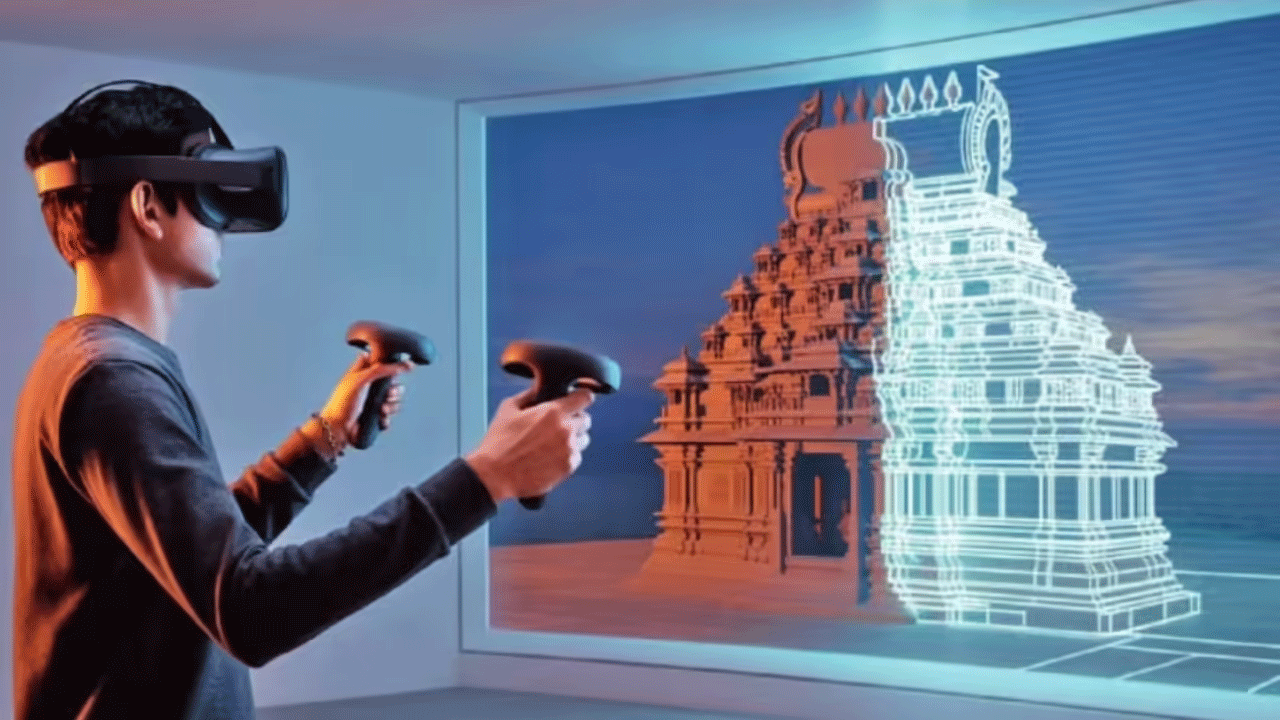
AR, VR, and MR technologies revolutionize interpretation by transforming static exhibits into immersive experiences. Visitors can explore reconstructed temples, interact with holographic artefacts, and visualize historical environments, thereby deepening understanding and engagement with cultural heritage.
Together, these technologies form a comprehensive digital ecosystem in which aerial surveys become 3D models, spatially analysed through GIS, preserved on cloud platforms, and presented through immersive applications. This integrated approach not only enhances conservation and research but also supports peace-building and inclusive cultural dialogue.
Within the 4E framework, museums become catalysts for sustainable development. They strengthen Education by providing interactive learning environments and digital knowledge resources. They generate Employment by creating opportunities in drone operations, GIS mapping, 3D modelling, conservation, tourism management, and creative industries. They stimulate the Economy by expanding heritage tourism and supporting hospitality, handicrafts, and cultural entrepreneurship. They promote the Environment by enabling ecological planning, disaster risk management, and the preservation of traditional sustainable practices.
These innovations are especially valuable for regional and private museums that preserve Dogra, Kashmiri, Buddhist, and tribal traditions. Institutions with limited resources can use digital tools to reach global audiences, enhance local identity, and integrate community heritage into national and international tourism networks.
India possesses one of the richest cultural heritages in the world, yet many museums remain underutilized within tourism and development strategies. Coordinated action by Government agencies, universities, museums, tourism departments, and private heritage organizations is essential to build digital infrastructure, develop technical skills, and foster innovation in conservation and interpretation.
In conclusion, the evolution from traditional T?rtha Y?tr? to digital tourism represents a profound transformation in the way culture is experienced and shared. In Jammu and Kashmir, the strategic convergence of 4T (Terrain, Tourism, Terrorism, and Technology) and 4E (Education, Employment, Economy, and Environment) offers a comprehensive roadmap for sustainable peace and development. Museums empowered by drones, photogrammetry, LiDAR, GIS, cloud computing, and AR-VR-MR technologies are no longer static repositories of the past; they are becoming vibrant centres of knowledge, innovation, conservation, and social transformation. By harmonizing ancient wisdom with contemporary technology, museums can preserve cultural heritage, empower communities, generate livelihoods, and build a resilient and harmonious future.
(The authors are Co-Convener INTACH Sub-Chapter Udhampur and Assistant Professor, School of Architecture and Planning SMVD University)
 Follow our WhatsApp channel
