

KOLKATA, May 5:
Alleging that the West Bengal assembly poll verdict was “not a people’s mandate but a conspiracy”, TMC supremo Mamata Banerjee today refused to resign as Chief Minister, opening up a constitutional grey zone and a political confrontation in the state.
Follow the Daily Excelsior channel on WhatsApp
A day after the BJP sealed a landslide victory with 207 seats in the 294-member assembly, ending the Trinamool Congress’s uninterrupted 15-year rule, Banerjee dismissed the outcome as “engineered” and asserted that her party was fighting the Election Commission, not the BJP. The TMC could only manage 80 seats.
“Why should I step down? We have not lost. The mandate has been looted. Where does the question of resignation arise?” she said, doubling down on her refusal to vacate the office.
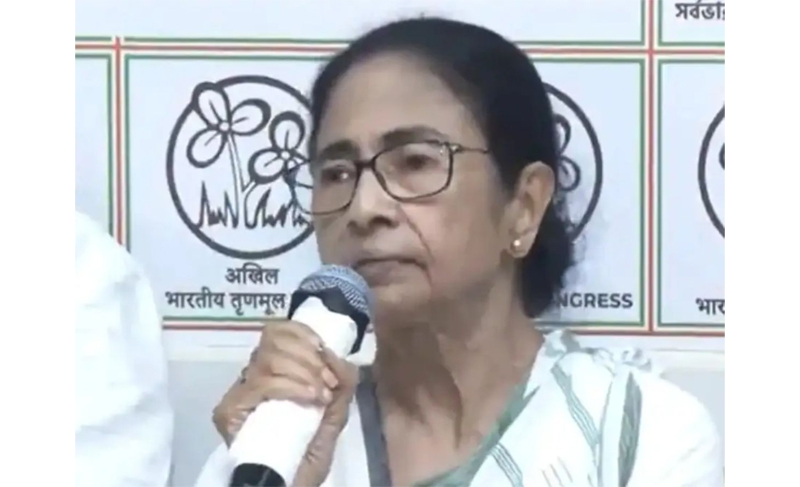
“The question of my resignation does not arise, as we were defeated not by a public mandate but by a conspiracy…I did not lose, I will not go to Lok Bhavan,” she asserted at a packed press conference, her tone oscillating between grievance and combativeness.
Banerjee alleged large-scale irregularities in counting, claiming nearly 100 seats were “looted” and that the pace of counting was deliberately slowed to sap her party’s morale.
“We were not fighting the BJP; we were fighting the Election Commission, which was working for the BJP. I have never seen such an election in my entire political career,” she said.
“A black chapter in history has been created. The Chief Election Commissioner has become the villain,” she added, escalating her attack on the poll body.
Yet, beyond the rhetoric, Banerjee’s refusal to resign has opened up a constitutional grey zone.
According to constitutional experts, a scenario in which a Chief Minister, after losing an election, declines to step down has never been envisaged.
Significantly, experts note that there is no precedent in India of a defeated Chief Minister refusing to resign after losing an assembly election. If Banerjee persists with her stance, it could mark an unprecedented moment in the evolution of India’s parliamentary democracy.
Constitutional expert and former Lok Sabha secretary general P D T Achary said that Banerjee “has to go” once a new Chief Minister takes the oath. ”There cannot be two Chief Ministers in a state,” he added.
He also underlined that she was elected to the outgoing legislative assembly. Its term ends on May 7. “As per constitutional provisions, a Government is accountable to the legislature. Once the term ends, the Government too has to go,” he noted.
Asked about the constitutional or legal options available to the West Bengal Governor following Banerjee’s assertion, senior advocate and constitutional law expert Rakesh Dwivedi said political morality and constitutional discipline demand her resignation.
“But, in any case, a new legislative assembly has been elected, and soon a BJP leader will stake a claim and be appointed Chief Minister by the Governor. The Governor will dismiss her (Banerjee) if she doesn’t resign,” Dwivedi said.
Senior advocate and former Supreme Court Bar Association President Dushyant Dave said, “He (Governor) must dismiss her”.
Senior advocate Ajit Sinha said Banerjee must resign, or she will be out once the new incumbent takes over and proves a majority on the floor of the House.
“Mamata Banerjee has to resign. As per the constitutional provisions, the Governor must call the party having a majority to form the Government and prove that majority on the floor of the House… Once the new incumbent takes over, she is deemed to be out of the office,” Sinha said.
When the Left Front’s 34-year rule ended in 2011, then Chief Minister Buddhadeb Bhattacharjee promptly drove to Raj Bhavan to submit his resignation to Governor Gopalkrishna Gandhi after conceding defeat. He relinquished the trappings of office without delay, symbolising an orderly democratic transition. (PTI)
 Follow our WhatsApp channel
