

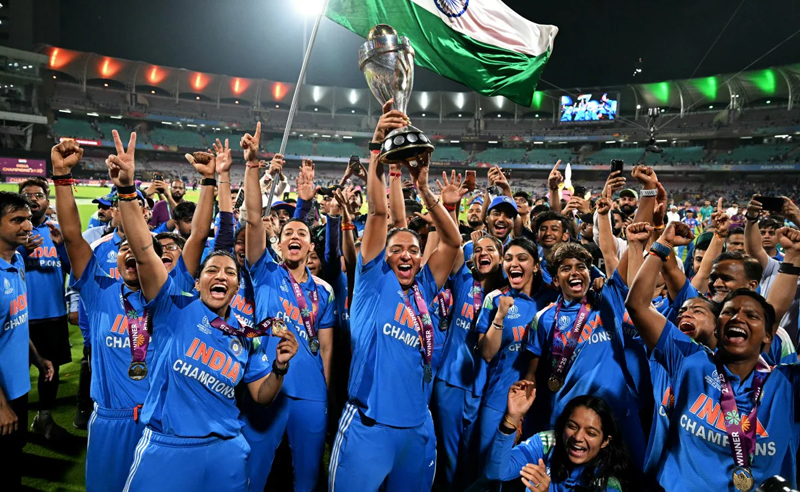
Indian cricket witnessed another epoch-making moment when the women’s national team lifted its maiden ODI World Cup after a commanding 52-run victory against South Africa in Navi Mumbai. This triumph is not only a historic milestone but also a culmination of years of preparation, vision, and resilience. If June 25, 1983, belongs to Kapil’s Team, November 2, 2025, will forever be etched as the day Harmanpreet Kaur’s warriors. What makes this win extraordinary is not merely the fact that India finally secured a long-awaited world title-it is the emphatic manner in which they achieved it. This win was no narrow escape, no last-over miracle, but a comprehensive, authoritative performance befitting world champions. From the intensity shown in the semifinal against Australia to the clinical precision in the final, India played with the poise of a side that believed destiny was theirs to script.
This victory was not an accident of form or fortune. It was the result of vision, long-term planning, leadership, and relentless pursuit of excellence. It was the story of a group of women who dared to dream big, worked tirelessly to bridge the gap with the world’s best, and ultimately conquered it with style and authority. The road to glory was far from smooth. India’s campaign was a roller coaster-peppered with close contests, patches of inconsistency, and heartbreaking defeats. But what set this team apart was an unshakeable focus and a relentless hunger to improve. Each setback became a lesson; each lesson translated into tangible on-field corrections. The most striking evidence was the dramatic improvement in bowling discipline and fielding sharpness in both the semifinal and final, the two matches that matter most in a World Cup.
One or two stars never win cricket. It is a team symphony, where different instruments rise at the right time. India’s World Cup run embodied this philosophy. Shafali Verma’s inspirational 87 and her crucial wickets, Deepti Sharma’s five-for under pressure, Smriti Mandhana’s foundation-setting partnerships, Jemimah Rodrigues’ calmness, Richa Ghosh’s fearless finishing, and Shree Charani’s breakthroughs-every match saw new heroes emerge. This was not a collection of individuals but a well-knit unit that adapted, learnt, and delivered when it mattered. And towering above all was the leadership of Harmanpreet Kaur. Scarred by past final-over heartbreaks, she carried both experience and emotion with grace. This team did not let her walk alone; they ensured her dream became a national victory.
Behind India’s rise lies the meticulous planning of head coach Amol Muzumdar. A domestic titan with 11,000+ runs but denied a Test cap, Muzumdar finally found his moment of redemption on the world stage. His role extended far beyond strategy-he instilled belief, ensured clarity in roles, selected horses for courses, and unlocked the best in every player. Muzumdar’s profound understanding of the game-especially of Indian conditions and the psychology of young cricketers-proved decisive. He knew when to push and when to protect, when to take risks and when to consolidate. His emphasis on discipline, fielding drills, and adaptability was evident in the semifinal and final, where India’s execution was near-perfect. Building a world-class team requires more than talent; it demands the right atmosphere, trust, and long-term vision. Muzumdar provided all three.
This victory also bears the imprint of institutional reform. Under BCCI leadership, especially the transformative decisions made during Jay Shah’s tenure as secretary, women’s cricket received unprecedented support. Pay parity, a 300% increase in ICC prize money, enhanced domestic infrastructure, and now a Rs 51 crore reward for the World Cup-winning team represent a seismic shift in intent. The evolution of women’s cricket has also been powered by the introduction of the Women’s Premier League. The league provided exposure, financial stability, and fierce competition that allowed Indian players to sharpen their skills against the best international talent. For many players, including young stars like Shafali Verma and Richa Ghosh, the WPL was the perfect training ground-a laboratory where talent was tested and confidence was built.
These reforms signalled to every young girl in India that her dreams carry equal weight, respect and opportunity. The triumph cannot be viewed in isolation from India’s broader sports ecosystem. A decade of investment through the Khelo India initiative has expanded the talent pool, improved sports science support, and normalised sports as a serious career choice. Indian girls today are excelling across arenas-wrestling, badminton, boxing, athletics, and now cricket. Each champion carries a story of grit; each story inspires thousands more. From Rani of Jhansi to Harmanpreet Kaur, Indian women have always risen to the moment when history called. The difference today is that the system finally stands behind them.
The presence of legends like Rohit Sharma and Sunil Gavaskar in the stands is a powerful symbol of how women’s cricket has moved to the centre of national consciousness. Millions of families watched every ball of India’s campaign, social media erupted with celebrations, and late-night street jubilations resembled the festivals once reserved only for men’s cricket. This victory is not just about a trophy-it is about a transformation in perception.
This victory must not be treated as an endpoint but as the beginning of a new chapter. The challenge now is to sustain the momentum-to deepen the domestic structure, invest in coaching at the grassroots, and nurture the next wave of talent. Other sports federations should take a cue from BCCI’s reforms and ensure that gender equality becomes a lived reality, not a slogan.
Indian women’s cricket has broken a barrier. It has opened doors. It has inspired a generation. And it has reminded a nation that talent knows no gender, dreams know no boundaries, and glory belongs equally to all who dare to pursue it. As India stands tall as world champions after the heartbreaks of 2005 and 2017, one thing is clear: the future of Indian sport is bright, inclusive, and unstoppable. More moments of glory await. But for now, this golden day will forever shine as a beacon of what Indian women can achieve when given the stage, the support, and the belief they always deserved.
 Follow our WhatsApp channel
