

NAYPYIDAW, May 1 : Myanmar’s military authorities have moved former leader Aung San Suu Kyi from prison to house arrest following a reduction in her sentence under a prisoner amnesty, state media reported, quoting official statements.
The decision was announced after junta chief Min Aung Hlaing reportedly commuted part of the 80-year-old Nobel laureate’s sentence, ordering that the remaining term will be served at a designated residence. Suu Kyi has been in prison for nearly five years. She was arrested on February 1, 2021, the same day Myanmar’s military ousted her elected government and took control of the country. Since then, she has remained in military custody. She is now 80 years old and has rarely been seen in public during this period.
According to the state broadcaster MRTV, the remaining part of her sentence will now be served under house arrest instead of in prison. The military’s information department has also confirmed the move, although her exact location has not been disclosed.
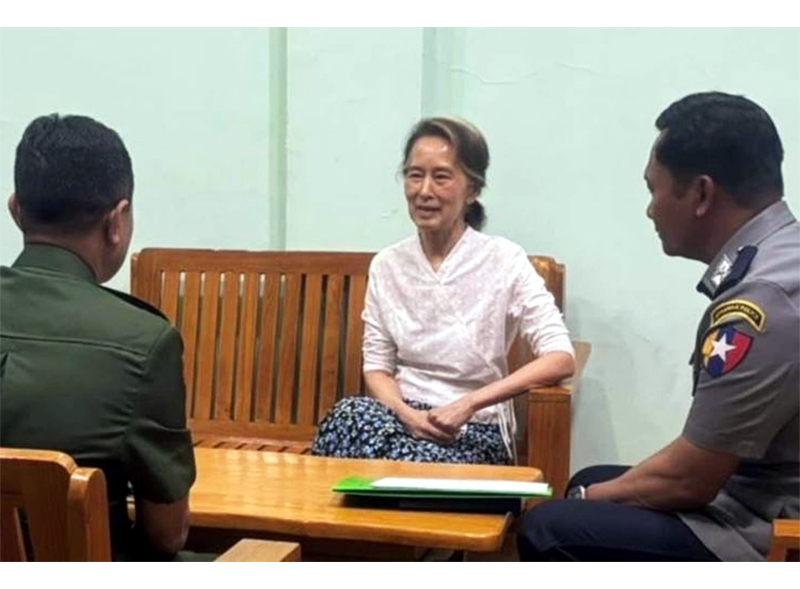
A new photograph of Suu Kyi has also been released, showing her in white clothing sitting on a wooden bench, with two officials in front of her-one of them in police uniform. However, it has not been confirmed when or where the photo was taken.
Recently, there had also been some reduction in her sentence during the Buddhist festival of Buddha Purnima, when several prisoners received sentence reductions, including Suu Kyi.
In 2022, she was sentenced to a total of 33 years in prison in multiple cases. Her supporters and human rights groups have called the charges politically motivated. After later reductions, her total sentence now stands at 18 years. She still has around 13 years left to serve, but now she will do so under house arrest instead of in prison.
Myanmar is currently facing a major crisis. Since the 2021 coup, the country has been in a state of civil conflict, with several areas controlled by rebel groups and ongoing fighting. The decision to place Suu Kyi under house arrest is being seen as a shift in the military government’s approach, although its future impact remains unclear.
She has faced multiple criminal charges, including corruption, which she denies. Human rights organizations have criticised the proceedings, describing the closed-door trials as unfair and politically driven.
Earlier, she was detained for nearly 15 years between 1989 and 2010, a figure in Myanmar’s pro-democracy movement and a symbol of nonviolent resistance against military rule.
Her long struggle for democratic reform in Myanmar made her an international icon of peaceful opposition to authoritarian rule.
(UNI)
 Follow our WhatsApp channel
