

AHMEADABAD, May 17 : Ahmedabad, long associated with trade and traditional enterprise, is now being repositioned as a hub for a different kind of ambition-one that seeks to place the city within the geography of Global Capability Centres (GCCs) and high-value services historically concentrated in Bengaluru, Hyderabad, Pune and other established technology hubs.
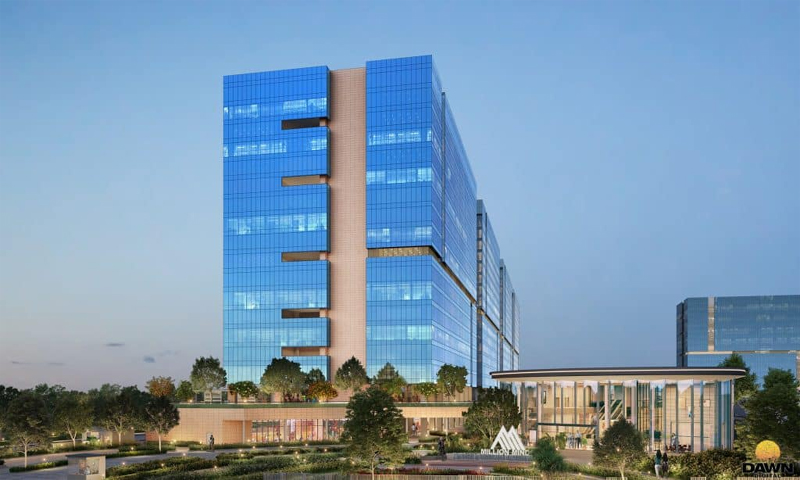
At the centre of this narrative is Ganesh Housing Limited, which has unveiled “Million Minds Tech City”, a Rs 15,000 crore integrated township project in Ahmedabad’s SEZ landscape.
Speaking exclusively to UNI correspondent, Managing Director Shekhar Patel traced the lineage of the project to the company’s origins and its evolution across generations of the Patel family. He said the group’s current phase of expansion is an extension of its decades-long presence in Gujarat’s real estate sector, now being scaled into what he described as a global benchmark.
“This is one of our largest developments-Million Minds Tech City. The total area is 65 acres. It is an integrated technology township,” he said.
He added that the project is designed as a mixed-use ecosystem rather than a conventional real estate development.
“Out of the total 18 million square feet, 10 million square feet is commercial development, six million square feet is residential, and two million square feet is allocated for a shopping mall, hotel and serviced apartments.”
Patel said the positioning of the project is strongly aligned with demand from Global Capability Centres and technology firms.
“Most GCCs, IT companies and technology firms are coming to us as customers,” he noted.
On Phase 1, he pointed to early leasing momentum as a key validation of demand.
“Out of 13.5 lakh square feet, we have already leased out about 8 lakh square feet,” he said, adding that the company had leased “more than 90 per cent of the first tower even before launch.”He said the strong uptake had already triggered plans for further expansion.
“Because of strong demand, we are going to start construction of the next two towers as soon as possible.”
On ownership structure, Patel said the project remains fully owned by the group.
“This is 100 per cent owned by Ganesh Housing. We do not have any investment partner in this project.”
He pegged the financial scale of Phase 1 at around Rs 1,100 crore, with total development across phases estimated at approximately Rs 15,000 crore.
Positioning the project within Gujarat’s broader urban strategy, Patel described it as complementary to GIFT City.
“GIFT City is the anchor development for the Ahmedabad-Gandhinagar corridor. We are complementing it. GIFT is finance, we are technology and GCCs.”
Explaining Ahmedabad’s growing attractiveness compared with established GCC hubs such as Bengaluru, Hyderabad and Pune, he said the shift was being driven by cost efficiency, lower congestion, faster project execution cycles and the availability of large integrated land parcels-advantages increasingly difficult to match in saturated metros.
He also cited Gujarat’s policy environment, connectivity infrastructure and the emergence of the Ahmedabad-Gandhinagar economic corridor anchored by GIFT City as structural strengths.
Patel added that global uncertainty-including geopolitical instability, disruptions in the Gulf region and post-pandemic corporate restructuring-had accelerated the movement of multinational firms toward stable and scalable Indian cities such as Ahmedabad.
“There are around 1,700 GCCs already operating in India. Gujarat is becoming an attractive destination because of policy support and connectivity,” he said.
Responding to a question on the presence and significance of union Home Minister Amit Shah at the launch event, Patel said the participation of senior leadership reflected the broader policy and political attention being given to large-scale infrastructure and GCC-led development in Gujarat.
He said the project should be viewed in the context of the state’s long-term industrial strategy rather than as an isolated real estate announcement, adding that such flagship developments are increasingly aligned with India’s ambition to expand its footprint in global services and technology-led employment.
Patel noted that the visibility surrounding the project, including participation by senior national leadership, signalled the importance being attached to Ahmedabad’s emergence as a new node on the GCC and IT services map. He said such engagement also reflected confidence in Gujarat’s policy ecosystem, infrastructure readiness and ability to attract global firms outside traditional metros.
He further indicated that political support and policy continuity had been key factors in enabling long-gestation projects such as Million Minds Tech City, which was conceptualised years ago but is now finding renewed relevance amid post-COVID shifts in global corporate strategy.
Without entering into political commentary, he maintained that the larger story was the structural shift of multinational companies towards India and the growing role of cities such as Ahmedabad in absorbing that demand alongside established hubs including Bengaluru, Hyderabad and Pune.
He linked the timing of the project to broader changes in global corporate strategy. “Post-COVID, the world has changed. GCCs are coming to India in a big way, and we feel this is the right time to build for that demand.”
Taken together, Patel’s comments position Million Minds Tech City not merely as a real estate development, but as a long-term bet on India’s expanding role in global services-where Ahmedabad is seeking to compete not by imitating Bengaluru, Hyderabad or Pune, but by presenting itself as a lower-cost, policy-aligned and geopolitically stable alternative in the next GCC expansion cycle.
(UNI)
 Follow our WhatsApp channel
