

Excelsior Correspondent
NEW DELHI, May 27: Referring to nearly 41 percent representation of women officers in 2024 batch of IAS, marking one of the highest-ever gender representation in the history of the IAS, Union Minister Incharge Department of Personnel & Training (DoPT) and Incharge Lal Bahadur Shastri National Academy of Administration (LBSNAA) Mussoorie, Dr Jitendra Singh today said that the changing character of India’s Civil Services mirrors the transformation taking place across the country, where access to opportunity is expanding beyond traditional social and regional boundaries and young Indians are shaping a new governance culture driven by aspiration, technology and accountability.
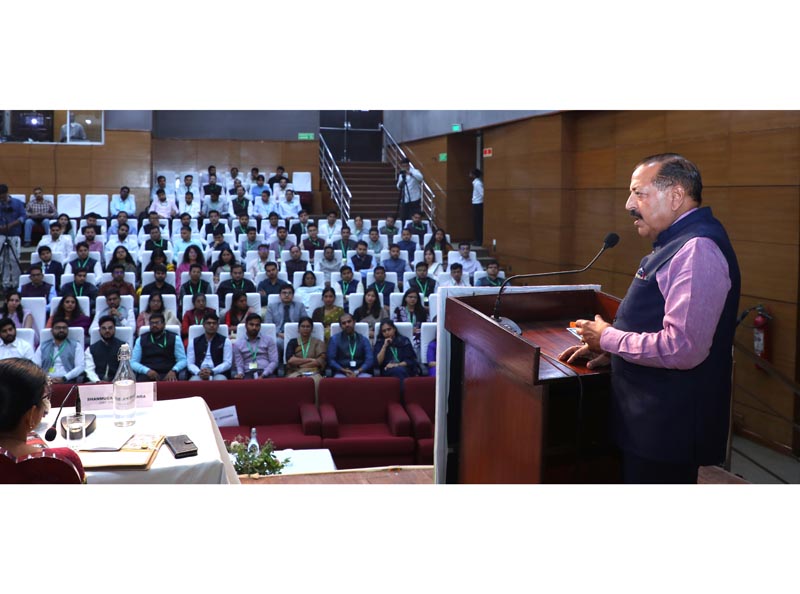
Interacting with IAS Officer Trainees of the 2024 batch at the Civil Services Officers’ Institute (CSOI), Vinay Marg, New Delhi, Dr. Jitendra Singh said the officers entering service today are uniquely placed in history, as they will occupy leadership roles at the peak of their careers when India completes 100 years of Independence in 2047. He described the moment as both a privilege and a responsibility, saying the future course of India’s governance journey would largely be shaped by this generation of civil servants.
The interaction formed part of the Assistant Secretary Programme under which 184 IAS officers of the 2024 batch have been attached with 49 Ministries and Departments of the Government of India for an eight-week period from May 4 to June 25, 2026, to gain first-hand exposure to policy making, coordination mechanisms and administrative functioning at the Centre.
Senior officials present during the programme included Chhavi Bhardwaj, Joint Secretary (Training), Department of Personnel & Training; Shanmuga Priya Mishra, Joint Director, Lal Bahadur Shastri National Academy of Administration (LBSNAA) and Kranthi Kumar Pati, Deputy Director, LBSNAA.
Dr. Jitendra Singh said the Assistant Secretary Programme, introduced under Prime Minister Narendra Modi’s leadership, has fundamentally changed the early administrative exposure available to young IAS officers. Recalling the evolution of the initiative over the last decade, he said the programme has helped create a generation of officers that is more confident, policy-oriented and institutionally connected from the very beginning of service.
The Minister said that nearly 41 percent representation of women officers reflects wider social change underway in India. He said the growing presence of women across competitive examinations, higher education and professional spaces demonstrates how opportunity and access are becoming increasingly democratised.
Dr. Jitendra Singh also spoke about the changing regional profile of Civil Services selections, noting that states which earlier had limited representation are now producing large numbers of successful candidates, while several traditionally dominant regions are witnessing a shift in career preferences toward emerging sectors and global opportunities. He said these changes indicate the rise of a more aspirational and dynamic India.
The Minister said 78 officers in the present batch come from engineering backgrounds, alongside professionals from medicine, law, management and humanities. He added that governance today increasingly requires technological understanding and interdisciplinary thinking, particularly at a time when government programmes are becoming more data-driven, digital and innovation-oriented.
Speaking informally with the trainees, Dr. Jitendra Singh said modern governance no longer functions through rigid hierarchies and one-way communication. He encouraged the officers to remain open-minded learners throughout their careers, saying the ability to adapt, unlearn and evolve is now more valuable than static knowledge.
During the interaction, the Minister also exchanged views with the officer trainees on district administration, governance challenges, leadership responsibilities and changing public expectations from civil servants. He encouraged the young officers to maintain neutrality, remain accessible to citizens and focus on meaningful public outcomes rather than visibility.
 Follow our WhatsApp channel
