

Lt Gen Narendra Kotwal (R), Dr Sumedha Kotwal
narendrakotwal@gmail.com
The deepest inquiry of human existence has never truly been about what we achieve, accumulate, or become, but about a far more fundamental question—Who am I? This question, echoed through the Upanishads as (Ko’ham), forms the very core of Vedic wisdom and spiritual exploration.
At first glance, the answer appears obvious—we identify ourselves with our body, our mind, our personality, our profession, and our relationships. Yet, upon deeper reflection, this identification begins to reveal its fragility. The body changes with time, the mind fluctuates with circumstances, and the personality evolves with experiences. That which is constantly changing cannot be the true Self. The sages of ancient India realized this profound truth and declared with remarkable clarity (Tat Tvam Asi)—You are That, the ultimate, unchanging reality.
In the Vedic understanding, human suffering originates from Avidya, or ignorance—specifically, the ignorance of our true nature. We mistakenly identify with the outer layers of existence, known as the Pancha Koshas. The physical body (Annamaya Kosha) is sustained by food and is subject to birth, growth, decay, and death. The mind (Manomaya Kosha) is a field of thoughts, emotions, and reactions, constantly oscillating between likes and dislikes. The intellect and ego (Vijnanamaya Kosha) provide discrimination but also reinforce a false sense of individuality. Yet beyond all these layers lies the Atman—pure Awareness, unchanging, eternal, and self-luminous. This Awareness is not an object to be perceived; it is the very subject, the witness of all experiences.
The analogy often given in Vedanta is that of mistaking a rope for a snake in dim light. Fear arises not because the snake is real, but because of misperception. Similarly, we suffer not because of reality itself, but because we misidentify ourselves with what we are not. The moment knowledge dawns, the illusion vanishes effortlessly. This shift from identification to recognition is the essence of spiritual awakening.
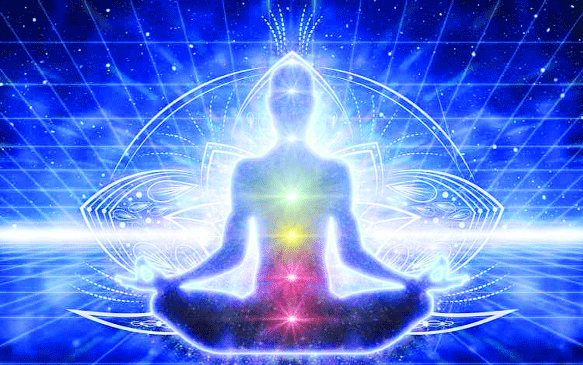
Awareness, in this context, is described as the Sakshi, the silent witness. It observes thoughts without being a thought, experiences emotions without being emotional, and perceives bodily sensations without being confined to the body. It is constant amidst change, still amidst movement, and silent amidst noise. The Upanishads describe it as Sat-Chit-Ananda—existence, consciousness, and bliss. It is existence because it always is; it is consciousness because it illumines all experiences; and it is bliss because it is free from all limitation and dependence.
One of the most profound paradoxes of spiritual life is that this Awareness is not something to be attained or achieved. In a world conditioned by achievement and acquisition, this idea appears counterintuitive. We are trained to believe that happiness must be earned, that peace must be cultivated, and that fulfilment must be attained through effort. Yet the sages insist that Awareness is already present, ever available, and ever complete. It does not need to be created; it only needs to be recognized. This is why great masters like Adi Shankaracharya and Ramana Maharshi emphasized Atma Vichara—self-inquiry—not as a process of gaining something new, but as a method of removing false identification. When one persistently asks, “Who am I?” and discards every answer that refers to body, mind, or role, what remains is pure Awareness.
This insight is not confined to Vedanta alone. It resonates across multiple spiritual and religious traditions. The Bhagavad Gita describes the Self as indestructible, beyond the reach of weapons, fire, water, or air. Buddhism speaks of mindful awareness—observing thoughts and sensations without attachment. Sufism refers to Fana, the dissolution of the ego into the divine presence. Christian mysticism suggests that the Kingdom of God is not external but within. Across these traditions, the message converges: the true essence of the human being is not the limited self, but a deeper, universal consciousness.
In a modern and innovative lens, one might compare Awareness to the fundamental operating system of existence. The body can be seen as hardware, the mind as software, and the personality as the user interface. Yet none of these function without the underlying power that enables them. Awareness is that power—like electricity that runs through a system yet remains unaffected by the functioning of the devices it supports. Without Awareness, no experience is possible. Yet Awareness itself is not altered by what it illuminates. Joy, sorrow, success, and failure arise within it, but it remains untouched.
From a neuroendocrine perspective, this insight opens an entirely new dimension. Human experience is often understood through the lens of hormones and neurotransmitters. Cortisol influences stress, dopamine drives reward-seeking behaviour, serotonin modulates mood, and oxytocin fosters bonding. These biochemical agents undoubtedly shape our experiences and behaviours. However, they are not the ultimate experiencer. They are processes occurring within the field of Awareness. One could say that hormones are the “weather” of the body-mind system, while Awareness is the “sky” in which this weather unfolds. The weather changes—sometimes calm, sometimes stormy—but the sky remains unchanged.
This perspective offers a profound redefinition of resilience and well-being. If identity is rooted in the fluctuating biochemical landscape, life becomes inherently unstable. Mood swings, stress, and emotional turbulence dominate the experience. However, if identity shifts to Awareness, a sense of equanimity naturally emerges. This is what the Bhagavad Gita refers to as Samatvam—a state of balanced awareness, unaffected by external circumstances. In this sense, true well-being is not merely biochemical optimization but existential clarity.
Despite the availability of this ever-present Awareness, most individuals remain disconnected from it. The reason lies in habitual identification. From early childhood, we are conditioned to believe that we are our name, our body, our achievements, and our failures. Society reinforces this identification through constant comparison and validation. As a result, we spend our lives trying to enhance or protect a constructed identity. Happiness becomes conditional—dependent on success, relationships, health, or external approval. When these conditions fluctuate, so does our sense of well-being.
The tragedy, therefore, is not that happiness is unavailable, but that it is overlooked. It is not distant, but hidden in plain sight. By seeking happiness in impermanent objects, we bind ourselves to their impermanence. The more we chase, the more elusive it becomes. Yet the moment we turn inward and recognize Awareness as our true nature, happiness reveals itself as our inherent state. It is no longer something to be pursued; it is something to be uncovered.
The transition from intellectual understanding to lived experience is subtle but transformative. It begins with simple practices of observation. When a thought arises, one can notice it as a thought rather than identifying with it. When an emotion emerges, one can observe it as a passing wave rather than becoming it. Even the act of breathing can serve as a doorway—between two breaths lies a moment of stillness, a glimpse of Awareness itself. Gradually, this practice of witnessing creates a shift in identity. Instead of saying, “I am anxious,” one begins to see, “Anxiety is arising in me.” Instead of “I am the body,” there is recognition that “The body is experienced within Awareness.”
This shift does not detach one from life; rather, it deepens engagement with it. When one is no longer bound by rigid identification, actions become more spontaneous, compassionate, and wise. Love becomes unconditional because it is no longer driven by need or insecurity. Peace becomes stable because it is no longer dependent on circumstances.
Ultimately, the journey of life is revealed to be a journey of homecoming. We are not limited beings striving to become infinite; we are infinite beings temporarily experiencing limitation. There is nothing to achieve, nothing to prove, and nowhere to reach. The search itself dissolves in the realization that what we seek has always been present. In essence, you are not the noise of thoughts, but the silence in which they arise. You are not the waves of experience, but the ocean that contains them. You are not the changing story of your life, but the Awareness in which the story unfolds. And in recognizing this—not merely as a concept, but as a living reality—one discovers a peace that is effortless, a love that is boundless, and a happiness that is truly everlasting.
 Follow our WhatsApp channel
