

Col Satish Singh Lalotra
‘The wildlife and its habitat cannot speak, so we must and we will’. —Theodore Rosevelt.
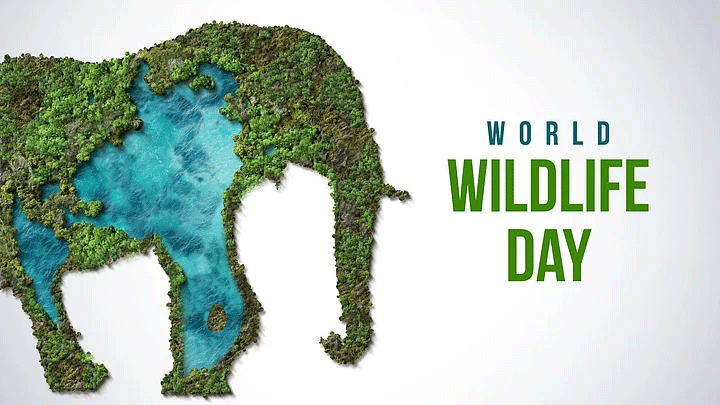
What an excellent quote from the late US president who had the sagacity decades back then to put the wildlife of the earth in its right perspective. Being mute in terms of voicing their grievances unlike we humans, is it any wonder that the wildlife had to be given their rightful place for their sheer survival by quotes as mentioned above. Every year on 03 March, the world pauses to celebrate ‘World Wildlife Day’, a reminder that the survival of our planet rests not only in policies and pledges but in forests, rivers, mountains and silent rhythms of nature. But it is a travesty of justice , that the most intelligent animal in this ecosystem ( human being) has to ring this day in order to save his lesser fortunate animals in the same ecosystem. In India, few regions embody this message more powerfully than J&K. Nestled deep in the lap of the Himalayas, this land of snowy peaks, alpine meadows, wetlands, and river valleys is not merely a tourist postcard; it is a living sanctuary of bio-diversity that holds ecological significance far beyond its geographical boundaries. Jammu and Kashmir lies within the Himalayan bio-diversity belt, one of the richest ecological zones in the world. Its varied topography -ranging from sub-tropical plains in Jammu to temperate valleys, and cold deserts -creates habitats for a remarkable array of species.
Though 03 March is ‘World Wildlife Day’ and with India being home to max number of wildlife species, my effort in this piece of writing as mentioned above will be primarily driven by focus towards the former northern most state of the country. India boasts incredible biodiversity, hosting 7% of the world’s recorded species but faces immense pressure from habitat loss, poaching and climate change. The cornerstone of Indian conservation is the ‘Wildlife (protection) act of 1972, which governs a massive network of over 1000 protected areas, including more than 106 national parks, and 573 sanctuaries covering roughly 5.32 % of its land. Key wildlife conservation efforts in India include specialized programs for iconic species, including ‘Project Tiger’ (1973), ‘Project elephant’, and recent efforts like ‘Project Cheetah ‘. Keeping J&K at the center of my writing for this article, certain facts–The department of ‘Wildlife protection’ J&K came into existence in the year 1978 to implement the J&K (Wildlife Protection Act) , providing protection to the wildlife, flora and fauna and management of protected areas in the erstwhile state. This department evolved from the erstwhile ‘J&K Game preservation’ department created under the ‘Game preservation act of 1942. The ‘Game’ included few species of wild life animals and birds considered important from hunting point of view as a sport. Prior to enactment of J&K ‘Wildlife protection act of 1978, few areas called ‘Game sanctuaries’ , ‘Game preserves’ and ‘Reserve areas’ were regulated under a set of various rules to provide protection to few species of wild animals and birds considered as important from shooting and hinting point of view. Gurez valley nestled in the northern part of Kashmir was one such ‘ reserve’ that was afforded the moniker of ‘Game reserve’. Yet this valley was an official ‘Shikargah’ of the Dogra royalty during the rule of Dogra Maharajas.
Jammu and Kashmir’s unique geographical features contribute immensely to its rich bio-diversity. As mentioned by me in the preceding paragraphs the diverse landscapes create a variety of ecosystems that support different forms of life. Among the notable species that inhabit the region is the majestic ‘Golden Eagle’,a top predator that preys upon a plethora of life forms on the earth, and crucial for the control of smaller animals. These raptors are not only vital for maintaining ecological balance, but also serve as indicators of environmental health. The ‘Kalji pheasant’, recognized as Jammu and Kashmir’s state bird inhabits the forested areas and symbolizes the rich avian diversity of J&K. Its vibrant plumage and unique behaviours contribute to the region’s ecological mosaic. Another iconic but elusive species is the ‘Snow leopard’ which roams the rugged mountains of northern part of the UT. Similarly the ‘Hangul’ or Kashmiri wild stag a critically endangered deer species as per the IUCN list is indigenous to the forests of Jammu and Kashmir. Same is the case with ‘Markhor’ a typical ungulate found in the higher reaches of Kashmir, and the state animal of Pakistan. Now let us come to the specifics of Wild life conservation efforts in the UT. The UT has seen in the past many successful wildlife conservation initiatives that have made a significant impact on wildlife population and habitat protection. One of the most notable among them is the ‘Snow leopard conservation programme’ ,which was initiated in response to the declining population of this elusive species. This programme combines a plethora of efforts to include scientific research, community engagement, and habitat protection. Another successful conservation story that has been doing the rounds the country relates to ‘Hangul recovery project’. This project involves habitat restoration and anti-poaching campaigns.
Be that as it may, it has to be understood by the readers of this article of mine that ‘wildlife conservation’ and ‘Forest conservation’ go hand in hand. Since both are in a symbiotic association and cannot thrive when seen in isolation; one may ask which assumes more importance of the two? It is but natural that the home and hearth of wildlife aka forests takes precedence over the wildlife for the latter to survive. And what is the state of forest conservation in J&K? As per the latest data given by the minister for forests, ecology, and environment, Javed Ahmad Rana a few days back a total of 19,496.73 hectares of forest land is under active encroachment. As per the minister the forest department has launched sustained measures to retrieve encroached land , including detailed surveys, and demarcation of forest boundaries, issuance of notices under section 79(A) of the Indian forest act of 1927, eviction drives , fencing and restoration of retrieved land with indigenous agencies etc. And what is the state of forest rangers, foresters and field staff of J&K forest development corporation (JKFDC), the actual ‘Boots on ground” in so far as wild life conservation goes in the UT? The truth is that the JKFDC is facing a human resource crunch that significantly gets converted into staff shortages due to a recruitment ban in place for over two decades, specifically since August 2000. As of January 2026, the corporation operates with a total of 1323 employees, with many positions remaining vacant due to the lack of new opportunities. As if the above was not enough, the long litany of woes by the forest department who are also burdened by wildlife conservation include redress of pay anomalies, grant of additional salary for uninterrupted duties, risk allowance, uniform allowance and a structured ‘Martyr relief policy’ for personnel who lose their lives in the line of duty. The front line staff of the Jammu and Kashmir Forest Department, including forest guards, foresters, Deputy foresters, and rangers form the backbone of not only ‘Forest Conservation’ but also ‘Wildlife Conservation’ in the union territory performing round the clock duties in remote, rugged and high risk terrains. These are the personnel who fight forest fires with their bare hands at night, confront poachers and smugglers who are the main enemies of wildlife conservation; face wild animals so that the forests and wild life remain protected.
As a corollary to the above, it will be a shocker for the readers to know that as on September 2024, India is the world’s most deadly country for foresters and the rangers (all uniformed personnel of the forest department). The two most responsible posts for wild life conservation in the country. Between the years of 2012-2017, India accounted for nearly 31% i.e 162 deaths out of a recorded 526 deaths all over the world. Besides being the highest globally, this is just one less than the sum total deaths of the next five countries on the list-Congo, Thailand, Kenya, US and South Africa. As per ‘Sean Will more’ President ‘international ranger federation’ and director of ‘The thin green line foundation’ quote-‘ India has one of the highest ranger deaths in the world’-unquote. I have had the unique opportunity in 2010 while still serving in the army of witnessing the plight of these rangers at the STR ( Satpura tiger reserve). With practically no insurance cover while going over their duties, and staff shortage to the extent of 30 % to 90% over the last decade or so which wild life conservation are we talking about? Isn’t the day marked as ‘Wild life conservation’ on 03 of March all over the earth/ India also a mere cliché? With such glaring loopholes in the Wild life conservation efforts as also the personnel responsible for ensuring these efforts reduced to a peripheral existence, when will they gain centrality? Or do we wait for the prophetic words as quoted by the late US president in my topmost paragraph to manifest in its real terms to witness real action in wildlife conservation? Let the readers decide themselves.
(The writer is a retired army officer)
 Follow our WhatsApp channel
