

Dr Dushyant Pradeep
dushyant3186@gmail.com
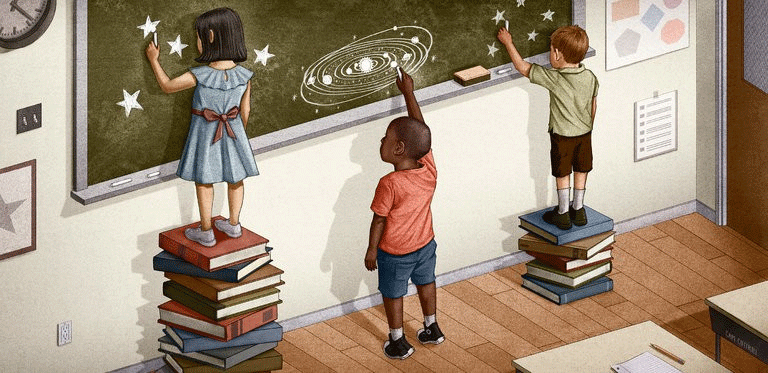
A classroom is often imagined as a room where one teacher delivers the same lesson, at the same pace, to the same age group, and expects similar outcomes from every child. That image is neat, efficient, and deeply misleading. In reality, children differ widely in prior knowledge, language ability, home support, motivation, confidence, pace of learning, and the ways in which they understand ideas. An education system that ignores these differences does not create equality; it merely standardises disadvantage.
The phrase “one size does not fit all” is not a fashionable slogan in education. It is a statement of fact. In any classroom, some students learn quickly, some require repetition, some need visual support, some thrive through discussion, and some perform better after hands-on activity. There are also children who are gifted, children who are slow to process, children with learning disabilities, and children whose difficulties arise not from lack of intelligence but from poverty, language barriers, or emotional stress. To teach such a class as though every child were identical is to misunderstand both pedagogy and childhood itself.
Yet school systems, particularly in large public systems, often continue to operate as if uniformity were the goal. The curriculum is fixed, the timetable is rigid, the examination is common, and the classroom pace is dictated by an abstract “average” learner who rarely exists in real life. The result is predictable. Some children are left behind, some are bored, and many are trained not to learn deeply but to survive the system. When learning becomes a race governed by the fastest or the loudest, education loses its moral purpose.
The problem is not that teachers are unwilling to meet diverse needs. In most cases, they are already doing so with admirable patience and ingenuity. The real problem is that the system asks too much of teachers while giving them too little support. A single teacher handling a large class cannot be expected to individualise instruction for every learner without training, time, teaching aids, and a manageable pupil-teacher ratio. Inclusion cannot remain a policy slogan while classrooms remain overcrowded and assessments remain narrow.
What is needed is a serious shift from uniform teaching to differentiated teaching. This does not mean abandoning common standards or lowering expectations. It means reaching the same learning goal through different paths. A child who struggles with text may need oral explanation; another may need group work; a third may need advanced tasks that extend understanding. Differentiation is not an indulgence for weak students or an extra burden for teachers. It is the practical form of justice in education.
This is where teacher preparation becomes crucial. Many teachers are still trained to complete the syllabus rather than diagnose learning gaps. They are taught to cover content, not to observe variation in learning styles. If teachers are to manage mixed-ability classrooms effectively, they must be equipped with methods of formative assessment, flexible grouping, remedial support, peer learning, and classroom adaptation. Teacher education must move beyond theory and prepare educators for the real classroom, not the idealised one.
Assessment, too, must be reconsidered. When the entire system values only memorisation under time pressure, it privileges one narrow type of learner. Children who understand well but write slowly, children who think creatively but do not fit the standard answer pattern, and children who need more time to process are all unfairly penalised. A more humane system would use varied assessment methods, including projects, oral tasks, portfolios, observation, and continuous feedback. Such approaches do not weaken standards; they reveal learning more honestly.
There is also a deeper ethical issue. Uniform schooling often hides inequality by treating everyone the same. But equal treatment is not always equal opportunity. A child who comes from a supportive home, has access to books, receives tuition, and speaks the language of instruction at home begins far ahead of a child who has none of these advantages. If the school pretends that both are identical, it does not become impartial; it becomes blind. Fairness in education requires attention to difference, not denial of it.
The debate on inclusion must therefore be broadened. It should not be limited to children with disabilities, though their needs deserve urgent and serious attention. It must also include children with different abilities, learning speeds, and socio-economic backgrounds. An inclusive classroom is not one where every child is taught the same thing in the same way. It is one where every child is given a meaningful chance to participate, progress, and succeed.
Technology may offer useful support, but it is no substitute for thoughtful pedagogy. Digital tools can help teachers provide practice, adapt content, and monitor progress. However, technology alone cannot solve the core problem of overburdened classrooms and underprepared systems. Nor should it deepen inequality by privileging schools with better infrastructure while leaving others behind. Technology must serve inclusion, not replace it.
Ultimately, the challenge before education is not merely administrative. It is philosophical. Do we see children as identical units to be processed, or as distinct learners to be developed? The answer to that question determines the shape of the classroom, the training of teachers, the design of curriculum, and the nature of assessment. If education is to be meaningful, it must recognise that human beings do not grow in the same way or at the same speed. That is not a defect to be corrected. It is the reality that good education must respect.
A classroom becomes strong not when every child is forced into one mould, but when differences are understood as part of learning itself. True excellence in education lies not in uniformity, but in the ability to teach many minds without leaving any behind.
(The author is Educator and Subject Matter Expert)
 Follow our WhatsApp channel
