

Adhiraj Sharma
anjalisanjay04@gmail.com
The Trigger: When Misinformation Becomes Fear
In the last few days, I found myself unusually disturbed, not by any real-world crisis but by a flood of information(I call it misinformation)on social media. Claims that India was about to attack Pakistan on 21 March, that the Earth is dome-shaped, that recent rains were chemically induced and harmful, and that satellites never truly reach the Moon or Mars. At first, these appeared laughable but what followed was deeply concerning when a day ago, while stepping out of a mall during the recent rains, I witnessed something unsettling. A large number of people stood hesitant, almost fearful, reluctant to step outside. The reason was not the rain but the belief that it carried harmful chemicals. This was neither a science nor an advisory but a fear generated by forwarded messages on social media. And that moment planted the seed for me writing this article.
Truth vs Misinformation: A Battle of Speed and Sensation
What pains is not merely the existence of such misinformation, but the speed and scale at which it proliferates. Truth by its nature is very slow and more importantly without any masala that fuels mass gossips vis a vis misinformation which on the other hand is fast, emotional, sensational and full of Tadka & Masala. In today’s digital world, fear travels faster than facts and our so called influencers exploit the emotions and sentiments of the netizens. Influencers, in their pursuit of views and relevance, often cross the line between expression and irresponsibility. Social media algorithms reward what is shocking, controversial, and emotionally charged. Content laced with “tadka”-fear, panic, curiosity, ego gets amplified, while meaningful, verified information struggles for attention.
The Harsh Reality: Misinformation is Celebrated
The result is an unfortunate reality:
Misinformation is not just consumed, it is celebrated.
We must acknowledge an uncomfortable truth. A large section of our population is deeply influenced by what they see online. For many, social media is no longer a source of information, it is the ultimate source of truth. In such an environment, even a 30-second video can create disproportionate panic.
Psychology of Virality: Designed to Bypass Logic
Messages are carefully crafted to trigger instant reactions:
“Emergency! Share fast!”
“My scientist friend told me…”
“Before it gets deleted…”
“Hidden truth the media won’t show you…”
These are not random phrases. They are psychological hooks, designed to bypass logic and provoke emotion. And more often than not, we respond, not with reasoning, but with reflex.
The Consequences: Fear Beyond Facts
It takes just a few seconds for an astrologer or a self-proclaimed expert to predict war, gain fleeting popularity, and accumulate views. But the fear and anxiety such claims generate among innocent people are far greater and far more lasting than their momentary digital success.
We rarely pause to ask basic questions:
Why is this not reported by credible news agencies?
Why is there no official advisory?
Why should I trust any unknown Tom Dick and Harry over established systems?
Science and technology have evolved over centuries, scientists sacrificed and dedicated their comfort, youth and families doing rigorous study and experiments and understanding this universe. And yet, today, a 30-second reel by an uninformed individual is enough to challenge established knowledge and worse, to gain acceptance by innocent and ignorant masses.
Our Role: We Are Part of the Problem
The fault, however, is not entirely theirs.
Misinformation survives because we consume and circulate it.
Every unverified forward, every impulsive share, every moment of curiosity without verification contributes to the problem. We have gradually built an ecosystem where speed is valued over accuracy, virality over truth, and emotion over reason. In this sense, the problem of misinformation is not imposed upon us rather it is co-created by us.
Freedom vs Responsibility: A Blurred Line
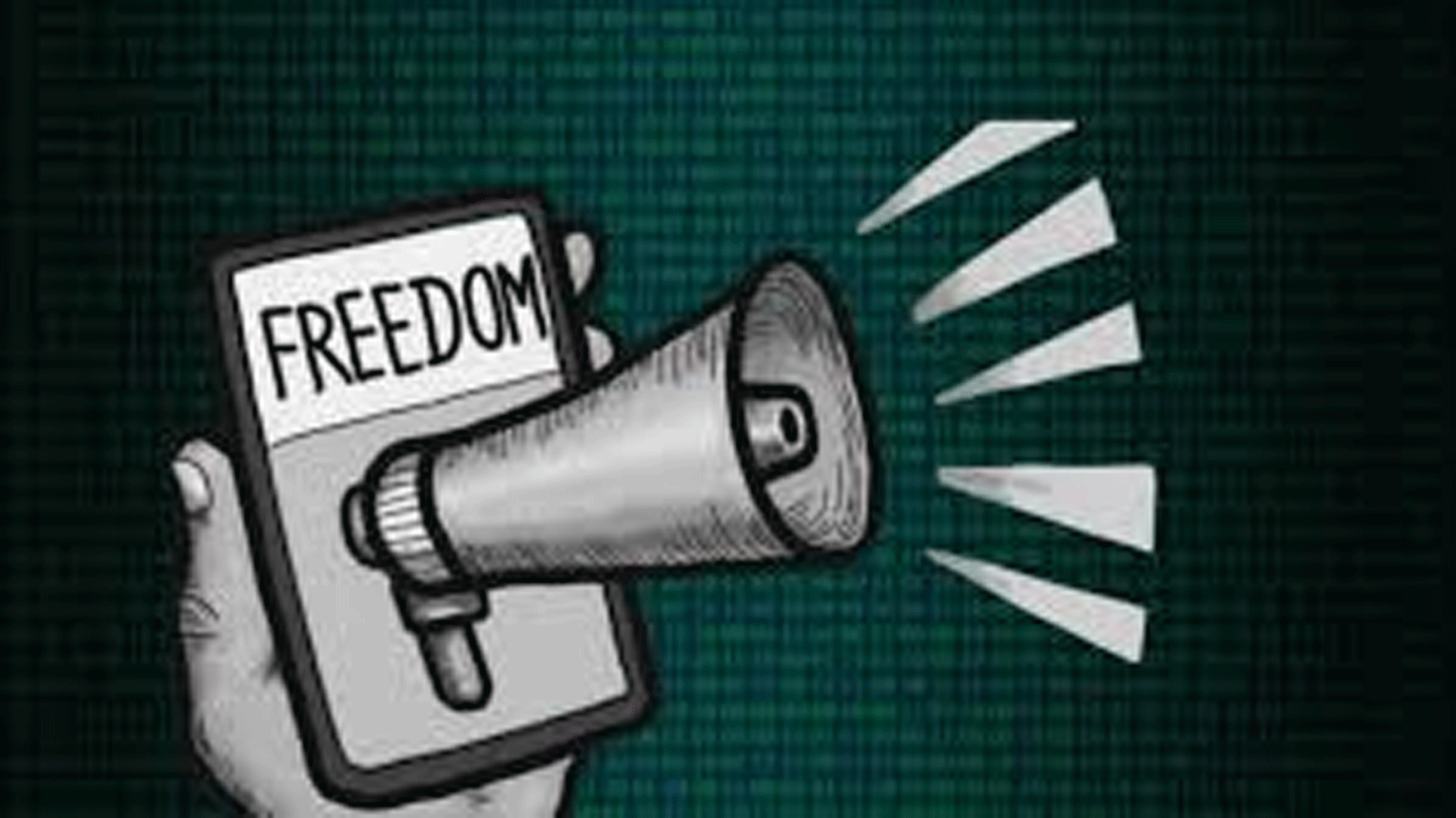
Freedom of speech is one of the pillars of democracy. But it was never meant to become a license to mislead. Today, that line is increasingly blurred. When false narratives begin to create panic, distort reality, and undermine trust, the issue is no longer individual,it becomes a matter of collective responsibility and, at times, national concern.
Way Forward: What Must We Do
So, what should be our way forward?
Firstly, we must resist the urge to react emotionally. Not every alarming message demands immediate attention.
Secondly, we must verify information through credible and authorized sources before accepting it as truth.
Third and most importantly, we must exercise restraint in sharing. Not everything we receive deserves to be forwarded.
We must also understand that social media platforms are moderators, not guardians of truth. The ultimate responsibility lies with us- the users. Awareness, critical thinking, and discipline are no longer optional; they are essential.
Final Thought: The Responsibility Lies With Us
In today’s environment, the truly educated mind will not be the one that knows the most, but the one that can filter the best.
The question, therefore, is not whether misinformation exists. It always has, in different forms. The real question is whether we, as a society, are willing to confront our role in amplifying it.
Because if we do not, we risk transforming one of our greatest freedoms into one of our greatest vulnerabilities.
Freedom of speech, if left unchecked, risks being diluted into freedom to mislead.
 Follow our WhatsApp channel
