

Dr Suman Kumar Kasturi
sumankasturi@gmail.com
Wars seldom conclude with the cessation of bombings, even if the artillery may become quiet and an arsenal is reached. A comprehensive examination of the entire Iran-Israel conflict, exacerbated by U.S. involvement, leads us to the conclusion that the war has not yielded any definitive victory. However, it has resulted in a destabilised Middle East, a strained global economy, and, importantly, a more unpredictable international order.
The Iran-Israel conflict could be more accurately described as a war without resolution, showcasing the inherent limitations of military power. The primary aim of the war, which was to curb Iran’s nuclear aspirations or dismantle its regional influence, remains unachieved despite significant strikes that have impaired Iran’s military infrastructure—the outcome is an unwarranted stalemate characterised by volatility, which poses a risk of re-ignition. It is volatility, rather than victory, that this war has bequeathed.
As Carl von Clausewitz stated, “War is a continuation of politics by other means.” Yet, this conflict has weakened the political deadlock. Furthermore, the destruction throughout the Middle East is palpable. Additionally, fragile diplomatic initiatives have been obstructed, rivalries are intensifying, and military expenditures are skyrocketing. Although Iran has been weakened, it has intensified its reliance on indirect strategies. This reality serves as a reminder that contemporary power is measured not solely by military might but also by influence. Regarding human resources, while difficult to quantify, their significance cannot be overlooked. This is not merely a conclusion—global oil markets have been disrupted, supply chains strained, and economies—particularly in energy-dependent countries—have faced mounting pressure. Most importantly, the state of the world order is of great concern. International institutions have struggled to respond effectively, and major powers remain at odds.
The closure of the Iran-Israel war does not signify a definitive end; rather, it can be viewed as a frozen conflict characterised by ongoing hostility without a clear resolution. This unresolved conclusion may represent its most perilous legacy. It guarantees that escalation is not merely a possibility for the future—it is a likelihood. Undoubtedly, this conflict has transformed regional geopolitics in ways that could endure for decades. Attempts to normalise relations between Israel and Arab nations have been hindered, while regional powers are intensifying military build-ups in reaction to perceived threats.
Iran, utilising proxy networks and asymmetric strategies, has weakened militarily yet shown resilience—ranging from missile strikes to indirect influence across borders, Iran’s approach indicates a transition from conventional warfare to sustained strategic pressure. Consequently, the Middle East is increasingly characterised by overlapping rivalries rather than alliances—an unstable equilibrium where mistrust prevails in diplomatic relations.
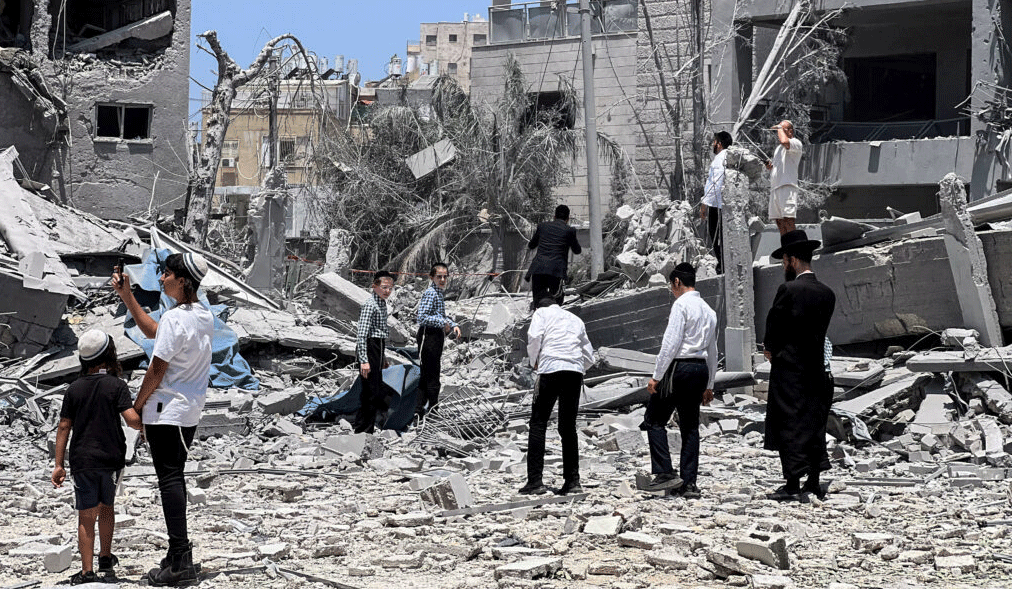
Insofar as humanitarian and social impacts are concerned, beyond the geopolitical landscape, the war has inflicted profound human consequences. Civilian populations in the affected areas have faced displacement, destruction of infrastructure, and long-term health hazards due to environmental degradation. Moreover, it has potentially instigated new waves of migration and social unrest in neighbouring countries. These are not transient injuries; such conflicts embed trauma within societies, influencing political attitudes and shaping generational perceptions of warfare.
Furthermore, the economic impacts of the war have reached well beyond the battlefield. Disruptions in the Strait of Hormuz—through which a considerable portion of global oil is transported—have unsettled energy markets and caused price fluctuations. As an alternative response, shipping routes have been redirected, trade expenses have increased, and global supply chains have faced significant strain. For numerous nations, including India, this results in increased fuel costs, inflationary pressures, and economic instability. It is important to note that in a highly interconnected world, regional conflicts no longer remain confined to their areas. Palpably, Globalisation and Glocalisation have united nations, and as a result of disputes between any two countries, the entire globe experiences perceptible effects.
Clearly, the conflict has involved a combination of cyber operations, proxy militias, information warfare, and targeted strikes. Another lasting consequence is the normalisation of hybrid warfare. This approach obscures the distinction between war and peace. Violence no longer necessitates formal declarations—it occurs in secrecy, across borders, and through networks that are challenging to trace or counter.
Lastly, the most significant impact may be on the international system itself. The war has strained alliances, revealed rifts among major powers, and diminished trust in diplomatic processes. Global public opinion indicates a rising war fatigue—majorities in numerous countries advocating for non-involvement. Consequently, the divide between political choices and public opinion is expanding.
In summary, it can be asserted that the Iran–Israel war has not concluded—it has simply transformed. It leaves a fragile and militarised Middle East, a strained global economy, an escalating humanitarian crisis, and a weakened international order. History may not recall this conflict for its victors, but for how it reshaped the region—and the world—into a state of greater uncertainty, division, and volatility.
– — Dr Suman Kumar Kasturi
–
(An Air Veteran turned independent researcher cum author of 22 Books) E-Mail: suman@sumankasturi.com
 Follow our WhatsApp channel
