

By Dr. D.K. Giri
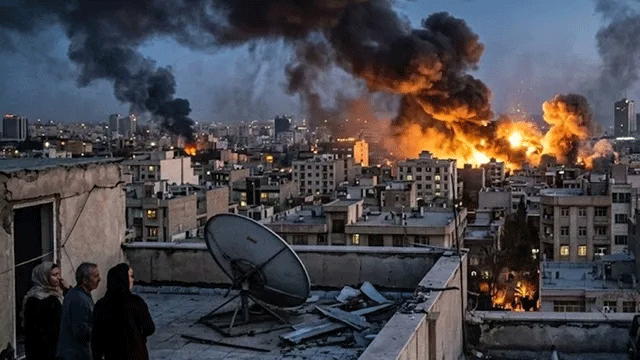
Iran war has entered into the phase of ceasefire. On request from international quarters, Donald Trump has put off the bombing of critical resource hub and infrastructure. Only Trump knows how long he will maintain that position. The entire world knows that Trump likes to ham and haw and is capable of changing his mind without any reason. As the President of the most powerful country, Donald Trump has disastrously disrupted the world economy, security and politics by his undependable and untenable approach.
Be that as it may, it is in order that we discuss the durability of the ceasefire leading to an end of the war. Donald Trump as his wont would like to end the war as soon as possible. Perhaps like Vladimir Putin in Ukraine, Trump expected to have a quick operation in beating Iran into submission. That was not to be. The conditions put forward by both warring parties; America and Iran are not acceptable to either. It will require highly skilful mediation to get them on the same page. It is now next to impossible to predict how Trump will respond at a particular time. And Pakistan, hosting the negotiation meetings is merely a facilitator rather than a mediator. More on this a bit later.
There are various theories on why America went into the war against Iran. We have discussed it more than once in this column. The main actor in this Iran drama is Israel. But America has taken the cudgel to back Israel in its battle against Iran and communicate the proceedings to the world. Although, obviously, Donald Trump is not doing it so well, in fact, doing it quite badly. His flip-flops, about turns, statements on shifting sands and so on will certainly become part of the political folklores. But the regime in the United States does not consist of President alone although he is in the forefront. That said, Trump has two able and articulate deputies in the government – Mark Rubio, the Secretary of State and J.D. Vance, the Vice President. The latter is representing America on the next negotiation meeting with Iran in Islamabad.
Talking of the war aims of the US, Mark Rubio has made a convincing and a formidable statement on 8 April. He said in a presser, “Iran wanted nuclear weapons. There is zero doubt about it. If they wanted what they claim, the nuclear energy like many countries have done, they should have imported the fuel and built the nuclear reactors above the ground. That is what they have not done. They have built the reactors and the facilities deep in the mountain away from the public glare. They want to enrich that material. They want to develop into nuclear weapons. They were entitled to have nuclear energy, and the world has agreed to that, not to acquire weapons. But Iran has turned it down every time. At the same time, they have built a conventional shield consisting of drones and missiles that will deter any attack on their nuclear weapon infrastructure. They had on the verge of acquiring that capability which will make them immune from any attack on their nuclear programmes. This was an intolerable risk. In fact, this was the last chance to dismantle that conventional shield that is why America took the military step.”
The above is a persuasive argument for the war. Admittedly, many countries especially India would like to talk about dialogue and diplomacy and international law not war. But there are occasions in international relations, war becomes unavoidable. It is said that war is failure of diplomacy and vice-e-versa meaning diplomacy begins when war is inconclusive. However, has that war objective been accomplished? Is the ceasefire an excuse for re-strategising and rebuilding?
The moot question in this piece is where India is in this war which is closer in many ways than the war in Ukraine. Frankly, New Delhi has let itself down once more. When the world expects India to step up, New Delhi dithers. The slips between the cup and the lip, lost opportunities have been experienced since the times of Pt. Nehru. Modi regime which seems determined to undo the mistakes of Nehru ends up repeating them. To illustrate, during Covid, an international disaster caused by China, the world expected India to be an alternative manufacturing hub given its demography and democracy, but New Delhi could not even come close to it.
On Ukraine war, India could initiate the mediation as New Delhi claims to be neutral having strategic autonomy etc. That did not happen. In Iran war, the same expectation surfaced again. In fact, the Prime Minister of Finland, a credible, often neutral country, Alexander Stubbs openly exhorted Prime Minister Modi to plunge into a mediator role. On the contrary, that position went to Pakistan of all the countries, a terrorist hub.
One could decipher the main reason for India’s failure to occupy the stage on mediation. India traditionally has presented a moral profile in international politics but has not built on it. At the same time, New Delhi has not emphasised on building capabilities which is the sine qua non of geo politics, surely the real politik. America has thrived on its capability in utter denial of international norms and laws; so have Russia and China. India tried to shift from a moralist, self-righteous position to a pragmatic stance by beginning to decouple from its traditional ally Russia and engage with America. But again, New Delhi got caught in moralistic postures and fouled up the relations with Trump.
At the cost of repeating, Narendra Modi breaking diplomatic traditions and protocols endorsed the candidature of Trump in the presidential election in a much-advertised public meeting called Howdy Modi. Trump supported India solidly in his first term. Modi regime, especially the Foreign Minister failed to understand Trump’s personality and therefore to deal with him. Modi’s visit to Israel just before the war, a right step, has backfired as the External Affairs Ministet failed to build on it. Disappointingly, the main Opposition party, Congress, instead of attacking Modi on alienating Trump and United States, is misfiring by accusing Modi of kowtowing to Trump. So, Modi has become a frenemy to United States and vice-a-versa.
A word on Pakistan’s surprising elevation to a facilitator, Pakistan has sucked up to Donald Trump by proposing him for the Nobel Prize. Trump likes such adulation. Islamabad may be active as a proxy of China. By many accounts, Beijing seems to be the big winner in this war. The elaboration on this thesis is for another article. Objectively, Pakistan’s proximity to Iran and its existing diplomatic channels made it an ideal conduit for communication. To be sure, Pakistan’s role is seen more as a facilitator than a full-fledged mediator with limited access and influence. But for now, Pakistan has edged India on Iran war. New Delhi has a lot to think about it. Maybe they will do so after the state elections where Prime Minister is actively campaigning. —INFA
 Follow our WhatsApp channel
