

Wg Cdr Mahesh Chander Sudan (Retd)
maheshchander59@gmail.com
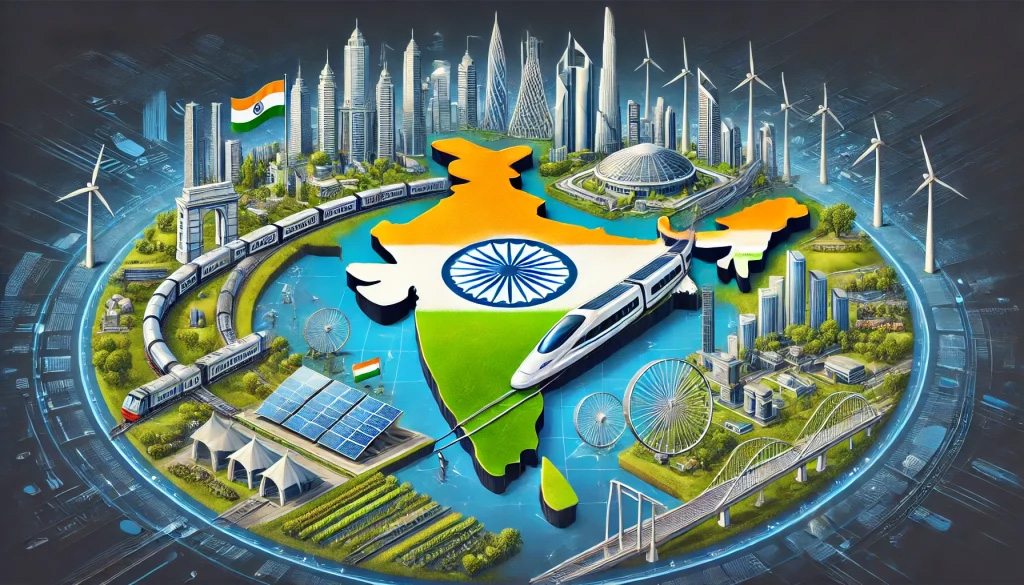
We, the people of India, have been introduced to an ambitious vision of the Government of India to transform the nation into a fully developed, self-reliant and globally influential country by the 100th anniversary of its independence. The roadmap so drawn focuses on economic prosperity, sustainable growth, innovations, social inclusion and robust infrastructure targeting to $30-40 trillion economy with high per capita income. Key pillars identified include economic transformation, empowered citizens, world class infrastructure and technology, Good governance, national security and environmental sustainability. The focus areas demanding core care include youths and innovations, Agriculture, MSMEs, social development and global leadership. Achieving the target of Viksit Bharat on centenary throws challenges to closely address several structural, social and economic grey areas like economic inequality, low female labour participation, educational gaps and necessity to balance rapid industrialization with net zero commitments.
While the progress is underway, grey areas and structural challenges present significant risks to this vision. Keeping the national objective restricted to Government departments, officials and higher political leadership may lack comprehensive approach and on ground involvement of the people across the societal spectrum that would impede cohesive efforts in this direction. It is pertinent to widen scope of approach and identify weak corners to deal with. We have already passed through three quarters of the centenary and it therefore calls for a close and coordinated practical policy reforms. Few grey areas are dwelt upon in the following paragraphs.
Socio-Economic Disparities. Indian society faces socio-economic disparities that lacks inclusivity and equity. Benefits of economic growth has not proportionately reached all sections of the society particularly marginalized communities that requires balancing rapid economic growth across the nation so that rural and urban population get benefit of it. There are inbuilt constitutional provisions of reservations for socially marginalized people that requires review so that ground reality match with the official records. A balanced and sustainable effort to empower all citizens economically through healthy Government schemes on long term basis to create an environment developing economy to move towards developed economy. Despite rising GDP, the country continues to face income inequality that ultimately affect Human Development Index by on an average of 30 percent.
Demographic Factors. Leverage of demographic dividend needs massive job creation and unrestricted female participation in the job market that apparently is low in the present context and needs to be boosted up through policy frame work and other social initiatives. Unbridled rise in the rate of unemployment across the spectrum poses significant challenge for the economy to meet the target especially in case of women workers whose potentiality remains unexploited owing to social structure of the Indian society. To overcome regional disparities, rural and urban area criticalities and to create an environment for prosperity to reach across the demographic divide is a major challenge as female labour force participation hovers around 20 percent.
Economic and Infrastructure Gaps. To achieve an economy of $30 trillion, it requires massive sustainable investment across the country balancing gap noticeable in Urban and rural India. Public Private Participation in major industrial hubs unrestricted to big towns and cities through policy framework may create employment opportunities and resultantly attract professionals to rural areas for a balanced skill development and infrastructural growth across the nation. It may also discourage Rural-Urban divide resulting in bridging the gap that poses a significant challenge in this direction.
Digital Sovereignty. Emerging intervention of Artificial Intelligence and technology calls for a robust cyber security and data security against emerging threats in the field. Our policy framework as on date remains insufficient to deal with these recent interventions and calls for updated guidelines to adopt the emerging field of AI in our day to day life so that the system become robust to deal with these challenges especially in the field of software technology. Involving AI step by step in a coordinated and controlled manner may enhance the productivity rather than posing a challenge to obstruct the path of development in all the economic activities.
Governance and Bureaucracy. A transparent and system friendly information symmetry for upgrading public services for meeting developed nation standards is critical. A healthy policy frame work paves way for good governance and efficient bureaucracy is required for a nation to achieve required growth across the spectrum. An analytical glance of GDP growth rate for last decade shows that it stayed in single digit hovering around 6-8% except for 2019 and 2020 where it worked out between 3-6% due to Covid-19. However, to attain $30-40 trillion, it needs extra ordinary performance to achieve and retain the growth rate in higher double digit scale throughout, a big challenge for quality of governance and dedicated bureaucracy.
Sustainability and Infrastructure. Financing Green transition to achieve net zero by 2070 requires massive investment and financial gaps significantly noticeable for clean energy and green hydrogen production would ultimately affect this critically. Rapid urbanization along with climate risks pose serious threat to the sustainability of long term development efforts. Also the uneven development across the nation would hinder the national goal of collective prosperity.
Addressing these grey areas requires going beyond high level growth targets and to focus on inclusivity and information sharing across social structure of the country. It is quite clear that for “Viksit Bharat” to become a reality, it is must to look beyond GDP figures and address deep rooted socio-economic inequalities, institutional inefficiencies and environmental sustainability. A comprehensive plan to rejuvenate the education system, revamp policy framework, align pattern of governance and enhance information flow till last beneficiary so that it could work through a preset trajectory of growth to become “Viksit Bharat” by 2047 and prove to the world that India made Indians empowered by the turn of centenary.
 Follow our WhatsApp channel
