

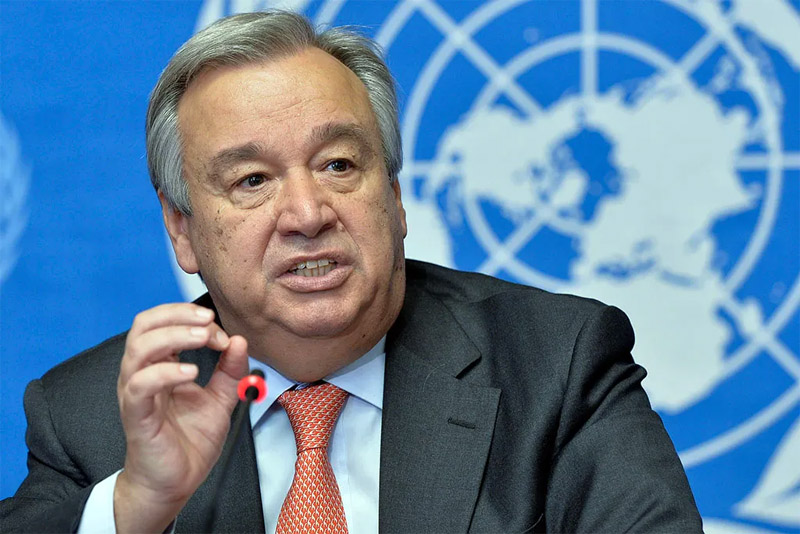
TOKYO, May 20: Concerned over a deepening global economic crisis, United Nations Secretary-General Ant nio Guterres on Wednesday called for the immediate restoration of freedom of navigation in and around the Strait of Hormuz, while urging a political solution to the ongoing conflict.
He also urged for the new composition of the UNSC, stating it would be essential to ensure “greater representation of Asian countries in permanent membership” to reflect the region’s demographic and geopolitical weight in today’s world.
He said that as the world is “rocked by conflicts, climate chaos and inequality,” and the situation is worsening global instability.
Emphasising about the cumulative effect of the Iran war, he said, “Inflation is rising and the cost-of-living crisis is deepening, made worse by the conflict in the Middle East, which is driving up prices of energy and raw materials, including fertilizers.
“It is essential to immediately reestablish the freedom of navigation in and around the Strait of Hormuz, and to end all ceasefire violations and create conditions for a political solution to the conflict,” he said, referring to tensions in the Gulf region.
He further said that “mistrust and widening geopolitical divisions” are the major hurdles blocking effective solutions, adding that some countries are flouting international law with impunity.
Calling for an urgent reform of the UN Security Council and the global financial system, he asserted that growing geopolitical divisions are undermining international stability and the effectiveness of multilateral institutions.
He said that the sustainable development goals, “blueprint for a better future”e for people and planet, require much stronger progress. He also raised concerns over the multilateral development banks that lack the ability to support developing countries, who are drowning in debt service and facing a lack of financing.
“We must recapitalize those multilateral development banks for them to have the necessary resources to support developing countries,” he said.
Addressing what he described as his final press conference in Japan as Secretary-General, Guterres praised Japan’s longstanding support for the United Nations and reaffirmed the importance of strengthening the UN-Japan partnership amid escalating global crises.
“I am determined to ensure a strong UN-Japan partnership for the future. The true hallmark of partnership is revealed in times of crisis,” he said.
Speaking in Tokyo, Guterres said the current composition of the UN Security Council no longer reflects present-day global realities, stressing that its legitimacy and effectiveness have been “dramatically affected” by the fact that the permanent members have three European countries, one Asian country – when Asia today has at least half of the world’s population, one North American, but no African nor Latin American countries.
“The most important reform that needs to be established is the reform of the UN Security Council,” he said, adding that the body’s structure reflects a bygone era rather than the current demographic and geopolitical balance.
Guterres said there was an urgent need to expand both permanent and non-permanent membership of the Security Council to better represent developing countries and enhance the institution’s credibility.
He also called for sweeping reforms of global financial institutions, saying developing nations were “drowning in debt service” and facing severe financing shortages. He urged the recapitalization of multilateral development banks to provide stronger support for poorer nations.
He also highlighted concerns over military spending surpassing humanitarian aid, shrinking global development financing, and the rapid advancement of Artificial Intelligence without adequate safeguards.
During the address, Guterres praised Japan’s seven decades of support for the United Nations since joining the organization, describing the country as a “steadfast and generous champion of multilateralism.”
He thanked Japanese Prime Minister Sanae Takaichi for the warm welcome during his visit and lauded Japan’s contributions to peacekeeping, disaster risk reduction, nuclear disarmament and humanitarian assistance worldwide.
Guterres reiterated solidarity with Japanese citizens abducted by the Democratic People’s Republic of Korea, calling the issue “an unacceptable violation of human rights.”
The Secretary-General also underscored the importance of international cooperation in tackling climate change, sustainable development and the governance of emerging technologies such as Artificial Intelligence.
“The United Nations remains the essential, one-of-a-kind meeting ground to advance peace, sustainable development and human rights,” Guterres said.
He added that despite mounting global challenges, he remained convinced that, with support from countries such as Japan, the international community could “restore global trust in what we can achieve by standing as one.”
(UNI)
 Follow our WhatsApp channel
