

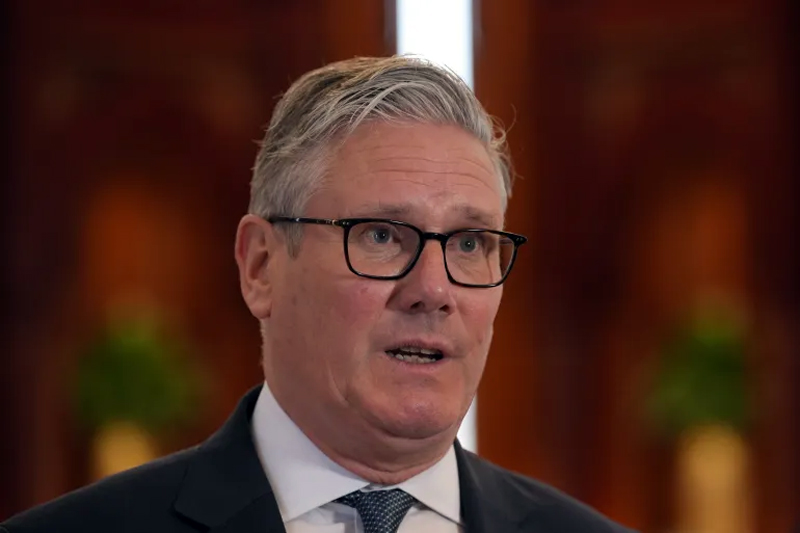
LONDON, Apr 13 : UK Prime Minister Keir Starmer on Monday firmly ruled out British involvement in any US-led blockade of the Strait of Hormuz, reiterating that London will not be dragged into a conflict with Iran.
“It is, in my view, vital that we get the Strait open and fully open, and that’s where we’ve put all of our efforts in the last few, and we’ll continue to do so,” Starmer said, underlining the UK’s commitment to keeping vital shipping lanes accessible without escalating military tensions.
His remarks came as Iran threatened ports in the Persian Gulf and the Gulf of Oman after US Central Command (CENTCOM) announced on Monday that ”it would begin blockading maritime traffic entering and exiting Iranian ports at 10 am Eastern Time (8:30 pm Indian Standard Time) “in accordance with the President’s proclamation.”
The blockade will be applied impartially to vessels of all nations entering or departing Iranian ports, including those along the Arabian Gulf and Gulf of Oman.
Starmer also highlighted that the UK does have “minesweeping capability,” though he declined to discuss operational details.
He noted that Britain has been consistently in consultation with allies on measures to keep the Strait of Hormuz open once tensions between Iran and the US ease.
“Having the Strait open is a priority,” Starmer said.
Keir Starmer expressed grave concern over the impact of restrictions on the Strait of Hormuz on global energy markets.
Starmer said, “The strait is shut or not free for navigation in the way it should be. That means that oil and gas is not getting to market. That means the price is going up. That means everybody listening to this is facing higher energy bills. And I don’t want that to happen. I want their energy bills to be stabilised and lower.”
Starmer has earlier, during an address to the nation, said, “Whatever the pressure on me and others, whatever the noise, I am going to act in the British national interest in all decisions that I make. That’s why I have been absolutely clear that this is not our war, or we are not going to get dragged into it.”
Australia’s Prime Minister, Anthony Albanese, echoed the call for open navigation, emphasizing that Canberra has received no request from Washington to participate in the blockade of the strategic waterway.
Albanese stressed the importance of renewed negotiations to resolve regional conflicts and called for full respect for international maritime law. Speaking to the media, he said: “We’ve received no requests, and they’ve made this announcement overnight in a unilateral way. We haven’t been asked to participate.”
Pointing to global fuel supply concerns, Albanese added that Canberra is “committed to working with international partners to help keep fuel flowing at home.”
Meanwhile, the Unified Command of the Iranian Armed Forces issued a stark warning in response to the US naval blockade, declaring that the security of ports across the Persian Gulf and the Gulf of Oman is under direct threat.
Tehran stressed that any aggression toward Iranian ports could trigger regional instability, declaring these strategic waters are “either for everyone or for no one.”
“The Armed Forces of the Islamic Republic of Iran consider defending the legal rights of our country a natural and legal duty, and accordingly, exercising the sovereignty of the Islamic Republic of Iran in the territorial waters of our country is the natural right of the Iranian nation,” IRIB cited Iran’s forces as stating.
“Enemy-affiliated vessels” will not have the right to pass through the Strait of Hormuz, while other vessels will be allowed passage, subject to regulations by Tehran, according to the statement.
“The criminal US’s imposition of restrictions on the movement of vessels in international waters is an illegal act and amounts to piracy”.
Iran stated that if the security of the ports is threatened, no port in the region “will be safe.”
(UNI)
 Follow our WhatsApp channel
