

Harsha Kakar
kakarharsha@gmail.com
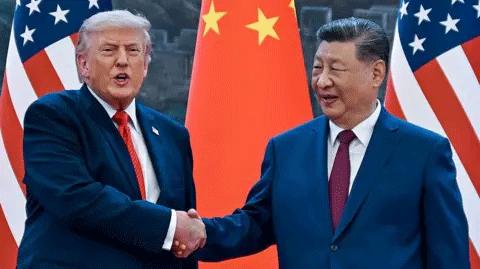
The much-awaited summit between the leaders of the world’s two most powerful nations has concluded. Trump’s team arrived in China under conditions of a strict digital lockdown, with cell phones and lap tops left behind due to fears of state-level surveillance, hacking and data interception. Members of the team used burner phones or devices with limited temporary data. While returning, every single Chinese gift, including lapel pins, souvenirs, burner phones etc were dumped in a dustbin prior to boarding.
This has been the tradition for some time as US fears gifts could be programmed for spying or tracking. This, in itself indicated lack of trust. It also conveys that the US accepts Chinese capabilities in cyber surveillance systems.
Diplomatic clash between the two commenced even before the visit. Trump had imposed sanctions on five Chinese firms procuring Iranian oil. China ordered its companies not to comply with US sanctions. Trump had also threatened additional sanctions in case China supplies weapons to Iran. None of this came up during discussions. In Beijing, Trump called Xi ‘a great leader.’
On Iran, statements by both sides indicated differing views. Evidently, Trump wanted Beijing’s support to end the conflict on favourable terms. The US handout read, ‘President Xi made clear China’s opposition to the militarisation of the Strait and any effort to charge a toll for its use.’ It added, ‘Both countries agreed that Iran can never have a nuclear weapon.’
China had a different version, which read, ‘The conflict has inflicted severe losses on the people in Iran and other regional countries.’ It made no reference to charging of tolls, militarization of Hormuz and on Iran developing nuclear weapons. On the contrary, it supported dialogue to ‘reach a settlement on the Iranian nuclear issue.’ Whom does one believe.
Trump had hoped that the blockade imposed on Hormuz would impact China’s oil supplies but it did not happen. China had insulated itself by pipelines from Russia and Central Asian nations and huge reserves. A regime change would have impacted China’s hold in the Middle East but that did not happen. Trump returned with no promise of support from China.
On trade, Trump mentioned that China agreed to purchase 200 Boeing aircraft as also 450 engines, instead of the 500 aircraft he had hoped. The Chinese ministry of commerce mentioned, ‘The two sides have reached arrangements on China’s purchase of aircraft from the US.’ There was no confirmation of numbers nor a timeline. Trump claimed China agreed to purchase more farm products, while Beijing was non-committal.
Major discussion was on Taiwan. On this the Chinese handout quoting Xi, mentioned, ‘If (Taiwan is) handled well, bilateral relations can maintain overall stability. If handled poorly, the two countries will clash or even fight, pushing the entire China-US relationship into a very dangerous situation.’ Trump stated that he just listened. However, he subsequently confirmed that he is holding in abeyance the proposed sale of military hardware to Taiwan, even though it was approved by Congress.
This raised doubts on the US’s support to Taiwan, in case invaded. Trump created doubts by mentioning ‘China is just 59 miles away, we are 9500.’ He added that Taiwan is a ‘very good negotiating chip,’ with China. He literally threw Taiwan to the wolves. Taiwan responded by insisting that it is ‘sovereign and independent.’ It subsequently added that it would maintain ‘cross-strait status quo,’ implying it would not declare independence from China.
Trump’s first call after boarding his flight was to the Japanese PM, Sanae Takaichi. The conversation was confidential and claimed to be a debrief of his China visit. In reality, Trump would have advised her to desist from making provocative statements on Taiwan. She had mentioned in the Diet (Japanese parliament) in Nov last year that a Chinese blockade of Taiwan could ‘constitute a survival-threatening situation (for Japan).’
The Chinese denounced this as violating the one-China principle. Trump would have cautioned Takaichi to avoid such comments, in deference to Chinese concerns. This subject could have emerged in private conversation between Trump and Xi.
In brief, the US statement focused on trade, fentanyl and Iran, while Beijing emphasised Taiwan, stabilising bilateral ties and Trump’s compliments about President Xi Jinping. Xi’s statements on declining US power as also the Thucydides Trap indicated that China no longer considers itself inferior but instead a challenger to the US. Its refusal to procure US chips is because of its confidence to develop its own.
While Trump heaped praises on Xi, there is little indication that the same was reciprocated. There was also no mention on rare earth exports indicating that for China, this remains a lever. Xi clarified three stages of US-China ties, ‘cooperation, managed competition and predictable peace.’ It was upto the US to implement it. A major takeaway was that the two could avoid confrontation.
In such summits, statements and promises mean little, what is discussed between closed doors, matter. China is known to not adhere to its promises. Xi does not appear before the media, statements are issued by the government through its mouthpieces, largely conveying their viewpoint. Trump has a habit of blabbering to the press, sharing his views on social media, how truthful remains questionable. The crux of what was actually discussed behind closed doors may emerge later.
The fact that a week after the summit, Pak PM Shehbaz Sharief is scheduled to visit China, appears to indicate that US-China came to an agreement on an end state in the Iran conflict. Shehbaz Sharief, as the messenger would now work towards an agreement.
At the end of the day, both sides claimed that they achieved what they set out for, Trump on trade and China on Taiwan.
What does the summit hold for the rest of the world. Trump had earlier mentioned US and China as G2. This is coming true. With Trump backing away from Taiwan, the message is clear. China will be the dominant power in Asia while the US would manage Europe and the Americas. This would concern Japan, South Korea and the Philippines, with whom the US has defence agreements. For India, if it is Taiwan today, it could be Arunachal tomorrow. The US will never stand beside. We have to develop capabilities to handle it on our own.
 Follow our WhatsApp channel
