

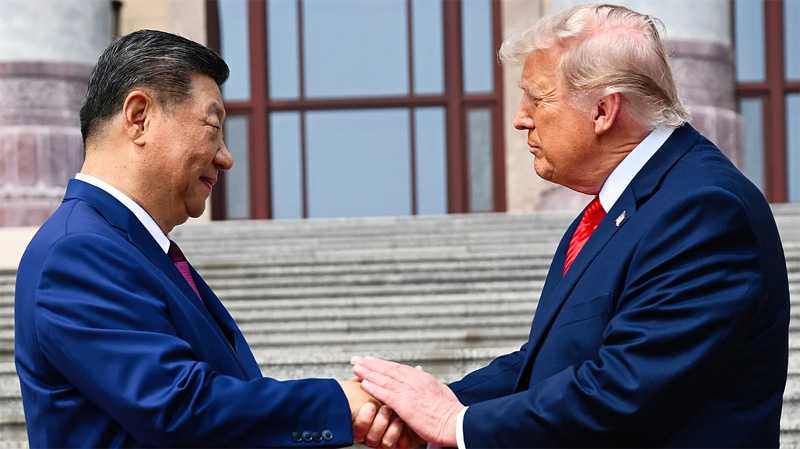
WASHINGTON, May 16: US President Donald Trump said he held extensive and “very positive” discussions with Chinese President Xi Jinping covering Taiwan, Iran, trade, artificial intelligence, and global security architecture, describing the engagement as a key step toward stabilising major power relations.
Speaking to reporters aboard Air Force One on his return flight from China, Trump said Xi expressed strong views on Taiwan, warning against any push for independence. Trump said he made no commitments during the discussions and would take a decision later.
“On Taiwan, he does not want to see a fight for independence, because that would be a very strong confrontation,” Trump said, adding, “I heard him out. I didn’t make a comment on it, I heard him out. I have a lot of respect for him.”
On Iran, Trump said Xi “feels strongly they can’t have a nuclear weapon,” adding that the Chinese leader also stressed the importance of reopening the Strait of Hormuz.
“He said that very strongly they cannot have a nuclear weapon, and he wants them to open up the strait,” Trump said, adding that Iran’s actions had disrupted global energy flows.
Trump also noted that both sides discussed the importance of keeping global shipping routes open, particularly the Strait of Hormuz. The US President claimed that Iran’s closure of the strait had already resulted in significant economic disruption, stating that “no business has been done in the last two and a half weeks,” estimating losses of about $500 million per day.
Trump claimed the US holds strategic leverage over the waterway, stating, “It’s true, we control the strait,” and suggested that Iran’s economic activity had been significantly constrained during the recent tensions.
On broader geopolitical alignment, Trump said he and Xi “agree almost entirely” on the Iranian situation, while noting differences in economic interests.
“He doesn’t want to see a war. On Iran, I think we agree almost entirely,” Trump said, adding that discussions also touched upon China’s energy dependence: “He gets about 40% of his energy or oil from the strait. We get none.”
Trump further said he had not made any commitments on Taiwan, adding that he would take a decision “over a fairly short period” after consulting relevant stakeholders, including Taiwan’s leadership.
On US-China relations, Trump said, “We had a great relationship last time, and now it’s as strong as ever,” adding that both sides discussed denuclearisation efforts involving China, Russia, and the United States.
Trump also suggested that he had not sought any assistance from Beijing on Iran, but said Xi Jinping could independently influence Tehran due to China’s heavy dependence on Middle Eastern energy supplies.
On broader strategic issues, Trump said the two leaders discussed denuclearisation efforts involving China, Russia, and the United States, describing the response from Xi as “very positive” and suggesting it was an early step toward future coordination.
“We discussed almost everything you could discuss except tariffs,” Trump said, while adding that trade issues were not formally raised during the talks.
He further claimed that China acknowledged concerns over fentanyl trafficking and that the US tariff measures related to it had generated significant revenue.
Trump also indicated that multiple high-level diplomatic engagements are planned with China later this year, including possible participation in G20-related meetings and bilateral visits, suggesting continued engagement on global security issues.
On Russia and North Korea, Trump said discussions were also touched upon, adding that he maintains a “very good relationship” with North Korean leader Kim Jong Un.
The briefing came amid heightened geopolitical tensions in West Asia and the Indo-Pacific, with Trump portraying the talks as part of a broader effort to stabilize major power relations and prevent escalation across multiple conflict zones. (UNI)
 Follow our WhatsApp channel
