

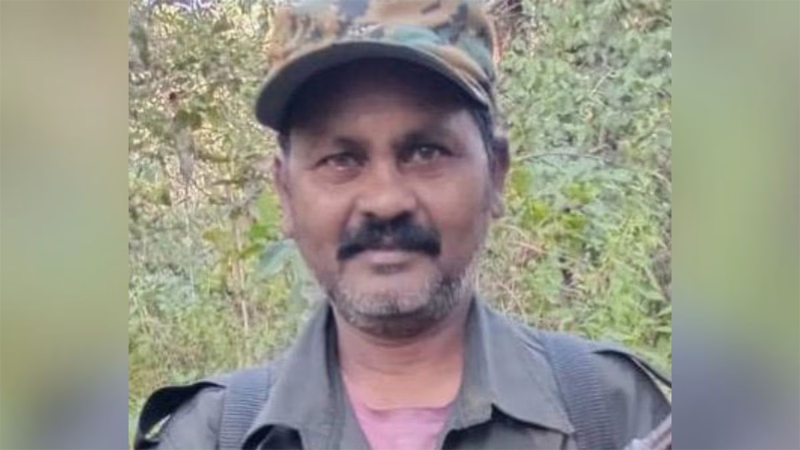
RAIPUR, Mar 24 : One of the last remaining senior Maoist commanders, Papa Rao, surrendered along with his 17 team members on Tuesday, marking a significant milestone in Chhattisgarh’s fight against Left-Wing Extremism (LWE), officials said.
The surrender underscores the waning fortunes of one of the country’s longest-running insurgencies, as a combination of security pressure and rehabilitation efforts chips away at the movement’s core, they said.
The surrender of Rao, a member of the Dandakaranaya Special Zonal Committee (DKSZC) and in-charge of south Sub Zonal Bureau of Maoists, along with his team members, marks a decisive breakthrough in the government’s sustained efforts to bring an end to LWE in the region, said Inspector General of Police (IGP), Bastar Range, Sundarraj P.
Of the 18 surrendered cadres, seven were women, he said.
Other key cadres among surrendered include divisional committee members Prakash Madvi and Anil Tatti, the IPS officer informed.
They also handed over AK-47 rifles and other graded weapons to police, he said.
For the first time in the history of the Maoist movement in Dandakaranya, the Naxal outfit has effectively become leaderless. As envisioned by the Government and passionately desired by the people of the region, Bastar is now set to emerge stronger, carrying a renewed spirit and a positive identity for the future, Sundarraj asserted.
The DKSZC, which handles Naxal activities in the Bastar division and parts of adjoining states, was considered the strongest formation of the outlawed outfit CPI (Maoist) and had been instrumental in executing several deadly attacks on security forces in the past two decades.
“We remain hopeful that the few remaining cadres, now wandering in small scattered groups, will also choose the path of peace and return to the mainstream in the coming days, the IGP said.
The formal reintegration process of all the 18 surrendered cadres belonging to the South Sub Zonal Bureau area will be carried out later, he stated.
Operating for over two decades in the dense Indravati-Abujhmad forest belt, a once-formidable redoubt of the insurgency, Rao was among the last prominent commanders of the insurgent network associated with the Communist Party of India (Maoist) who masterminded a number of deadly attacks on security forces in south Bastar, including the Tadmetla attack (in then Dantewada district, now in Sukma) in 2010, wherein 76 troopers were killed.
Earlier in the day, Deputy Chief Minister Vijay Sharma, who holds the Home portfolio, said Rao, also known as Mangu, will surrender along with more than a dozen team members in the Bastar region.
“Once it is done, no Naxal operative of that senior rank will remain active in Chhattisgarh, and the state is set to be free of armed Naxalism by the stipulated deadline of March 31, 2026, Sharma said.
The surrender marked not just the exit of a senior figure, but a broader unravelling of the Maoist network linked to the CPI (Maoist), which for years sustained a parallel authority across swathes of central India, the officials said.
The “Red Corridor”, an arc that once stretched from “Pashupati to Tirupati” across Bihar, Chhattisgarh, Jharkhand, Odisha, Maharashtra and parts of Andhra Pradesh, was considered the “gravest internal security challenge” to the country, where governance was attenuated, and the Maoists cultivated both coercion and consent among marginalised communities, they said.
Official data on LWE surrenders from 2014 to early 2026 show that over 10,000 cadres have surrendered nationwide, with 2,300 laying down arms in 2025 alone. More than 630 cadres have already surrendered in the first three months of 2026.
The surrenders indicate a sharp collapse of organisational morale within the Maoist ranks, particularly pronounced in Chhattisgarh and Telangana, where hundreds of cadres have chosen to give up arms in the past year, they said.
The downward trajectory of the guerrilla movement over the past decade tells a story of one of sustained political resolve, coordinated security operations, development outreach, and effective rehabilitation policies, resulting in a steady rise in the number of Maoist cadres surrendering and returning to the democratic mainstream, the officials said.
Security officials describe the trend as a “cascading effect,” in which high-profile defections erode the movement’s aura of permanence.
“With this (Rao’s) rehabilitation, Naxal presence within Chhattisgarh’s territory will effectively come to an end,” Deputy CM Sharma stated hours before the formal surrender.
He said Rao had been active for nearly 25 years and had been involved in multiple encounters. The state government had announced a reward of Rs 25 lakh for him.
More surrenders are expected in the coming week, Sharma added.
As part of a comprehensive strategy pursued by the Union and state governments, security forces, including the Central Reserve Police Force and its elite CoBRA units, and state police, sustained a campaign of intelligence-led operations, tightening the net around insurgent strongholds.
The strategy aligns with the government’s multi-pronged approach under the SAMADHAN doctrine, focusing on intelligence-led operations, improved mobility, infrastructure expansion, and modernising police forces to bring bureaucratic coherence to a historically fragmented effort, the officials said.
At the same time, Chhattisgarh has sought to extend its presence in more quotidian ways with financial and logistical support from the Centre, strengthening state capabilities through programmes like the Security Related Expenditure Scheme, which assists states in covering operational costs in LWE-affected districts, they said.
Many districts once deeply affected by insurgency have been part of the Aspirational Districts Programme, which focuses on improving health, education, infrastructure and livelihood opportunities.
Roads have been pushed deeper into forested districts and fortified police stations now dot areas that were previously inaccessible. The extension of banking services and digital connectivity has brought remote tribal regions closer to mainstream governance.
Sharma said members at the party and area committee levels of Maoists are no longer engaged in armed activities in Chhattisgarh.
“They have laid down their arms and given up uniforms,” he pointed out.
Only a few remaining names linked to Chhattisgarh are currently active in Gadchiroli (Maharashtra) or Telangana. Efforts are also underway there to facilitate their surrender, the Deputy CM noted.
The most consequential factor leading to the constriction of the violent movement has been the recalibration of rehabilitation policy. The revised Surrender-cum-Rehabilitation Scheme provides financial aid, skill development training and housing support for former cadres. (PTI)
 Follow our WhatsApp channel
