

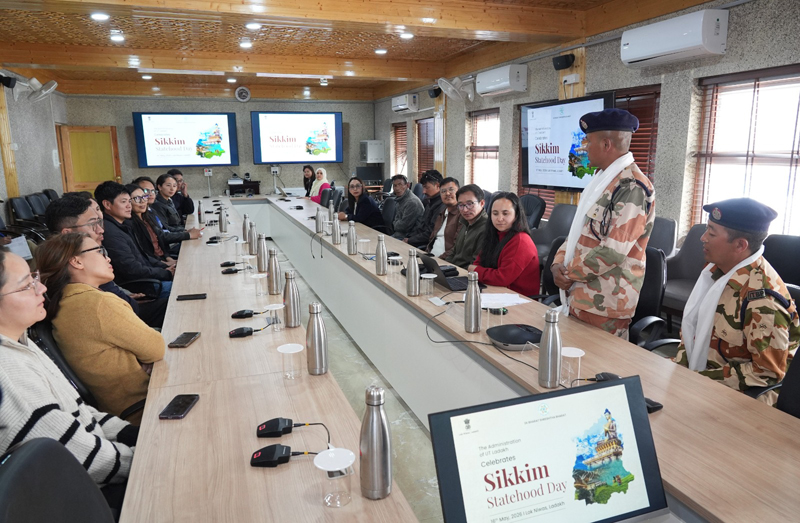
Leh, May 16: The Sikkim Statehood Day was celebrated with great enthusiasm and patriotic fervour at Lok Niwas in Leh as part of the Ek Bharat Shreshtha Bharat initiative aimed at fostering national integration, cultural exchange and emotional unity among the people of different states and Union Territories of the country. The event witnessed the participation of defence personnel from Sikkim currently serving in Ladakh, along with officials and staff of Lok Niwas.
The programme highlighted the rich cultural, historical and geographical heritage of Sikkim while celebrating the deep bonds shared between the Himalayan regions of Sikkim and Ladakh. The occasion also served as an opportunity to strengthen the spirit of unity in diversity and promote mutual understanding among people from different parts of the country.
During the programme, it was highlighted that Sikkim became the 22nd State of India on May 16, 1975, following the merger of the erstwhile princely Himalayan kingdom with the Indian Union.
The speakers also highlighted Sikkim’s unique geographical and ecological importance. Nestled in the eastern Himalayas, Sikkim shares international borders with Bhutan, Nepal and China (Tibet Autonomous Region), making it one of India’s strategically significant Himalayan states. It was also mentioned that Sikkim is recognised as India’s first fully organic state for adopting sustainable and chemical-free agricultural practices. The programme further highlighted the presence of Mount Kanchenjunga, the world’s third-highest peak, which remains a symbol of pride and spiritual significance for the people of Sikkim.
The participants were informed that Leh’s Main Market has been modelled on the famous MG Marg of Gangtok, reflecting the inspiration drawn from Sikkim’s clean, organised and pedestrian-friendly urban design.
Speaking on the occasion, Shri Sajit Pradhan from Sikkim, who is presently serving in Ladakh, shared his experiences of living in Ladakh and spoke about the similarities between the people of Sikkim and Ladakh, particularly in food habits, physical appearance and Himalayan traditions. He also highlighted the differences between the two regions in terms of climate and greenery, noting that while Sikkim is known for its lush green landscapes and abundant rainfall, Ladakh possesses a unique cold desert beauty. He expressed deep admiration for the warm hospitality of the people of Ladakh and their rich cultural heritage.
During the event, a special video message from the Hon’ble Governor of Sikkim, Shri Om Prakash Mathur, was screened for the audience. A documentary showcasing the culture, traditions, art, natural beauty and heritage of Sikkim was also screened on the occasion, providing participants with a glimpse into the vibrant cultural life of the Himalayan state.
 Follow our WhatsApp channel
