

Excelsior Correspondent
NEW DELHI, Aug 21: Union Minister of State (Independent Charge) for Science and Technology; Earth Sciences and Minister of State for PMO, Department of Atomic Energy, Department of Space, Personnel, Public Grievances and Pensions, Dr. Jitendra Singh today said that the flagship mantras consistently practised by Prime Minister Narendra Modi are steering India’s growth story, including its ambitious space programme.
“Shubhanshu’s Space voyage vindicates “Atmanirbhar” “Vishwabandhu” Bharat”, said Dr Jitendra Singh.
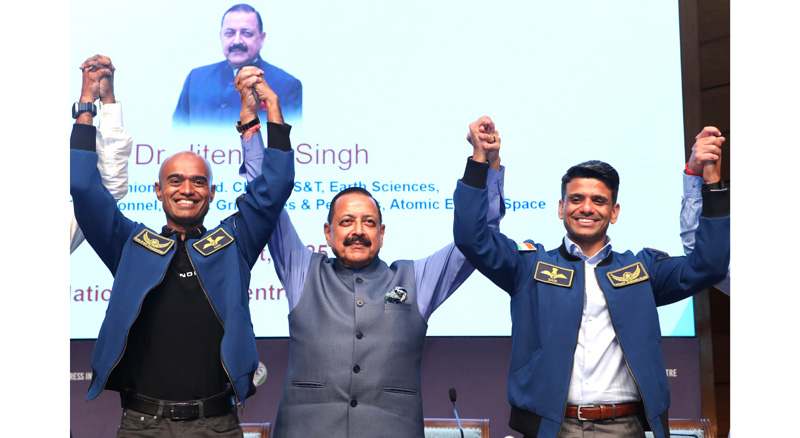
The Minister was speaking at an ISRO press conference here where he formally introduced two Indian-origin astronauts, Group Captain Shubhanshu Shukla and Group Captain Prasanth B. Nair, to the country.
Dr. Jitendra Singh said that in a single mission, India’s astronauts had lived up to the three flagship mantras that Prime Minister Modi has been practising and propagating for nearly 12 years. The first, Atma Nirbhar Bharat, was reflected in the use of fully indigenous kits and technology during the mission, a principle that will also guide the forthcoming Gaganyaan programme.
The second, a Whole of Government and Whole of Nation approach, was evident in the contributions from diverse institutions such as the Department of Biotechnology, IISc Bengaluru and IITs, with experiments that even pointed towards the future possibility of a “space physician.”
The third, Vishwa Bandhu Bharat, was demonstrated by the fact that while the experiments were conducted by an Indian astronaut, their benefits would reach humanity at large-strengthening both India’s confidence and the world’s trust in wider collaborations.
Dr. Jitendra Singh underlined that the astronauts’ achievements reflected the Prime Minister Modi’s emphasis on integrating India’s traditional strengths with modern innovation. He noted that India’s expanding presence in space research and exploration has been enabled by policies that encourage openness, collaboration, and private sector participation. Introducing the astronauts, he said their presence and experiences would inspire a new generation of young Indians to look at space research as a career and national calling.
Both astronauts interacted with the media and shared their experiences, ranging from rigorous training to the unique challenges of living and working in space. They also highlighted the spirit of teamwork and scientific pursuit that underpinned the Axiom-4 mission.
Shubhanshu Shukla, who recently became the first Indian to travel to the International Space Station as part of the Axiom-4 mission, shared his experiences as the mission pilot of the Crew Dragon spacecraft. He described how months of training across multiple international space agencies prepared him for the flight, but said the actual experience of space went far beyond what could be taught on the ground. He spoke of the physical adjustments the body undergoes in orbit, the invaluable lessons from working on experiments aboard the ISS, and the collaborative spirit of astronauts and scientists from across the world. “This mission has been extremely successful in achieving its objectives, but more importantly, it has given us insights that cannot be documented on paper. These will be critical as India prepares for Gaganyaan and beyond,” he said.
Group Captain Prasanth B. Nair, who trained alongside Shubhanshu Shukla for the Axiom-4 mission, described the experience as a reminder of India’s growing stature in the global space community. Drawing from his interactions abroad, he said that India’s achievements were met with respect and admiration, often accompanied by surprise at the scale of progress made with humility. He emphasised that India’s approach to space was rooted in inclusivity and shared benefit, reflecting the nation’s belief in the oneness of humanity.
Stressing that the future lies in space and related technologies, he said the progress made was possible only because of the collective contributions of scientists, policymakers, and citizens. Concluding on a note of gratitude, he acknowledged the support of the Government, ISRO teams, and the people of India, remarking that their work provides the foundation for the country’s aspirations in space exploration.
Dr. V. Narayanan, Secretary, Department of Space and Chairman, ISRO, outlined India’s Human Space Flight Programme and briefed the gathering on upcoming ISRO missions, including preparations for the Gaganyaan project. He said these initiatives mark an important step in positioning India as a key player in future human space exploration.
 Follow our WhatsApp channel
