

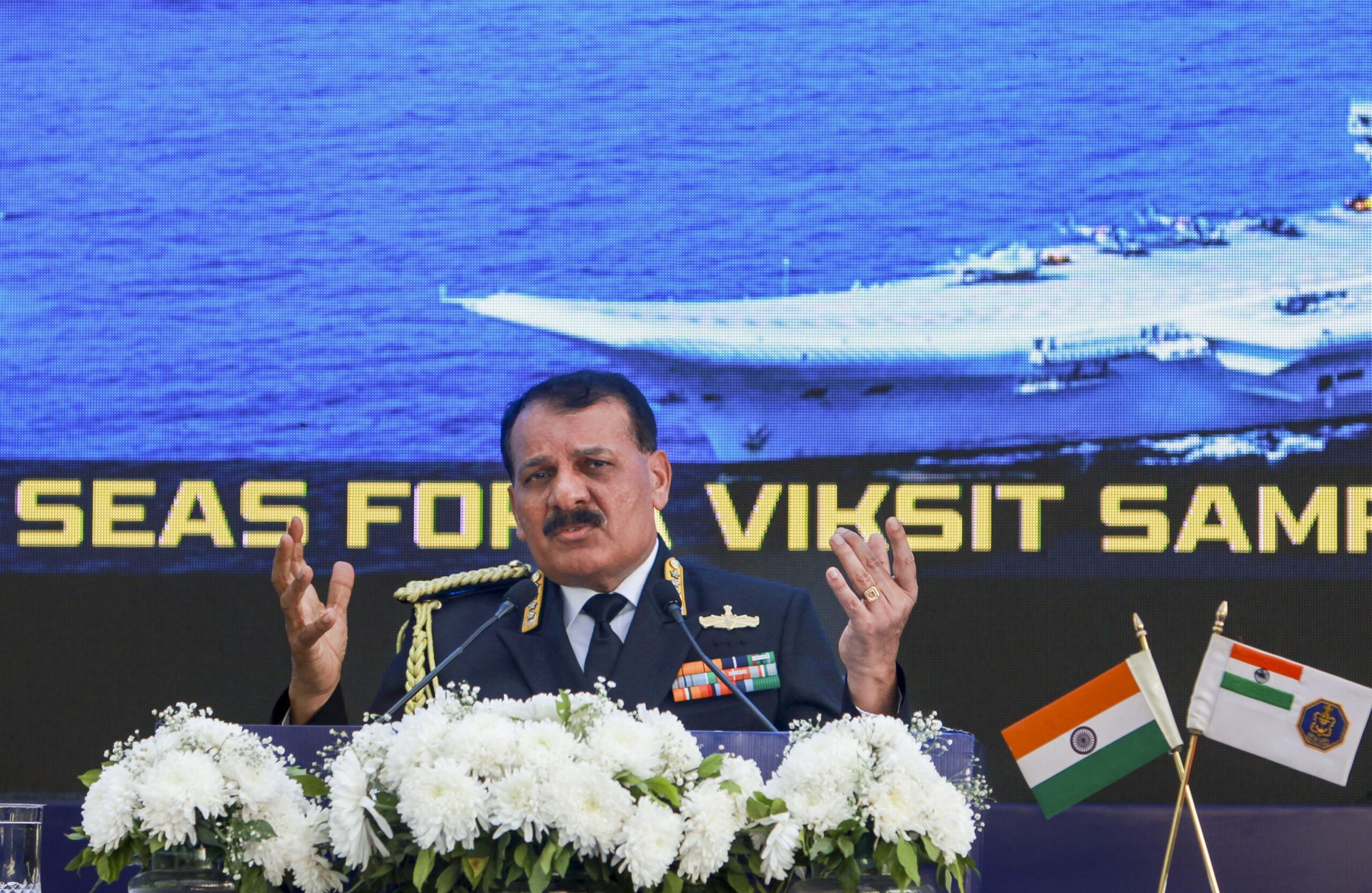
NEW DELHI, May 30: Navy Chief Admiral Dinesh K Tripathi on Saturday strongly pitched for a dedicated naval theatre command integrating capabilities of all three services and the Coast Guard, driving home the lessons of the West Asia conflict regarding maritime security’s direct link to energy security, economic growth and national resilience.
In an exclusive interview to news agency, Admiral Tripathi said theaterisation must remain strictly guided by operational effectiveness and enhancement of national military capability rather than organisational restructuring alone.
The Navy Chief also argued that the ongoing instability in West Asia and the Russia-Ukraine conflict serve as “stark reminders” that security is interconnected, and distance from conflict does not equate to distance from its consequences.
Framing military jointness as a combat necessity rather than a concept, the Navy Chief said any new joint structure must prioritise maritime realities while fully aligning with the broader national objective of integrated warfighting.
Admiral Tripathi said the myth of short and swift wars has been debunked and the strategic depth no longer guarantees sanctuary in an era of long-range precision weapons and persistent surveillance.
Additionally, the weaponisation of tariffs and the disruptions to interdependent supply chains require nations to shift their logistics from “just-in-time” efficiency to “just-in-case” resilience, he said.
In view of the unfolding crisis in West Asia, setting up a dedicated naval theatre command incorporating assets and personnel from the Army, Navy, Air Force and the Coast Guard has gained traction.
The overarching blueprint envisions setting up three theatre commands focused on China, Pakistan and the maritime domain. The Navy has favoured rolling out the naval theatre command on priority as the maritime domain is witnessing increasing contestations.
“The first and most critical lesson (from the ongoing conflicts) is that maritime security is directly linked to economic security, energy security, and national resilience,” he said.
“Disruptions to shipping routes, energy flows, and maritime logistics chains have immediate strategic and economic consequences, affecting insurance costs, shipping patterns and the strategic balance across entire regions,” he said.
The Navy Chief said the character of warfare itself is undergoing a profound transformation and that the maritime battlespace today extends seamlessly from seabed to space, while cyber, electromagnetic, informational and cognitive domains have become equally vital.
“Jointness and integration are no longer optional — they are an absolute operational necessity in modern battlespace. Future conflicts will demand seamless coordination across land, sea, air, cyber, space, and information domains,” he said.
“No single service can operate effectively in isolation under such complex conditions, making tri-service integration central to the way India must plan and execute its future defence architecture.” Admiral Tripathi said the Indian Navy has historically remained at the forefront of promoting jointness as the country’s first joint command, the Andaman and Nicobar Command, was a major step towards ensuring synergy.
“As we move towards theaterisation, our ultimate aim is to achieve unified planning, a common operational picture, and integrated operations that allow us to generate effects faster and more coherently,” he said.
“Regarding a dedicated maritime theatre command, the maritime domain, by its very nature, inherently requires the integrated application of naval, air, land, and coast guard capabilities,” he said.
The Navy Chief said as India’s maritime interests expand, theatre structures and integrated operational frameworks will become increasingly important to secure interests that cut across traditional boundaries.
“However, theaterisation must remain strictly guided by operational effectiveness, unity of command, speed of response, and the enhancement of national military capability rather than organisational restructuring alone.” “The Navy’s role will be to ensure that any such a framework is designed securely around these maritime realities, while remaining fully aligned with the larger national objective of integrated warfighting,” he said.
To emphasise his point, Admiral Tripathi said modern conflict is increasingly defined by speed, scale and simultaneity. Speed is no longer just an enabler; it is a distinct capability.
“To build a future-ready force, the Indian Navy is aggressively incorporating AI, quantum technologies, and autonomous solutions across all domains in line with the Indian Navy Roadmap for Uncrewed Systems,” he said.
Admiral Tripathi said the Indian Navy’s future fleet will not be defined by platforms alone, but by the integrated effects it can generate, utilising an optimum mix of low-cost, high-impact uncrewed solutions alongside high-end crewed platforms.
“We are continuously refining our operational concepts, training methodologies, space-based communications, and cyber resilience to ensure our people can operate in a highly transparent, contested, and data-driven environment,” he said.
The Navy Chief said the past year has been a definitive testament to his force’s commitment to being a first responder and a preferred security partner. “In an increasingly interconnected and contested maritime environment, the Indian Navy maintained an unprecedented operational tempo across our areas of interest – clocking nearly 11,000 ship days and over 50,000 flying hours in 2025 alone,” he said.
“Foremost among these achievements was Operation Sindoor, which demonstrated our absolute combat readiness, operational reach, and deterrence potential.” “The immediate deployment of a Carrier Battle Group and our forward operational posture in the Northern Arabian Sea forced the Pakistan Navy to remain confined to harbour or close to the Makran coast,” he said.
This aggressive posturing, Admiral Tripathi said, reaffirmed the Navy’s ability to rapidly position combat power and successfully shape the strategic environment, while simultaneously impacting their maritime economy due to increased shipping risks and elevated insurance premiums. “Equally important was the tri-service synergy demonstrated during the operation, which validated the growing importance of joint operational capability,” he said. The Navy Chief said all stakeholders operated with a singularly clear focus, aided to a large extent by the “freedom and flexibility” given to teams at all levels — from the Chiefs of Staff Committee (COSC) to the tactical level — in planning, preparation, and execution.
To a question on China’s increasing presence in the Indian Ocean Region, he said the Navy is fully aware that the region is witnessing increasing ‘strategic contestation and greater extra-regional presence”.
“As a professional maritime force, the Indian Navy monitors all regional developments very closely, and our approach remains strictly capability-based and threat-informed,” he said.
“We continuously assess the evolving strategic environment and accordingly adapt our force structure, operational concepts, deployment patterns, and preparedness levels,” he added.
“Our efforts are not aimed at any specific nation, but rather at ensuring the absolute security of India’s maritime interests and contributing to a stable, free, open, and inclusive Indo-Pacific,” he said. (Agencies)
 Follow our WhatsApp channel
