

By Arun Srivastava
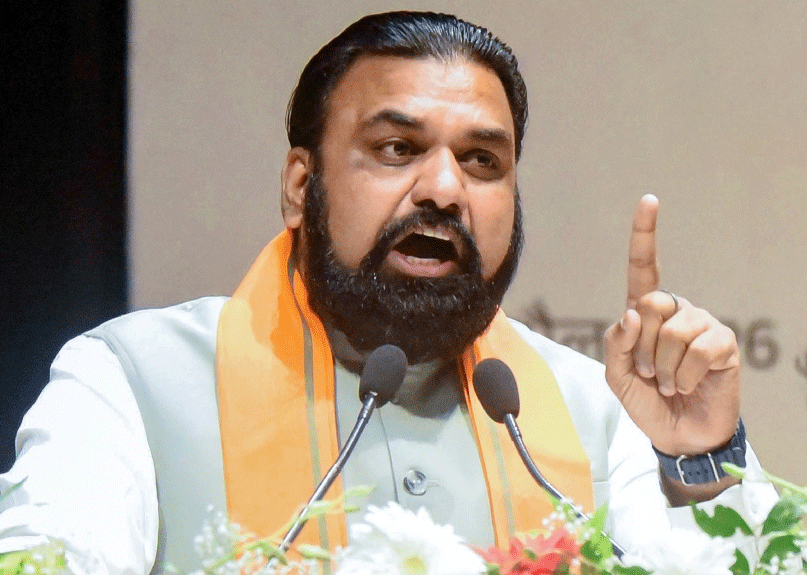
Samrat Choudhary becoming the chief minister of Bihar is not only the dream coming home for BJP, it will help the BJP to redefine social justice politics in India by shifting the focus from traditional identity-based mobilization to a model based on Hindutva, Samrasta (social harmony) and pursuing exclusionary politics. Though BJP has been patron of the feudal lords and upper caste gentry, it has brought in to maintain the façade of being a party concerned of the welfare of the poor and marginalised. As the strategy to shift from identity to empowerment, BJP’s mantra emphasizes that development should reach all, empower the “most backward” among the backward classes (MBCs) and the most marginalized among Dalits, rather than just the politically dominant castes within these groups.
Unfortunately, Nitish Kumar has become the victim of self-deceit. And the most important role in deceiving was played by his own colleagues, who were blackmailed by the BJP leadership to behave like Caeser’s wife. While wild message was spread across that Nitish was not keeping well and he is suffering with dementia, these leaders also convinced him that preferring for a candidate from BJP’s backward leaders for the office of CM, he would also be putting a check on the resurgence of saffron upper caste jingoism.
Already the small spell of seven months, since the assembly elections were held in November in Bihar has been witnessing aggressive upper caste reprisal on the poor. A couple of incidents of lynching of Muslims have taken place. Indeed a dichotomy, while the BJP promises to empower the poor and marginalised it has turned blind eye to the aggressive assertion of the upper caste and feudal lords. Installation of Samrat is a shrewd move to win over the trust of the EBC, IBC, poor and marginalised. For BJP these are the potential votebank who will help the party to sail trough river election Baitarani. BJP plans to give higher representation to OBCs, SCs, and STs within the party and government structure.
Saffron ecosystem intends to exploit the element of distrust between the Yadavs and two other OBC sections, especially Kori and Kurmis. Nitish Kumar’s politics survived on this paradigm. BJP will net these two sections from Nitish through Samrat. At one stage during the beginning of the current month, some Koiri and Kurmi leaders had opened a dialogue with the RJD leader Tejashvi with the mission to obtain a firm assurance that the he would ensure that the Yadavs do not adopt postures against other weaker communities. The discussion is still on. In fact realising the potential threat to its own design, BJP was quick to agree to Nitish’s suggestion and install Samrat as CM.
The political relationship between the Rashtriya Janata Dal (RJD), led by Lalu Yadav, and its opponents—particularly the BJP and at times JD(U)—is characterized by intense, ongoing conflict, with both sides accusing each other of fear-driven tactics. Opponents often criticize the RJD for its past 15-year rule, which they label “Jungleraj” (lawless rule), alleging high levels of crime, corruption (including the fodder scam), and extortion. The BJP frequently accuses the RJD of focusing only on family politics and corruption, with leaders asserting that the RJD’s “rule of crime and lawlessness” will not return to Bihar. Rabri Devi and Tejashwi Yadav, claim that the BJP is “scared” of Lalu Yadav’s political influence and ability to unite opposition forces, which they argue drives the BJP to use central agencies like the CBI against them. Media in Bihar and upper-caste bureaucracy oppose Lalu because of his strong support for reservation policies and the empowerment of backward classes. Interestingly Samrat was a minister in Rabri government which is accused of being Jungle Raj.
His association with RJD is of great importance for BJP. His father Sakuni Choudhary was a close ally of Lalu. BJP intends to use the family relation with Lalu to convey a consoling message to OBC and EBC that must not feel scared of and join hands with it. Though the BJP has been a significant player and a junior partner in Bihar governments since 2005 (often in alliance with JD(U)), it never held the top post until this point. Obviously the BJP did not get much exposure of having its intentions tested by the dalit and marginalised.
Significantly Samrat, a prominent OBC face from the Kushwaha community, has been key to the BJP’s strategy to expand its base. Installation of Samrat formally changes the NDA power dynamics in Bihar, moving from a JDU-led alliance to a BJP-led government. After years of relying on alliances where Nitish Kumar led the government, this move signifies the BJP’s intent to dominate the state’s political landscape directly.
Samrat’s elevation within the BJP—culminating in his role as a key leader and becoming Chief Minister—is widely seen as a strategic move to counter Lalu Prasad Yadav’s political base in Bihar. As a prominent leader from the Kushwaha (Koeri) community, which is a significant part of the OBC vote bank in Bihar, his rise is designed to directly challenge the RJD’s social engineering and the Yadav-Muslim (MY) coalition. Samrat’s focus on the Koeri-Kurmi voter base is viewed as a direct attempt to win over OBC voters who have traditionally fluctuated between RJD, JDU, and BJP, thereby undermining RJD’s dominance.
Nonetheless RJD leader Tejashwi Yadav has labelled him a “product of Lalu Yadav’s classroom,” acknowledging his roots in the RJD before moving to the BJP, thus highlighting the battle over the same political space. By positioning a strong, assertive OBC leader at the helm, the BJP aims to break the hold that Lalu Yadav’s RJD has on the backward caste electorate. His rise is part of a broader, long-term plan to build an independent support base for the BJP in Bihar, moving away from relying solely on JD(U) leader Nitish Kumar to attract non-RJD votes.
Little doubt Samrat Choudhary as the chief minister marks a historic shift, likely altering the state’s political culture from a socialist, personality-driven model to a “nationalized” model focused on central welfare schemes, caste coalition management (EBCs), and aggressive Hindutva. The shift reduces the dominance of regional, socialist, or caste-centric parties, aligning Bihar’s governance more closely with the BJP’s central leadership, ideology, and “double-engine” agenda.
After more than forty years, Bihar will have a government headed by a national party. In the past during the rule of Congress, Bihar had witnessed high intensity of caste and class struggle. Apprehensions are being expressed that Bihar may once again see resurgence of the old form of politics. Induction of Samrat as C M brings to an end the era of JD(U)’s “social engineering” under Nitish Kumar, replacing it with a new focus on targeting the Extremely Backward Classes (EBCs) and OBCs. The new leadership, represented by Samrat represents a more aggressive, right-wing, and confrontational style of politics compared to the moderate image of Nitish Kumar. The rise of a BJP leader with a traditional symbol (like a saffron turban) signals a major ideological pivot in Bihar’s political landscape, breaking the perceived barrier against the BJP leading the state independently.
The political situation in the state has only further complicated with Nishant, son of Nitish, refusing to become deputy CM. However sources maintain that this has the tacit support of Nitish. Though in public he agreed to the popular demand, in private he was supportive of this political move. It would have been a tough proposition for Nishant, a green horn, to handle the administrative and political responsibilities. He would have to completely depend on the bureaucrats and some JD(U) leaders. Chances of his being used by these forces are serious. Nitish desires that he should manage the party affairs for some time and use the period to understand the efficacy of the political management and real politics. It is better to wait for some time than to rush and earn a failure stigma. (IPA Service)
 Follow our WhatsApp channel
