

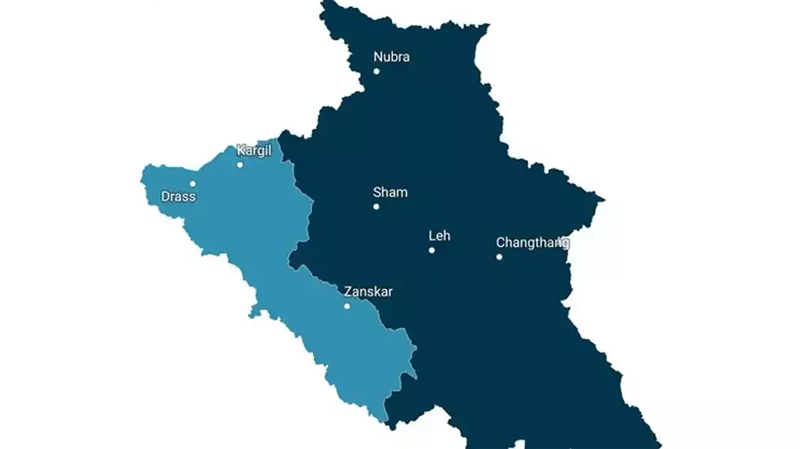
There are places in India where geography itself is the adversary. Ladakh is one of them. Straddling a vast expanse of 86,904 square kilometres along some of the most sensitive borders on Earth, this UT is, in fact, the most sparsely populated. With just 2.74 lakh residents counted in the 2011 census, distances between habitations make the administrative challenge immense. The approval of five new districts – Nubra, Sham and Changthang carved from Leh, and Zanskar and Drass from Kargil – is therefore not a routine bureaucratic exercise. In temperatures that routinely plunge to minus 30 or even minus 40 degrees Celsius, a patient requiring hospital attention, a student seeking college admission, or a farmer needing to register a land dispute has had no choice but to brave sub-zero conditions and treacherous mountain roads to reach a District Headquarters. The human cost of this arrangement has been borne quietly for decades. Winter does not merely inconvenience life in Ladakh; it can make it impossible. Hospitals, to remain functional in such conditions, must be fully air-conditioned and equipped with heated residential quarters for staff-a logistical requirement of extraordinary expense that has meant medical services in remote sub-regions have remained skeletal at best.
The situation in education is no less troubling. By the cold logic of administrative planning, it is difficult to justify a full-fledged degree college for fifty students. But in the lived reality of high-altitude Ladakh, the alternative – compelling young men and women to migrate to Jammu, Delhi or elsewhere for higher education – amounts to a systematic draining of local talent and identity. This demographic haemorrhage has quietly undermined the social fabric of some of Ladakh’s most remote valleys. New district headquarters, with the administrative weight they carry, will provide a legitimate platform for demanding and sustaining schools, colleges and hospitals that are genuinely accessible.
The economic dimension of this reform deserves equal attention. Ladakh’s terrain and climate limit the scope for large-scale industrialisation. Employment opportunities have historically been scarce, pushing working-age residents towards the armed forces, tourism, or migration. The establishment of new District Administrations – complete with their own collectorates, revenue offices, development bodies and ancillary services – creates a significant tranche of Government employment that, crucially, will be filled locally. With Ladakh’s administrative services having a separate cadre, locals will be at the helm of affairs at the district level. Beyond direct employment, the ripple effects on local commerce – from construction of new offices to the daily needs of a resident administrative workforce – should not be underestimated.
There is also a political dimension that cannot be glossed over. Ladakh is not merely any remote territory; it is a borderland that shares its frontiers with both Pakistan and China and has been the theatre of some of India’s most consequential military confrontations in recent decades. A sensitive border region cannot afford to carry unaddressed grievances. The Home Minister’s two-day visit to Ladakh signals precisely the kind of sustained political attention the region deserves. In geopolitics, as in governance, perceptions of neglect can be as damaging as neglect itself. The Union Government’s intent is clear. Decentralisation of administration, localisation of decision-making and the involvement of Ladakhis at every level. It will, inevitably, take time to staff and operationalise five new District Administrations across terrain that defeats most conventional infrastructure. But the direction is right. Officials who live and work within the communities they serve will understand, in ways that distant administrators never can, why a particular road, clinic or school matters beyond its entry in a planning register.
The future will demand patience from all parties involved. Dialogue – conducted in good faith, across the table, without preconditions – remains the only durable instrument of progress. Politics, at its best, is the art of give and take, and much more can be achieved for Ladakh through sustained negotiation than through either unilateral imposition or organised discontent. The last six years have seen meaningful progress, from enhanced connectivity to defence infrastructure, and the trajectory points firmly upward. The creation of five new districts is a substantial stride in that journey. For the people of Nubra, Sham, Changthang, Zanskar and Drass, it is an acknowledgement that their geography is no longer their destiny.
 Follow our WhatsApp channel
