

Dr. Meghna Dhar
On April 26, we mark World Intellectual Property Day to learn about how IP rights encourage innovation and creativity. Established by the World Intellectual Property Organization (WIPO) in 2000, the date commemorates to raise awareness about how patents, copyright, trademarks and designed impact daily life .The date marks the day, when WIPO Convention came into force in 1970. The theme for 2026 is “IP and the SDGs: Building Our Common Future with Innovation and Creativity”. WIPO’s 2026 theme links intellectual property to the UN Sustainable Development Goals. The idea behind it was that patents, copyrights, trademarks, and designs aren’t just legal tools for business but they help solve global problems like health, climate, hunger, and education when used well.
What is Intellectual Property (IP)?
IP refers to creations of the mind that is inventions, literary works, designs, symbols, names and images used in commerce. Intellectual Property (IP) protection plays a crucial role in safeguarding the creations of individuals and businesses. IPR stands for Intellectual Property Rights. These are legal rights given to people or organizations to protect their creations of the mind. In simple terms, IPR ensures that if you create something original, others cannot use or copy it without your permission. Intellectual Property Rights are not just legal protections but powerful tools that nurture innovation, safeguard heritage and empower creators. Emphasizing the need to protect and value original ideas, Steve Jobs has rightly said, “Innovation distinguishes between a leader and a follower.”
Why is IPR important?
Intellectual Property Rights (IPR) is important because they protect the original creations and innovations of individuals and organizations, ensuring that creators receive recognition and economic benefits for their work. By safeguarding inventions, artistic works and brand identities from unauthorized use, IPR encourages creativity, research and technological advancement. It also promotes fair competition, supports economic growth and helps to preserve traditional knowledge and cultural heritage, making it essential for both individual progress and national development.
The Four Pillars of Intellectual Property
There are four primary types of intellectual property rights, each offering protection for different forms of innovation and creativity. Choosing the appropriate type of protection is essential and professional legal guidance is often recommended. The four main categories of intellectual property protection are as follows:
Copyright
Copyright protects original works of authorship, including literary, artistic, musical and dramatic works, as well as computer software and architectural designs. Unlike patents, copyright protection arises automatically upon the creation of the work. However, formal registration is required if the owner wishes to enforce their rights through legal action. Copyright ensures that creators retain control over the reproduction, distribution and adaptation of their work.
Trade Secrets
Trade secrets refer to confidential and valuable information that provides a business with a competitive advantage. If such information is disclosed or acquired by competitors, it may result in significant harm to the original owner. Examples include formulas (such as recipes for food and beverages), manufacturing processes, software, inventions and marketing strategies. Trade secrets do not require formal registration; however, businesses must take reasonable measures to maintain their secrecy. Legal protection is granted only when the owner demonstrates efforts to safeguard the information. In cases of misappropriation, the owner can seek legal remedies to prevent unauthorized use or disclosure.
Trademarks
Trademarks protect distinctive signs such as words, phrases, logos or symbols that identify and differentiate the goods or services of one entity from those of others. For example, a recognizable brand logo serves as a trademark that helps consumers identify the source of a product. Trademark rights are primarily established through use and can last indefinitely, provided they continue to be used in commerce. Although registration is not mandatory, it offers additional legal benefits and stronger protection.
Patents
A patent is a form of legal protection granted for inventions that are new, non-obvious and useful. It covers innovations such as processes, machines, manufactured items or compositions of matter. Patents provide exclusive rights to the inventor, preventing others from making, using, selling or distributing the invention without permission for a limited period. Patent protection encourages innovation by allowing inventors to benefit commercially from their creations while eventually contributing to public knowledge.
IP Rights in India: What They Protect and For How Long”
In India, different types of intellectual property (IP) protection safeguard various forms of creativity and innovation. Copyright Act 1957, protects literary, artistic and musical works such as books, software, music and research papers for the lifetime of the author plus 60 years after the death of author. Patents cover new inventions, including drug formulas and innovative library software and are granted for 20 years. Trademarks protect brand names, logos and symbols, for 10 years, with the option of renewal. Design protection applies to the visual appearance of products, including book covers and library furniture, for an initial 10 years with a possible 5-year extension. Additionally, Geographical Indications (GI) tag is an Intellectual Property Right issued under Geographical Indication of goods Act , 1999 .It safeguards region-specific products like Basohli Paintings and Kashmir’s Saffron for 10 years, also renewable forever.
Bottom of Form
IPR Rooted in Jammu & Kashmir Heritage
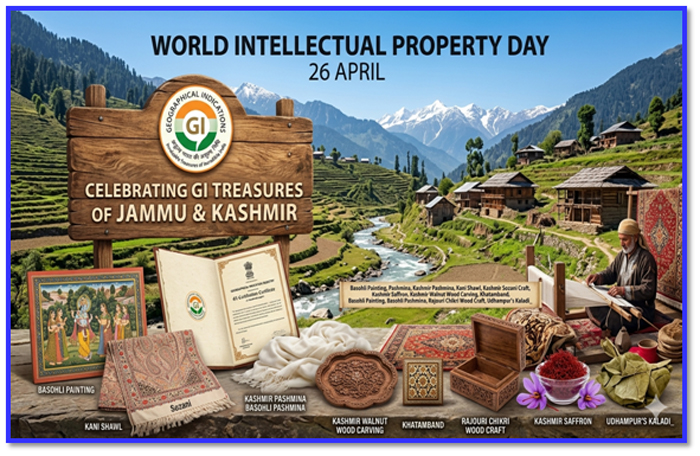
World Intellectual Property Day holds special significance for Jammu & Kashmir Union Territory, a region rich in Geographical Indication (GI)–tagged products that safeguard its traditional knowledge and crafts. GI tag is applied to tangible goods and handicrafts. Renowned items such as Kashmir Saffron, Kashmir hand woven Kani Shawl, Kashmir Pashmina (fine wool luxury textile combed from Changthangi goat), Sozani Craft (fine needlework embroidery), Kashmir’s Carpet, Namda, Gabba, Wagguv, Tweed, Crewel (Chain Stich), Papier-Machie (traditional decorative craft), Walnut Wood Carving, Khatamband (geometric wooden ceiling art), Willo Bat ,Shikara , Basohli Painting, Basohli Pashmina , Rajouri’s Chikri Wood Craft, various agriculture and dairy products like Gucchi Mashroom (wild forest Mushroom), Bhaderwah Rajmash, Ramban’s Anardana and Sulai Honey and Kashmir’s aromatic Mushqbudji Rice , Jammu’s aromatic Basmati Rice ,Udhampur’s Kaladi Cheese are protected under the IPR framework. A GI tag certifies that these products possess unique qualities and reputation linked to their geographical origin, preventing misuse while ensuring economic rights for local artisans. Thus, IPR serves as a vital tool to keep J&K’s heritage both visible and viable, ensuring that future generations recognize its origins and rightful ownership.
Intellectual Property Rights play a vital role in protecting creativity, fostering innovation, and preserving cultural heritage, especially in regions rich in traditional knowledge. By safeguarding the rights of creators and communities, IPR not only promotes economic growth but also ensures that unique identities and indigenous practices are respected and sustained for future generations. As innovation continues to shape the modern world, strengthening awareness and protection of intellectual property becomes increasingly essential. As Victor Hugo aptly said, “Nothing is more powerful than an idea whose time has come,” highlighting the need to protect ideas so they can flourish responsibly.
Happy World IP Day – Innovate, Create and Always Cite.
(The author is Assistant Professor in
University of Jammu, Jammu)
 Follow our WhatsApp channel
