

Dr D. Mukhopadhyay
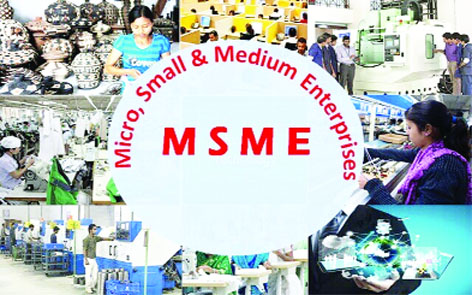
Micro, Small and Medium Enterprises (MSMEs), erstwhile Small Scale Industrial Sector (SSIS), emerged to be an important force playing a pivotal role in bringing about quick economic recovery during post globalization era in India. The MSMEs sector has proved to be an effective contrivance not only in generating employment but also encouraging semi-skilled and ambitious workers to become entrepreneurs . MSMEs has roughly been observed to have employed about 40% of Indian workforce and as an enabling industrial engine for Indian manufacturing sector which is the major constituent of Export Oriented Units(EOUs) in India . It is an empirical observation that the Indian MSMEs sector has been playing a prominent role in manufacturing variety of products and generating wide range of services. This has been observed to be an efficient instrument for bringing about industrialization in rural, semi-urban, backward and hardly industrially empowered and covered areas. Moreover, this sector plays an important role in reducing regional imbalances in terms of socio-economic development. The country has been passing through an acute economic sluggishness which is adversely eclipsing the process of socio-economic sustainability. Now, question of economic sustainability should receive the highest degree priority and attention of the policy formulators and decision makers at the regional and national levels and MSMEs sector should get to be identified as the most effective enabler of economic recovery from the recent on-going COVID-19 Pandemic . The MSMEs sector has been observed to make contribution enormously to employment generation for the semi-skilled employment seekers over a period of last five decades and for Indian economic rejuvenation and quick recovery , it needs to be strengthened further in order to achieve a quick range of sustainability besides recovery of the economy from the ongoing Pandemic crisis. The MSMEs sector has empirically been observed to be contributing to National Income otherwise known as Gross Domestic Product (GDP) to the extent of 7 to 8 % of GDP. Besides, it has been a important vehicle and enabler of export leading to earning foreign exchange. The MSMEs in conjunction with large and heavy industrial sector has been playing as a catalyst for contributing in bringing about socio-economic progress of India. It is a well-known fact India is burdened with huge population of 1.35 or more billions and it is hardly possible for any Government to provide gainful employment to each and every job seekers . It is mentionable that course curriculum of the existing University Degree Awarding System is devoid of application orientation and application oriented knowledge creation. There is hardly any keen bridge between the Universities and the Industries. Hardly any University can be found in India in general whose Board Studies Comprise Member(s) from corporate, industry or chamber of commerce and Universities are not well conversant about the requirements of contemporary skill , training and course curricula for generating confidence in the Degree Awardees besides making the higher education purposeless. Therefore, besides strengthening MSMEs , higher education delivery mechanism should invariably be based on the foundation of application oriented course curricula and education delivery system should be meeting the needs of the MSMEs .
It is mentionable that the market for medical and healthcare products manufactured by certain countries could not sustain in the international market even during the time of ongoing Pandemic environment because the quality of the products were found to be devoid of quality standard and benchmarks against the price of such products charged in the international markets. The countries emerged to be economically advanced across the globe had the Unique Selling Proposition(USP) in terms of producing the goods and services at competitive cost and providing benchmarked quality through the enabling vehicle of MSMEs. For instance, more than 70% of employment is provided by small and medium enterprises in the United States of America, Canada, Australia, Japan, France, Germany etc . While referring to domestic market , it may be justified to assert that Howrah District of the State of West Bengal was known as ‘Birmingham” of India because of phenomenal growth of MSMEs sector in this part of the country which is now a history. All the State Governments and Union Territories of the country should give a serious thought to rejuvenation of this sector in conjunction with the Central Government. India needs to have a robust industrial policy giving an important room to the MSMEs sector which should include revision of the existing industrial policies in place .
India is a large market for wide range of Chinese products because of their low prices and reasonable life span and price and life of the products are always responsive to each other in securing international markets for China. It can be mentioned that the Chinese companies’ product and service costing system is very robust leading to competitive price determination which is easily acceptable by the consumers since they are consumers wallet friendly and time honored. The present uncertain economic era is not suitable for establishing giant size industrial undertakings but the promotion of the MSMEs may be an appropriate enabler which needs moderate investment and professional management is the sine qua non for its success. In essence, cost implies loss of resources in the process of consumption and wastage means incurrence of cost and the same is measured in monetary term. Price of any product or service is the function of cost and profit. Only manufacturing profit and cost should be enveloped by price when market is competitive and theory of comparative cost is foundation of sustainability in the international markets. The MSME Development Act, 2006, is a very important legislation which has lessened bureaucratic impact on registration procedure and financing assets, and introducing ease of governance in this sector through providing unambiguous definitions of Micro, Small and Medium Enterprises in terms of investment in Plant and Machinery in case of Manufacturing Sector and investment in Equipments in case of Service Sector. It is interesting to note that efficient cost management mechanism has been introduced by Government of India by introducing mandatory maintenance of cost records and audit thereof by the Practicing ACMAs/FCMAs for the large size industries but it is not understandable why this sector is , by and large , not mandated for professional approach to cost management. but they prefer the thumb rule in the place of adopting systematic and scientific method of cost projection and cost determination for the products meant for facing challenges stiff completion under globalization scenario . Where there is manufacturing of products and generating service, professional approach to cost management is a must because cost besides quality as mentioned elsewhere of this write up is the determinant of price irrespective of the extent of markets. Product costing and pricing thereof is an algorithmic scientific process and it is so relevant for the Indian MSMEs as elsewhere and those countries as mentioned above are empirically observed to be sustaining the in international competitive markets because of producing the products at sustainable costs. Only those costs needs to identifiably be incurred which can add to value. There is an enormous scope for cost management in the areas of competition, through appropriate technology usage, infrastructure development , and modern training and development for providing skilled manpower. The economic crisis caused by the novel corona virus pandemic in 2019-2020 has thrown open policy making challenges before the policy formulators and decision makers. Investment is infrastructure development is need of the hour which should have critical consideration in order to produce goods and services at sustainable cost. For instance, good metal roads can reduce the cost of wear and tear of the vehicular tyres and other equipments and accessories . To conclude, no option other than investments in the MSMEs sector for recovery from the pandemic stricken economy is available right now. Rather the MSMEs sector is having huge potential to act as the pivotal force for bringing the national economy back on the recovery track and ensuring financial security for sustainability in the present undone socioeconomic situation prevailing the country.
The policy formulators and decision makers should be inclined more and more to having assistance of professional management decision making process in the place of bureaucratic convention, efficient cost management, quality in terms of specified international benchmarks , ease of financing at low rate of interest, less collateral security burden for the entrepreneurs and venture loving youngsters and concentrating on promotion and development of the MSMEs sector on priority basis are the sine qua non for quick recovery from the ongoing pandemic national and global crises. It needs to create effective demand which depends on the purchasing power of the consumers. Therefore, income has to flow to the consumers and demand-supply gap is to be narrowed down as much as possible to make the economy overcome this uncertain catastrophic socioeconomic devastation created by Covid-19 Pandemic. The MSMEs sector needs to be empowered with industrial wheel so that the national economy shall gain the momentum for sustainable recovery in the forthcoming days.
(The author is Professor of Management and Dean-Faculty of Management, Shri Mata Vaishno Devi University, Katra, Jammu & Kashmir (UT)
feedbackexcelsior@gmail.com
 Follow our WhatsApp channel
