

Ranjit Thakur
JAMMU, April 21: Government schools in remote parts of Jammu and Kashmir’s Poonch district continue to struggle with acute infrastructural deficiencies, raising concerns about the gap between official claims and ground realities.
In the Mendhar and Mankote areas, several middle schools are functioning without basic amenities such as toilets, drinking water and electricity, directly affecting students’ learning conditions and well-being.
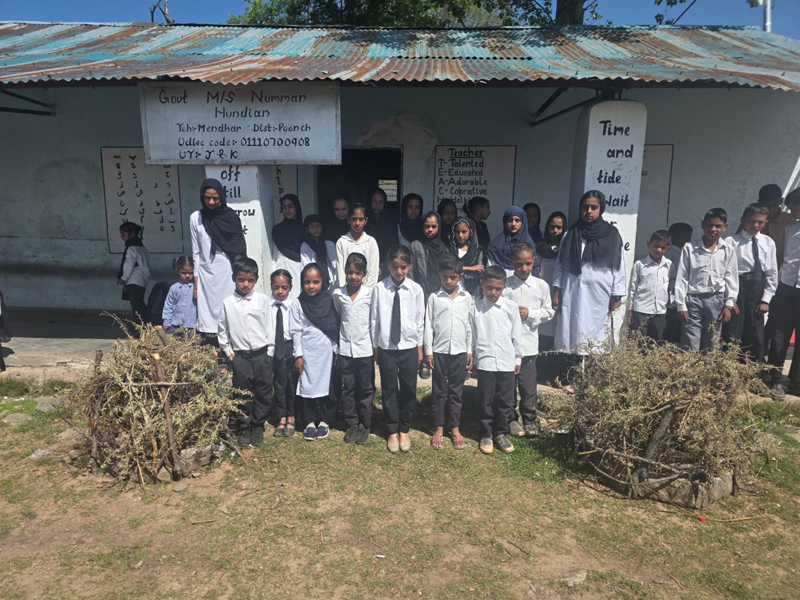
At Government Middle School, Numman Hundian in Mendhar tehsil, around 70 students are enrolled, but the school operates under severely constrained conditions. With only two rooms available and a staff of four teachers, the institution lacks essential facilities, including sanitation, potable water, and reliable power supply.
Students say the poor condition of the building makes learning difficult, especially during the rainy season. “Water enters the classrooms when it rains, making it impossible to study,” said a Class VII student. The school building, over 40 years old, has deteriorated significantly despite temporary repairs using tin sheets.
Due to space constraints, classes are often held outdoors or under trees. Students have repeatedly appealed to authorities to repair the existing structure or construct a new building. “We need proper classrooms, toilets, water and electricity,” another student said, echoing a common concern among peers.
The absence of toilets has emerged as a particularly serious issue. Female students, in particular, face discomfort and inconvenience throughout the school day, which may contribute to absenteeism and, in some cases, dropouts. Despite repeated representations, no concrete action has been taken so far.
Officials acknowledge the problem. The in-charge Zonal Education Officer (ZEO) said that a proposal for constructing a new school building has already been submitted to higher authorities. However, no clear timeline has been set for its execution.
The situation at Government Middle School, Barja in Mankote is similar. The school has an enrolment of around 62 students and is run by four teachers from just two rooms. Although three additional rooms have been constructed, only one is complete, while the remaining two are still under development.
Students at the Barja school also report a lack of drinking water and functional sanitation facilities. The absence of a boundary wall has further compounded problems, with stray animals frequently entering the premises. “There is no proper water supply even for maintaining the washrooms, which are in a poor condition,” a student said.
Education department officials concede that while some progress has been made in expanding infrastructure, critical gaps remain. “There are still issues, particularly with water supply and maintenance of facilities,” an official said, adding that such challenges are widespread in remote areas.
According to departmental estimates, nearly 60% of schools in the region are in poor condition, particularly those constructed under earlier schemes such as the Sarva Shiksha Abhiyan (SSA). Many of these buildings now require urgent repairs or complete reconstruction.
Local residents have urged the administration to prioritise these concerns, stressing that the lack of basic infrastructure undermines the quality of education. “Without immediate intervention, children in these areas will continue to suffer,” a community member said.
The situation highlights a broader challenge in ensuring equitable access to education in geographically remote and economically disadvantaged regions. While policy frameworks emphasise inclusivity and improved infrastructure, effective implementation and sustained monitoring remain key to bridging the gap between intent and reality.
 Follow our WhatsApp channel
