

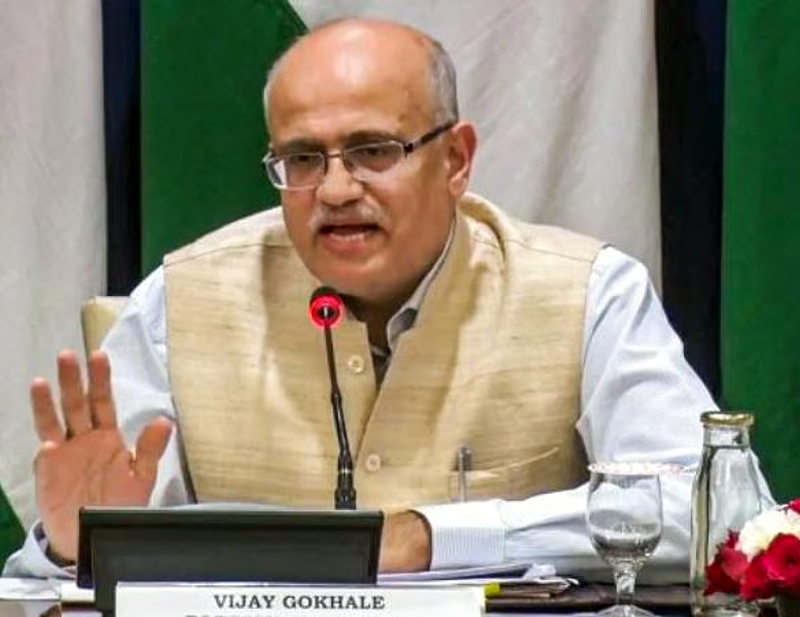
SINGAPORE, Jun 1 : Philippines Defence Secretary Gilberto Teodoro Jr reaffirmed Manila’s commitment to defending its maritime rights in the South China Sea, citing former Indian Foreign Secretary Vijay Gokhale and accusing China of employing a “talk and take strategy” to alter facts on the ground while projecting a commitment to negotiations.
Addressing delegates at the Shangri-La Dialogue in Singapore on Sunday, Teodoro said the Philippines would continue to uphold international law, strengthen deterrence, and deepen defence partnerships with like-minded countries to protect its sovereignty and maritime entitlements.
Referring to China’s position on the South China Sea dispute, Teodoro cited Gokhale’s recently published book China Wars.
“Instead of honoring their obligations under UNCLOS, the PRC exhorts the Philippines to ‘return to the path of negotiations’. This reflects what retired Indian Foreign Secretary Vijay Gokhale describes in his published book, China Wars, as a ‘talk and take strategy’,” Teodoro said.
Quoting from the book, he added: “The diplomacy gives the impression of restraint and a commitment to peaceful negotiation, even as the ground realities are fundamentally altered.”
Teodoro said the Philippines had witnessed a similar pattern of behaviour in the South China Sea and stressed that Manila would not be deceived by negotiations that, in its view, are used to gain strategic advantage rather than resolve disputes.
“For China, therefore, in the Philippine experience, negotiations are not a path to conflict resolution but a means of gaining advantage, and we will not be deceived,” he said.
The Philippine defence chief reiterated that the 2016 arbitral ruling under the United Nations Convention on the Law of the Sea (UNCLOS) remains legally binding and that China’s refusal to participate in the proceedings does not exempt it from compliance.
“The refusal to participate in Annex VII proceedings under UNCLOS by a party that ratified UNCLOS does not absolve that party of responsibility to comply with the judgment of the Arbitral Tribunal,” he said.
Teodoro emphasized that Manila would continue to exercise its sovereign rights and maritime entitlements “in full accord with the norms and expectations of the international community” and would do so “openly and transparently, with nothing to hide.”
Highlighting the Philippines’ growing defence cooperation network, he said Manila had conducted maritime cooperative activities with partners including India, the United States, Japan, Australia, New Zealand, Canada and France.
“We have conducted maritime cooperative activities with partners such as the United States, Japan, Australia, New Zealand, Canada, France, and India. We are open to the participation of other countries that share our commitment to a free and open Indo-Pacific,” he said.
Teodoro also underscored the importance of ASEAN centrality, saying the Philippines would work to ensure that Southeast Asia remains “peaceful, stable, and free from undue influence of any single hegemon.”
Calling for greater convergence among like-minded nations, he said diplomacy alone could not keep pace with rapid changes in the global order and stressed the need for stronger defence and security cooperation.
“Ultimately, in a changing world, convergence is not merely an option. It is an imperative, and the Philippines is actively embracing and acting on this imperative,” Teodoro said.
(UNI)
 Follow our WhatsApp channel
