

Mohit Mahajan (mohitmahajan123@gmail.com)
Roads are the life line of any country as these contribute significantly in its economic growth and overall development by providing connectivity, vital for efficient management of logistics besides, transportation of Goods and Passengers.
Similarly, road sector in India spanning approximately 66.20 lakh kilometres as of 2025-26 plays pivotal role in country’s rapid economic growth and its journey towards becoming a $5-Trillion economy in near future. Therefore, substantial additions to the road network are made each year to cater to the steadily rising traffic volumes.
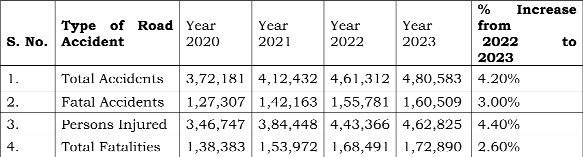
While road infrastructure fuels economic growth, it has also led to a troubling rise in road accidents in each successive year resulting in Injuries and Deaths as per the “Road Accidents in India – 2023” report published by the Ministry of Road Transport and Highways (MoRTH). The data as per this report reveals total 4,80,583 road accidents were witnessed in India in year 2023 which is a rise of 4.17% compared to year 2022, resulting in 1,72,890 fatalities.
Further, year-wise details since year 2020 are illustrated in the following table:
 Further, statistics related to data on the “Types of Collisions” reveal that “Hit From Back” collisions account for the highest share of 23% of the total 4,80,583 road accidents recorded in 2023 (it remained highest in preceding years, as well) followed by 18% accidents due to “Head on Collision”, 15% due to “Hit from Side” & so on.
In J&K, there were total 6,298 accidents recorded in the year 2023 resulting in 8,469 Injuries and 893 Deaths against 6,092 accidents, 8,372 Injuries and 805 Deaths in year 2022. Share of “Hit from Back” collisions in year 2023 is 245 accidents, 610 injuries and 23 Deaths.
The ever rising percentage of “Hit From Back” collisions is disturbing and needs special mention as these involve victims who mostly are innocent pedestrians walking on the left side of road with their back facing the oncoming traffic, oblivious to the rash and speeding vehicles approaching from behind and get hit by the erring vehicles as they cannot see the potential threat to their life and safety and hence are unable to take evasive action to save themselves from the impact, resulting in injuries ranging from severe to fatal. Whereas, in other forms of collisions (Head on Collision, Hit from Side collision etc. etc.), both the approaching parties may have some reaction time to avoid collision.
The principal reason for rise in “Hit From Back” accidents on urban roads is that the Pathways (Shoulders) and Footpaths, a dedicated infrastructure for exclusive use by the Pedestrians, are mostly inaccessible and unusable as these are either:
* Unpaved (kaccha),
* Encroached by street vendors, hawkers or kiosks,
Occupied by parked vehicles or
Blocked by dumped waste, garbage or debris etc.
Covered with wild Vegetation, Plantation etc.
For these reasons, the Pedestrians are compelled to walk on the Carriageway (Road) which in the City roads is mostly 5.50 metres wide while some roads are even narrow, allowing both-way traffic, which enhances the chances and risk of accidents.
Further, with “Left-side Drive” rule for vehicles and the Pedestrians by “default” also walk on the left side of road in the same direction as the traffic, makes them highly vulnerable to getting hit from behind as they cannot see the vehicles approaching from the back. Sometimes, the pedestrians occupied with their mobile phones, “inattentively” stray onto the road directly on the path of traffic, which is fraught with the risk of mis-happenings.
This behavioural factor of Pedestrians contributes significantly to the “Hit From Back” collisions which frequently result in “Hit-and-Run” cases as most of the times, after the accident, the offending vehicle flees from the scene leaving the victim injured or dead, with no clue left behind to trace the culprit, as we commonly say “Pata Nahi Chala, Ek Gadi Peeche Se Takkar Markar Baag Gayee”
Tragedies resulting from such “Hit From Back” accidents have struck many families where the innocent victims have either sustained grievous injuries or permanent disabilities or fatalities, in some cases.
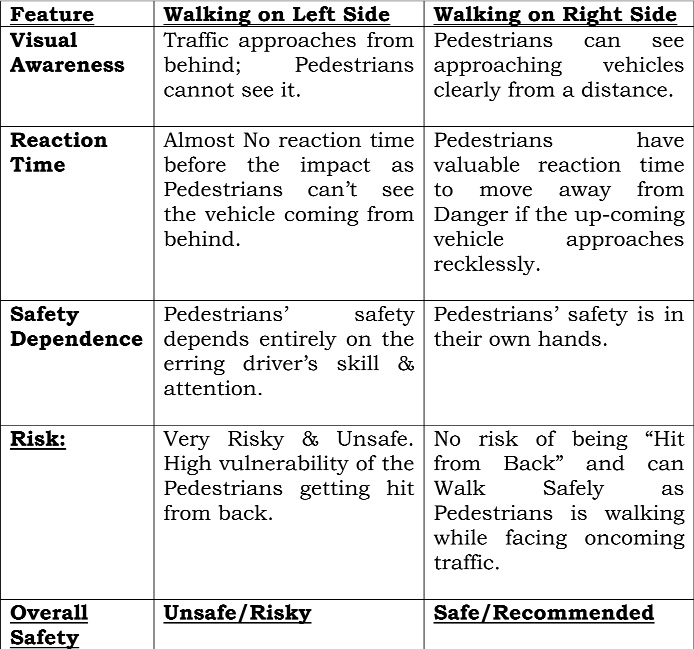
Therefore, it is always safe to walk on the right side of road facing oncoming traffic.
Comparison of Left-Side vs Right-Side Walking
 Turning Safety into a National Habit
A simple rule: “No Footpath or Shoulder? …. Walk on the Right side of Road” needs to be promoted in all seriousness with the focus to bring down the rising rate of accidents caused by “Hit from Back” collisions. Onus for this rests with J&K State Road Safety Council to take due cognizance and initiatives to spread the message of “Cautious Driving and Safe Walking” in the interest of Pedestrian’s safety, after bringing all the stakeholders on board.
This issue also needs to be brought within the frame work of the next edition of Jammu and Kashmir Road Safety Policy wherein, comprehensive guidelines are formulated to sensitize the citizens to imbibe safe walking habits and create awareness amongst drivers to drive cautiously while highlighting the consequences of road accidents for the drivers of the offending vehicles, Victims and their families, by extensive campaigning through following mediums:
1. Mass Media:
a. Advertisements in Public Interest in National and Regional newspapers explaining the logic and benefits of walking on the right side of the road through Short & Catchy Slogans in English, Hindi & Local Language, for instance:
1. Walk on Right side – Stay Safe.
2. Walk on Right side – Face Traffic, Remain Safe.
Likewise, many slogans can be coined.
b. Television broadcasts on Local and National channels demonstrating real life narrations from the survivors where walking on the right side prevented accidents and saved their lives.
c. Announcements and Jingles in short intervals on AM and FM Radio promoting Pedestrians’ safety by “Walking on Right side” and “Cautious Driving”.
d. Short videos on social media platforms: X (Twitter), Instagram, Facebook, LinkedIn and YouTube highlighting Safe Vs Unsafe Pedestrian practices and promoting “Walk on the Right side” and “Drive Cautiously” concept.
2. Ground-Level Awareness through:
* Signages and Messages on road side promoting Pedestrians’ Safety.
* Pamphlets with Pictures & catchy Slogans distributed in Schools, Bus stations, Railway stations, Traffic Junctions, Toll Plazas and other places of public gathering, promoting concept of Pedestrian’s Safety by “Walking on the Right side” of road.
* Public announcements at major traffic junctions urging Pedestrians to “Walk on Right side and Remain Safe” and for Drivers to “Drive Cautiously and Save Pedestrians”.
*Community and Institutional Participation:
* Non-governmental organisations (NGOs) can be roped-in to educate communities through street plays (Nukkad Nataks) to spread “Always walk on right side” message. These NGOs can act as bridge to facilitate grassroot awareness.
* School Programs
Introducing the concept of “Right-side Walking and Remain Safe” in the curriculum, during school assemblies and through awareness programmes to inculcate this habit from an early age.
* Inter-Departmental Coordination
The success of such a campaign will require coordinated efforts and convergent approach amongst all stake holders and decision makers including various government agencies to ensure citizen’s safety, viz:
*Ministry of Road Transport and Highways including its subsidiary National Highways Authority of India (NHAI) etc.
– Transport Department
* Public Works Department
* Municipal Corporations/Councils
* Education Department
* Social Welfare Department
* Information & Technology Department
* Traffic Police
Apart from above, another important initiative required to bring down the rate of “Hit From Back” collisions is to make the Pedestrian Pathways/Footpaths free from encroachments and obstructions so that these remain uninterrupted and obstruction free walking zones and the road carriageway remains free from the Pedestrians’ use. This finds mention in The Jammu & Kashmir State Road Safety Policy 2025, as well.
“Special Publication 44 of Highway Safety” of Indian Road Congress under Chapter 3 pertaining to “Safety of Pedestrians” specifically mentions that “if there is no Footpath or designated Shoulder along the road, the Pedestrians must walk close to the right side of the road such that they are facing the oncoming traffic and can see it”.
Conclusion
Transforming “Right-Side Walking” into a universal habit through sustained public awareness campaigns and coordinated institutional actions can save countless lives and significantly reduce accidents involving Pedestrians.
Spread the Message: Always Walk on the Right Side – Remain Safe.
Nothing is more rewarding than saving precious lives.
The author is Chief Engineer (Retd)
 Follow our WhatsApp channel
