

Friday, May 15, 2026
E-Paper
Home Blog Page 99

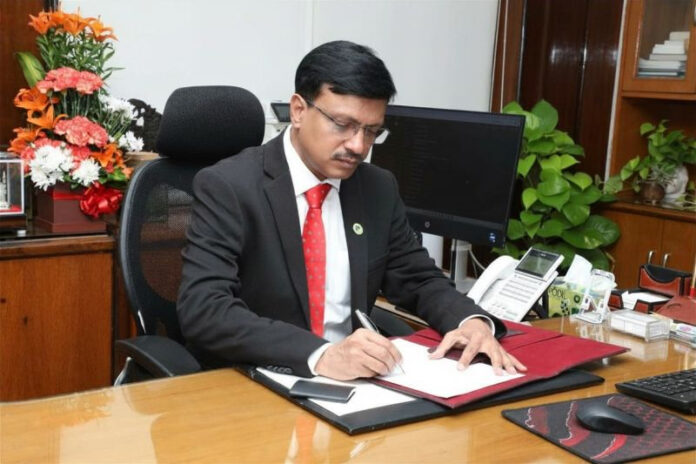
Dr A K Panda takes charge as new Chairman & Managing Director of SAIL
Dr A K Panda takes charge as new Chairman & Managing Director of SAIL

NEW DELHI, May 10: Dr Ashok Kumar Panda has assumed charge as Chairman & Managing Director of Steel Authority of India Limited (SAIL) on May 9, the SAIL statement said here.
He served as Director (Finance) of the company and also had the additional charge of Director (Commercial) for about nine months during this period.
Academically, Panda has done BE in Electrical Engineering in 1992 and began his career as a Management Trainee (Technical) in SAIL.
During his tenure as Director (Finance) he spearheaded several strategic initiatives aimed at improving operational efficiency and overall profitability of the organisation.
Upon assuming charge as CMD, SAIL, he said, “SAIL is on track for its next phase of capacity expansion to 35 MTPA. Alongside expansion, we will continue to place the highest priority on safety across all our workplaces.”
“Strengthening raw material security through enhanced domestic mining and exploration of overseas assets will be critical to support our growth ambitions.”
“At the same time, we are committed to expanding our market reach with a sharper focus on value-added products, strengthening our brand connect, and ensuring sustained value creation for all stakeholders,” he added. (UNI)

Crude oil prices likely to stay  higher for longer: ADB Chief Economist
Crude oil prices likely to stay  higher for longer: ADB Chief Economist
NEW DELHI, May 10:  Crude oil prices are likely to stay higher for longer due to the disruption caused by the longer-than-expected Middle East crisis, ADB Chief Economist Albert Park has said.
“With a higher oil price expectation, we actually have it as USD 96 per barrel as average for 2026 as per the new reference scenario. It should stay elevated at USD 80 per barrel in 2027. So, our idea is that the oil prices are likely to stay higher for longer,” Park told PTI in an interview.
Future prices are showing higher prices farther out into next year than they did before, he said.
However, he said, “We have also seen always a kind of a premium of the spot market prices and the nearby futures market because there is such a shortage currently.”
Speaking about the impact of the ongoing Middle East crisis on India, Park said it is going to shave off 0.6 per cent from the country’s GDP growth, bringing it to 6.3 per cent, and also stoke inflation significantly in the current financial year.
The Asian Development Bank (ADB) in April projected India’s GDP growth to remain “robust” at 6.9 per cent in the current fiscal, and rise to 7.3 per cent in the next fiscal, driven by strong domestic demand.
With regard to inflation, ADB had projected 4.5 per cent for the current fiscal.
For India, Park said, “We do find that growth would be lower by 0.6 per cent (FY27). This is based on our model scenario. But it would not negatively affect growth next year. India would kind of bounce back next.” Inflation would increase by 2.4 per cent this year to 6.9 per cent, he said.
“So that’s a bit higher than the inflation impacts for the region (Asia-Pacific), because India is more reliant on imported oil and gas. The growth effect, if you take out China, this negative 0.6 per cent on growth this year is pretty similar to the region as a whole region as well,” he said.
ADB, on April 29, in its special update, lowered the Asia Pacific growth projection for 2026 to 4.7 per cent from 5.1 per cent earlier, weighed down by prolonged West Asia disruptions.
Asked about El Nino’s impact on food production, Park said, “Of course, it’s very uncertain. Obviously, whenever there’s a bad harvest in India, we have an issue. With higher prices. India accounts for a huge part of the global trade in rice. So then whatever happens in India also often has a big impact on other countries.”
That is a reason for concern apart from the rising fertiliser prices, he added.
With the cost of fertiliser going up, farmers will use less fertiliser, which will also reduce yields and also reduce availability later in the year, he said.
It will definitely have a bearing on food prices, but how much would depend on the gas disruption, he added. (PTI)

ELV rules make auto sector non-compliant;  FY26 scrap target missed by 70 pc

ELV rules make auto sector non-compliant;  FY26 scrap target missed by 70 pc
NEW DELHI, May 10:  Auto companies in India fell short by 70 per cent in meeting the steel equivalent vehicle scrapping commitments in FY26 set under the environment ministry’s end-of-life vehicle rules, even as industry executives blamed ‘unrealistic policy’ for making the entire sector non-compliant.
The Ministry of Environment, Forest and Climate Change, notified the Environment Protection (End-of-Life Vehicle) Rules, 2025, in January last year, and it came into effect on April 1, 2025.
It required automakers to meet extended producer responsibility (EPR) obligations on the basis of the weight of steel recovered from the scrappage of end-of-life vehicles (ELVs) or other steel scrap materials processed at registered scrapping facilities.
However, a draft amendment to the notification on March 27, 2026, issued by the ministry removed the provision of ‘other steel scrap materials’ for the issuance of the EPR certificate, mandating only steel generated from scrapped vehicles to be counted for the certification.
The rule requires manufacturers to scrap ELVs sold in the domestic market 20 and 15 years back for private and commercial vehicles, respectively to get the EPR certificate.
According to the rule, in FY26, manufacturers had to scrap a minimum of 8 per cent of the steel equivalent of vehicles sold in FY2005-06 (for private) and FY2010-11 (for commercial). It translates to a total of 95.2 lakh vehicles eligible for fitness test in 2025-26, and out of which 7.62 lakh were required to be scrapped in order to meet the 8 per cent target.
“The actual old vehicles received for scrapping at scrappage centres were just 2.42 lakh in FY26, and there was a shortfall of 5.2 lakh vehicles,” an industry executive said on the condition of anonymity, citing official data.
“So, for the entire auto industry, there was a shortfall of 70 per cent,” the executive said.
What has made the condition worse for the auto industry in meeting the EPR obligation was the prohibition of counting ‘other steel scrap materials’ in the March 2026 amendment to the rule, said another industry official.
“Most OEMs had planned to meet targets with both vehicle scrapping and steel scrap from other sources. However, after the removal of that clause, meeting these targets has become nearly impossible,” lamented the executive.
Stating that the “policy is unrealistic”, another industry executive said, “This has resulted in the auto industry falling way short of the target set for scrappage. As such, there were not many ELVs coming to scrapping centres”.
Auto industry body Society of Indian Automobile Manufacturers (SIAM) had also written to the ministry, raising concerns over the limited availability of ELVs for meeting EPR targets.
Besides, SIAM had also highlighted to the ministry that automated testing stations were generating negligible ELV volumes, while urging it to allow the usage of other automotive steel scrap for EPR compliance in the initial years with a phased transition framework until the ELV ecosystem matures.
Another industry executive said the shortfall in EPR targets can only be achieved after using “other steel scrap materials” besides old vehicles, as after every five-year cycle, the shortfall will increase.
The 8 per cent target continues for five years till 2029-30, and then it increases to 13 per cent for the period 2030-31 to 2034-35 and 18 per cent for 2035-36 onwards, the executive said, while advocating for a relook at the policy. (PTI)

Global jitters keep FPIs on edge,  Rs 14,231 crore pulled out in May
Global jitters keep FPIs on edge,  Rs 14,231 crore pulled out in May
NEW DELHI, May 10:  Foreign investors continued to pare their exposure  to Indian equities, withdrawing Rs 14,231 crore so far this month driven by  persistent global macroeconomic uncertainties.
With this, the total outflow of Foreign Portfolio Investors (FPIs) from the equity market has crossed Rs 2 lakh crore in 2026, which is higher than the Rs 1.66 lakh crore pulled out during the entire 2025, according to data with the NSDL.
FPIs were net sellers in all months of 2026, except February. They withdrew Rs 35,962 crore in January before turning net buyers in February, when they invested Rs 22,615 crore, the highest monthly inflow in 17 months.
However, the trend reversed in March, when foreign investors pulled out a record Rs 1.17 lakh crore. The selling continued in April with net outflow of Rs 60,847 crore and extended into May with withdrawal of Rs 14,231 crore so far.
“The selling was largely driven by persistent global macroeconomic uncertainties, particularly concerns around inflation, interest rates and geopolitical risks, which continued to weigh on sentiment toward emerging markets,” Himanshu Srivastava, Principal – Manager Research at Morningstar Investment Research India, said.
He said uncertainty over the global interest rate trajectory remained a key factor influencing flows. Elevated crude oil prices and lingering geopolitical tensions, especially in West Asia, have kept inflation concerns alive globally, prompting investors to reassess expectations of near-term rate cuts by major central banks.
As a result, global bond yields remained relatively firm, enhancing the attractiveness of developed-market fixed income assets and reducing risk appetite for emerging market equities, he added.
Srivastava also noted that the Indian rupee remained under intermittent pressure, impacting dollar-adjusted returns for foreign investors.
V K Vijayakumar, Chief Investment Strategist at Geojit Investments, said that despite the overall selling, FPIs have been selectively investing in sectors such as power, construction and capital goods.
Another major trend is their increasing preference for mid-cap and select small-cap stocks with strong growth potential and healthy earnings performance, he said.
According to Vijayakumar, currency depreciation and concerns over earnings growth in India have been key factors driving FPI outflows this year.
He added that stronger earnings growth expected in markets such as South Korea and Taiwan, supported by the artificial intelligence boom, is attracting FPI flows to these markets. (PTI)

Govt working on FTA utilisation plan  to maximise benefits for businesses
Govt working on FTA utilisation plan  to maximise benefits for businesses
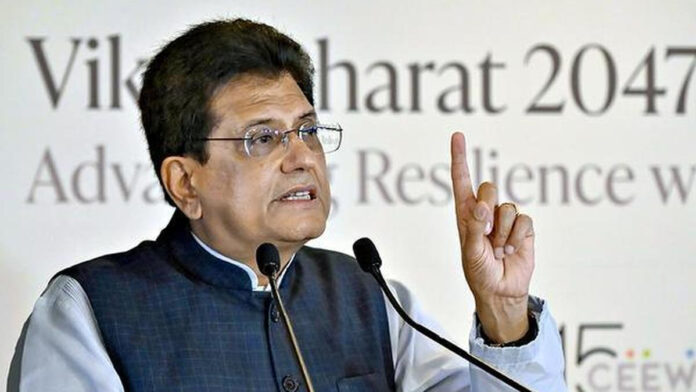
NEW DELHI, May 10:  With India signing a series of free trade agreements with developed countries, the government is working on an FTA utilisation plan to help maximise benefits from these pacts, an official said.
Since 2021, India has finalised free trade agreements (FTAs) with Mauritius, Australia, the UAE, Oman, New Zealand, the EFTA (European Free Trade Association), the European Union (EU), the UK and US.
These pacts cover 38 countries whose combined global imports stand at about USD 12 trillion.
The main Indian sectors that have received duty-free market access in these FTA partner countries include agriculture, textiles and apparel, gems and jewellery, leather and leather goods, engineering, electronics, chemicals, and pharmaceuticals.
Commerce and Industry Minister Piyush Goyal has held a series of meetings with industry associations, businesses and export promotion councils (EPCs) on ways to increase utilisation of these agreements. He suggested that businesses leverage these pacts to boost exports and domestic manufacturing.
The official added that the minister on May 4 held a review meeting with key officers and chief negotiators  to asses the progress of India’s free trade acts.
Another meeting on May 7, was held on preparing a roadmap for obtaining sanitary and phytosanitary (related to plants and animals) approvals for Indian agricultural and fisheries products across global markets.
The commerce ministry has involved Indian missions abroad in the exercise. Besides, all the line ministries are part of the process, the official said.
The role of Indian missions includes ensuring FTA awareness in importing country, market intelligence on new opportunities, and expediting resolution of non-tariff barriers.
Similarly, the line ministries’ role includes ensuring sufficient production, alignment with global standards, and focus on trade facilitation.
The whole exercise is important as the country is looking at increasing goods and services exports to USD 2 trillion in the coming years (one trillion each).
The country’s goods and services exports rose 4.6 per cent to an all-time high of USD 863.11 billion during 2025-26, from USD 825.26 billion in 2024-25, despite global economic uncertainties.
Merchandise exports grew 0.93 per cent to USD 441.78 billion in the last fiscal year from USD 437.70 billion in 2024-25. Services exports too surged to an all-time high of USD 421.32 billion in 2025-26, compared to USD 387.55 billion a year ago, recording a growth of 8.71 per cent.
Shishir Priyadarshi, President, CRF, and former Director, WTO, said Indian  businesses must stop viewing FTAs merely as tariff-cutting arrangements as their real value lies in helping firms integrate into global value chains, diversify supply chains, and position themselves as trusted partners in an increasingly fragmented global economy.
“The FTAs should be seen as an opportunity not just to export more, but to export smarter – through branded products, advanced manufacturing, processed goods, and higher-value services that strengthen India’s long-term industrial competitiveness globally,” he said. (PTI)

Mcap of four of top-10 most valued firms erodes  by Rs 1 lakh cr; State Bank biggest laggard
Mcap of four of top-10 most valued firms erodes  by Rs 1 lakh cr; State Bank biggest laggard
NEW DELHI, May 10:  The combined market valuation of four of the top-10 most valued firms eroded by Rs 1 lakh crore last week, with State Bank of India taking the biggest hit, amid a range-bound trend in equities.
Last week, the BSE benchmark Sensex climbed 414.69 points or 0.53 per cent, and the NSE Nifty went up by 178.6 points or 0.74 per cent.
“Indian equity markets witnessed a volatile and range-bound week, with sentiment remaining cautious despite intermittent recovery attempts. Early optimism driven by hopes of de-escalation in the Middle East and easing oil prices faded quickly as renewed tensions between the US and Iran resurfaced,” Ponmudi R, CEO – Enrich Money, an online trading and wealth tech firm, said.
While Bharti Airtel, State Bank of India, Tata Consultancy Services (TCS) and Larsen & Toubro faced erosion from their valuation, Reliance Industries, HDFC Bank, ICICI Bank, Bajaj Finance, Hindustan Unilever and Life Insurance Corporation of India (LIC) were the gainers from the pack. Together they added Rs 46,685.21 crore in market valuation.
The valuation of SBI dropped by Rs 44,722.34 crore to Rs 9,41,107.62 crore.
Bharti Airtel’s valuation declined by Rs 31,167.1 crore to Rs 11,18,055.03 crore.
The market capitalisation (mcap) of TCS diminished by Rs 28,456.26 crore to Rs 8,66,477.69 crore and that of Larsen & Toubro edged lower by Rs 5,371.84 crore to Rs 5,46,621.21 crore.
However, the market valuation of HDFC Bank jumped Rs 15,425.09 crore to Rs 12,02,699.26 crore.
The mcap of Bajaj Finance surged by Rs 11,486.89 crore to Rs 5,94,610.02 crore.
Hindustan Unilever added Rs 8,763.97 crore taking its valuation to Rs 5,37,562.98 crore.
The mcap of Reliance Industries climbed Rs 6,563.28 crore to Rs 19,42,866.58 crore and that of LIC went up by Rs 2,751.37 crore to Rs 5,07,549.44 crore.
The market valuation of ICICI Bank edged higher by Rs 1,694.61 crore to Rs 9,06,675.39 crore.
Reliance Industries remained the most valued firm, followed by HDFC Bank, Bharti Airtel, State Bank of India, ICICI Bank, TCS, Bajaj Finance, Larsen & Toubro, Hindustan Unilever and LIC. (PTI)

Titan Company unfazed about gold supply in short  term as exchange programmes aid sourcing

Titan Company unfazed about gold supply in short  term as exchange programmes aid sourcing
NEW DELHI, May 10:  Leading branded jeweller maker Titan Company is unconcerned about short-term gold supply issues due to West Asia conflict as its gold exchange programme and contingency sourcing plans are helping mitigate risks.
Titan, whose FY26 topline crossed Rs 75,000 crore, said the company’s gold exchange programme has been running successfully since the third quarter and it has further strengthened sourcing flexibility for its jewellery businesses.
“…our gold exchange programme is very, very successfully being run from the last quarter three onwards. We always used to run this but now we have another level,” CFO Ashok Sonthalia said while responding to a query around gold supply.
He said the company has measures in place to respond to any supply-related challenges if required.”On a short notice we can, if required, further ratchet it. Some of the other Plan Bs are also ready,” he said.
“We are at least not concerned in the short term as far as gold supply is concerned for Titan, Tanishq and CaratLane,” said Sonthalia.
The industry sources a considerable part of gold from the Middle East, and there were reports of a delay in the renewal of import licences by the government.
There was some slowness on the customs front which is picking up and “we are pretty much quite covered for quarter 1,” he said.
Besides, Titan doesn’t see any increase in cost in gold loan at least in the short term as tenure has been increased from 180 to 270 days, Sonthalia added.
Replying to another query, Titan CEO – Jewellery Division, Arun Narayan said now it is running the exchange campaign as a standalone campaign, particularly for Tanishq.
“You may have seen that a lot of our Tanishq campaigns, which are new collection campaigns, also have an exchange section in the same campaign.  In a sense, it’s getting reinforced with every campaign that we run,” he said.
The company expects the exchange programme to continue supporting buyer growth, especially among wedding customers and consumers looking to refresh jewellery collections.
“The sentiment of the campaign has resonated very well with people because it has a certain public service message and nationalistic angle to it. All in all, we think it is a good thing to run, and it will give us rewards even going forward,” he added.
Tanishq offers a comprehensive gold exchange programme designed to help customers swap old, worn-out, or unused gold for new jewellery designs
According to Narayan, Titan reported an 8 per cent buyer growth in the fourth quarter, compared with a flattish trend in the previous period, as customers who had deferred purchases amid rising gold prices returned to stores.
“Gold rates have gone up from festive onwards. Diwali onwards, it’s been climbing. There are many customers who were waiting on the sidelines who came in to buy in quarter four,” he said.
He added that wedding purchases were also advanced as consumers anticipated further increases in gold prices.
“Those who have weddings in their families in quarter one also ended up coming in the months of February and March too. It’s a mix of both, which has helped,” Narayan said.
Besides plain gold jewellery, Titan witnessed improved buyer growth in studded jewellery, aided by a successful diamond campaign.
Over the high gold prices, Narayan said consumers have gradually started accepting elevated gold prices, while a recent cooling-off in rates has encouraged buyers to return to stores.
“I think people have started accepting gold at this level and this small cool off that we have seen in the last month or two has also kind of helped bring people back,” he said.
According to him, consumers expect gold prices to continue their upward trajectory over the medium to long term, which has supported purchase sentiment.
“There seems to be an acceptance that in the medium to long term it’s again going to go back to its trajectory of upward movement. That seems to be the sentiment with consumers,” Narayan added.
Titan on Friday reported 35.36 per cent increase in its consolidated net profit to Rs 1,179 crore for the March quarter of FY26. Its sales surged 48.28 per cent to Rs 20,607 crore. (PTI)

New generation, new voice, new imagination: Rahul on Vijay’s swearing-in as TN CM
New generation, new voice, new imagination: Rahul on Vijay's swearing-in as TN CM

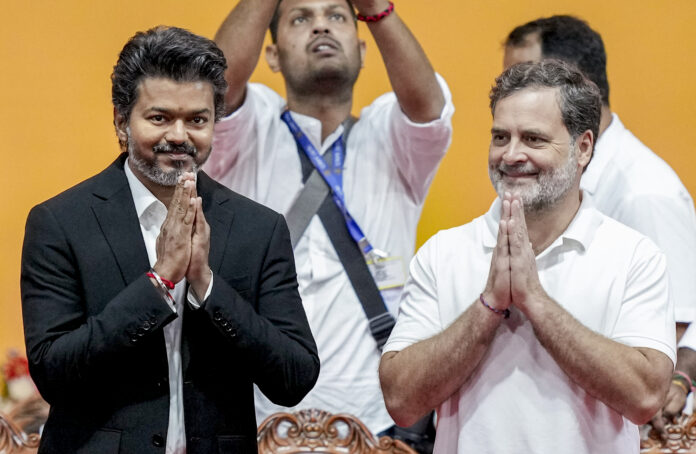
NEW DELHI, May 10: The Congress on Sunday hailed C Joseph Vijay on being sworn-in as the Tamil Nadu chief minister with Rahul Gandhi saying that the state has chosen a new generation, a new voice and a new imagination.
Gandhi, who attended Vijay’s swearing-in ceremony in Chennai, posted pictures from the event on X.
Vijay was sworn-in as the Tamil Nadu chief minister in a colourful ceremony, ushering in the first non-DMK, non-AIADMK government in the southern state in 60 years.
“Tamil Nadu has chosen. A new generation. A new voice. A new imagination.
My good wishes to Thiru Vijay – may he fulfil the hopes of the people of Tamil Nadu,” the Leader of Opposition said on X.
Congress president Mallikarjun Kharge also congratulated Vijay on being sworn-in as the Tamil Nadu chief minister and said he is confident that under the TVK chief’s leadership, the ideals that have long defined the state’s political and social consciousness will continue to guide governance.
“On the swearing-in of Thiru TVK Vijay as the Chief Minister of Tamil Nadu, I extend my heartfelt congratulations and best wishes to him, Tamilaga Vettri Kazhagam party and the entire progressive alliance,” Kharge said on X.
The formation of this government reaffirms the enduring strength of selfrespect, social justice, empowerment and rational thought, are values that have long defined Tamil Nadu’s political and social consciousness, he said, adding this is the legacy shaped by Periyar and Kamrajar.
“Millions of people across Tamil Nadu, especially the aspirational youth, have placed their trust in the TVK. I am confident that under his leadership, these ideals will continue to guide governance and inspire the nation,” Kharge said. “Wishing the new government great success in serving the people with compassion, inclusivity, and commitment,” the Congress chief said.
Vijay’s cabinet was a mix of young and experienced, with the TVK chief’s core team finding place in the maiden ministry of the 51 year-old actor-turnedpolitician. In his first address, Vijay said he was not from any royal lineage and that people welcomed and accepted him.
He also said that he will not deceive people with false promises. Vijay’s parents S A Chandrasekhar and Shobha, top actor Trisha and a whole lot of dignitaries attended the ceremony at the sprawling Jawaharlal Nehru Indoor Stadium in Chennai.
The TVK founder-chief was appointed as chief minister on Saturday by the governor after his party clinched key support to cross the magic 118 majority mark in the Tamil Nadu Assembly, ending days of uncertainty over government formation in the southern state.
Capping days of hectic parleying to shore up numbers to usher in the first nonDMK, non-AIADMK government in nearly 70 years, Vijay finally managed to secure the support of four MLAs of Viduthalai Chiruthaigal Katchi (VCK) and the Indian Union Muslim League (IUML) on Saturday. The Congress had pledged support of its five MLAs to TVK soon after the polls. (Agencies)

PM Hails Art Of Living’s Service Ethos, Calls For Collective Action For Developed India
PM Hails Art Of Living’s Service Ethos, Calls For Collective Action For Developed India

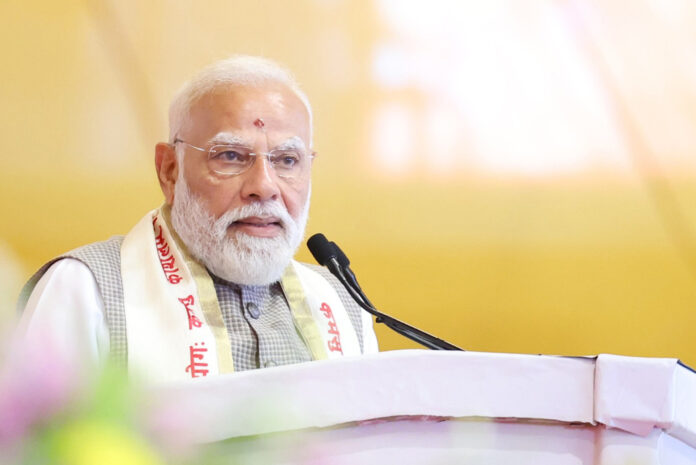
BENGALURU, May 10: Prime Minister Narendra Modi on Sunday lauded the role of the Art of Living Foundation in promoting service, spirituality and social transformation, and called for collective efforts to build a developed India through environmental responsibility, youth empowerment and inner well-being.
Addressing the gathering at the Art of Living International Centre here to mark 45 years of the foundation and participate in celebrations linked to founder Sri Sri Ravi Shankar, Modi described Bengaluru as a city that had not only emerged as a global technology hub but had also elevated India’s spiritual and cultural consciousness.
The Prime Minister also inaugurated a new meditation hall at the sprawling campus and congratulated the organisation for creating what he described as a centre of peace and healing for generations to come.
Referring to India’s civilisational values, he said the essence binding the country’s immense diversity was selfless service.
He said India’s spiritual movements had historically expressed themselves through service to humanity and praised Art of Living for embodying that principle through welfare-oriented programmes, including tribal empowerment initiatives and efforts to improve the mental health of prisoners.
“Spiritual movement in India lay emphasis on serving mankind,” Modi said. The PM emphasised that societal participation was more powerful than political systems and was essential for nation-building.
“No government can succeed unless society itself actively participates in nation-building,” he said, citing the success of the Swachh Bharat mission as an example of a campaign sustained by public ownership.
Highlighting India’s transformation in the digital era, Modi said the country had become a global leader in digital payments, developed one of the world’s fastest-growing startup ecosystems and was making unprecedented advances in infrastructure and space technology, driven largely by its youth.
“India is not only partnering in scientific innovation, but also leading in many areas,” Modi said.
He credited institutions such as Art of Living with helping young people navigate the challenges of modern life.
“Technology allows people sitting far apart to connect instantly. But whether or not we connect with the world, it is essential that we connect with ourselves,” he said.
He said a developed India would be built by youth who were mentally peaceful, socially responsible and sensitive towards society, underlining the importance of spiritual well-being, yoga, meditation and mental health initiatives.
The Prime Minister also urged the organisation’s volunteers to intensify their engagement in natural farming and environmental conservation.
“Today, even in illness, people are seeking natural healing. Our Mother Earth too needs natural healing. Chemical fertilisers have exhausted our fields and harmed Mother Earth. Protecting Mother Earth from chemicals is also Art of Living,” he said. (Agencies)

PIL In SC For Reviewing Wages Of Priests, Sevadars And Temple Staff In State-Controlled Temples
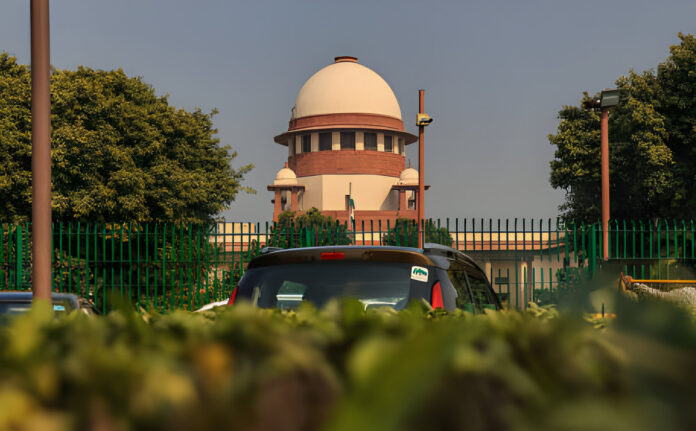
NEW DELHI, May 10: A plea has been filed in the Supreme Court seeking direction to the Centre and state governments to constitute a judicial commission or an expert committee to review the wages and other benefits given to priests, sevadars and temple staff in state-controlled temples.
The PIL filed by advocate Ashwini Upadhyay said that the writ petition seeks directions to the Centre and states to constitute a judicial commission or an expert committee to review the remuneration and other benefits given to the priests and temple staff in state-controlled temples.
“Petitioner also seeks a declaration that priests and temple staff are ‘employee’ under Section 2(k) of the Code on Wages, 2019. Petitioner submits that once the State assumes the administrative, economic and financial control over temples, an employer-employee relationship arises and denial of dignified wages to priests and temple staff violates the right to livelihood guaranteed under Article 21,” it said.
Upadhyay said that the cause of action accrued on April 4, when he went to Varanasi to attend a public programme and after performing ‘Rudrabhishek’ in the Kashi Vishwanath temple, which is controlled by the state, he came to know that even the minimum wages to live with dignity are not given to the priests and temple staff.
“Recently, in Andhra Pradesh and Telangana, priests and temple staff organised a large-scale protest demanding the minimum wages. Priests and temple staff are not getting even the minimum wage prescribed by the State for unskilled and semi-skilled workers. This is a systemic exploitation. State is acting as a model employer through the endowments department, but violating the minimum wages Act and the directive principles of state policy (Article 43),” it said.
The plea further said that the continued refusal to minimum wages with the 2026 inflation-adjusted cost of living index has forced the petitioner to seek judicial intervention to prevent the further marginalisation of priests and temple staff.
Upadhyay further said that the precarious nature of livelihood was starkly exposed on February 7, 2025, when a Tamil Nadu department issued a circular at the ‘Dandayuthapani Swami Temple’ in Madurai, strictly prohibiting priests from accepting ‘dakshina’ in ‘aarti plates’.
“It is necessary to state that priests in such temples often receive no formal salary from the State and rely entirely on ‘Dakshina’; the State’s administrative order directly threatened them with starvation. Although withdrawn due to public outrage, the incident highlights the State’s arbitrary power over the survival of the priests. This is also a bitter truth that States are controlling lakhs of temples but not a single mosque or church,” the PIL claimed.
The petition, alternatively, sought direction to the Centre and states to take appropriate steps for the welfare of priests, sevadars and other temple staff in the spirit of the Allahabad High Court’s earlier judgments. (Agenciese)