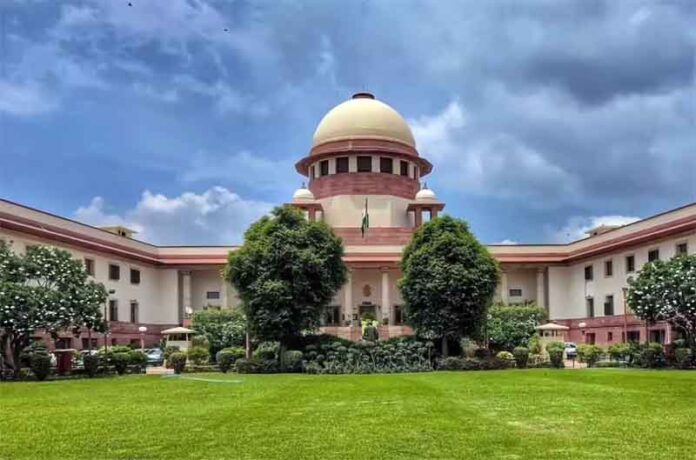
NEW DELHI, Apr 22: The Supreme Court on Wednesday strongly deprecated West Bengal Chief Minister Mamata Banerjee’s storming into the premises of Pratik Jain – the co-founder of political consultancy firm I-PAC – when the Enforcement Directorate (ED) was carrying out searches on January 8, this year, observing that such conduct by a constitutional functionary has the potential to undermine democratic processes.
Terming it “extraordinary”, a Bench of Justices Prashant Kumar Mishra and N V Anjaria, said, “A Chief Minister of any State cannot walk in the midst of an investigation, put the democracy in peril. This is per se an act committed by an individual who happens to be the Chief Minister, keeping the whole democracy in jeopardy.”
The strong observation by the bench came in the course of the hearing of a petition by the Enforcement Directorate seeking a probe by the Central Bureau of Investigation (CBI) against Chief Minister Mamata Banerjee and other State police officers who had accompanied her at the time of the incident. The Central agency and its officers have approached the Supreme Court, invoking the top court’s jurisdiction under Article 32 of the Constitution. Ordinarily, Article 32 can be taken recourse to by the citizens to safeguard their rights against the State. The West Bengal government has questioned the maintainability of the ED’s petitions.
As the senior lawyers appearing for the West Bengal government, opposing the maintainability of the ED’s petition, referred to the noted jurist M H Seervai and Dr Bhim Rao Ambedkar in support of their contention, the bench remarked “You have taken us through Seervai, Ambedkar, but none of them would have conceived this situation, that a sitting Chief Minister will walk into the office” (where searches by ED are underway.
Further voicing its concern over what had happened on January 8, during the ED raids at I-PAC co-founder Pratik Jain’s residence, “We cannot shut our eyes to the reality. This is an extraordinary situation where the contours are totally different, the court has to take decisions keeping in view socio-political realities.”
The bench also referred to the April 1 incident, when seven judicial officers, including three women judges – engaged in the special Intensive Revision (SIR) of electoral rolls in the State – were gheraoed, and there, the response of the State police was not immediate despite calls from the Calcutta High Court. The investigation into the incident has now been handed over to the National Investigation Agency.
The West Bengal government had in the earlier hearing, told the Supreme Court that the Enforcement Directorate was being “weaponized” by the Central government against political opponents,
Senior advocates Abhishek Manu Singhvi, Siddharth Luthra and Menaka Guruswamy, appearing for the West Bengal government, Chief Minister Banerjee and state police officials, argued that the petition was not maintainable under Article 32 of the Constitution.
The Bench, however, was not persuaded that the matter required reference to a larger Bench merely because questions of law were involved. It observed that in every issue, there is a question of law, but it does not necessitate reference to a larger bench.
The case arises out of an incident on January 8, when Banerjee allegedly entered the residence of I-PAC co-founder Pratik Jain during ED search operations linked to a money laundering probe in the coal smuggling case.
She has denied allegations of interference, stating that the documents taken pertained to the Trinamool Congress, while accusing the central agency of acting with political vendetta. The ED, on its part, maintains that the searches were part of an ongoing investigation into the alleged coal scam.
The hearing will continue on Thursday.
(UNI)