

By Poonam I Kaushish
A for apple, B for bat, C for cat…soon India’s future should be reciting this all over the country. No longer will children plan to spend their time playing gulli-danda. Nor will education make Jack a dull boy! It will make Ram an educated boy!
Thanks to a three-judge Bench Supreme Court majority verdict which upheld the Constitutional validity of the Right to Education Act, 2009, (RTE) which mandates 25 per cent free seats to the poor between 6 to 14 years in Government and private unaided schools except unaided private minority schools on Thursday last.
Undoubtedly, the Government has taken the first historical step in education. True, the objective of the RTE is laudable. There is need to strengthen our social fabric by providing equal opportunities to all. Certainly, it is the duty of the State to provide free and compulsory education to poor kids. The moot point: Does it know what constitutes education? Does writing one’s name make one literate? Will two plus two equal four?
Indeed, talk of each one, teach one sounds good but this has to translate into concrete action. The judgment not only underscores the collapse of the Government schooling system but also made it possible for the State to shrug-off its responsibility. Is it justified to ask unaided private schools to comply with the Government diktat?
Pertinently, the RTE has eliminated the age group between zero and six years. The Government and the State run the risk of leaving the young innocents illiterate. For, by the time a child reaches age six without even rudimentary education in terms of sound, colour and pictorials, how will het show any inclination or aptitude? Early childhood care cannot be segregated from education. The UN chapter for Education 1992, to which India is a signatory, states that early childhood care education should be taken care of by the Government. Why the exclusion?
Just by sending poor kids to a private school does not necessarily ensure education or success. Where they come from, do they get enough sleep and food is important, apart from their academic preparedness. Think. Four in 10 children suffer chronic malnutrition before reaching school age impairing their brain development and learning ability. According to recent annual report, of rural schools fewer than half of class 5 children could read a textbook and do basic arithmetic sums for class 2 students.
With 25 per cent seats reserved for the poor where should those who get in on merit go for education? Better would have been for the Government to first provide schools and teachers instead of offloading and outsourcing its responsibility. Where are the schools? Teachers? And infrastructure? Worse, schools are over-crowded with classrooms boasting of at least 50 children. It’s like putting the cart before the horse.
What after age 14 where will these students go after class VIII? Who will pay for books, uniforms, field trips, activity material, examination fee etc? Can they afford them? Topping this there is an acute shortage of teachers, good teachers a far cry of whom 25 per cent are always absent resulting in abysmal quality of teaching and decreased school hours.
Alas, universal elementary education has remained basically a paper tiger and has not been realised properly. Given that all villages are not listed on India’s map? They are neither commutable nor connected. School buildings are non-existent and basic infrastructure like classrooms, black boards etc are missing.
The text books quality is pathetic, study material out-dated, English is full of grammatical errors wherein it’s a miracle to find a paragraph with no errors. Student enrollment is a huge problem and incentives like mid-day meals are given to enroll them. Worse, poor parents read their children as a pair of additional hands to work rather than educate. Thus, it would be extremely difficult to make parents appreciate the benefits of education which would, in the long run, yield higher productivity and higher incomes.
Moreover, RTE sounds great and is excellent vote bank politics. But it does not make good economic sense as the Government does not have enough money. It would need Rs 2.3 lakh crores to fund its initiative for 2010-14 with the Centre-State in a ration of 65-35.
Astonishingly, the RTE bill is almost 5 times India’s allocation for school education (Rs 48,781 crores for 2012-13), more than the total annual subsidies of Rs 1.9lakh crore and larger than the estimated income tax receipts of Rs 1.96 lakhs. Where and how will it generate these extra funds? What with a growing deficit and runaway inflation. With unemployment on the ascendance, who will generate income and money for ploughing it back in education?
Sadly, even after 64 years of Independence, our literacy rate is only 66 per cent. According to the World Education Report, India shares 32.3 per cent of the illiterates of the world. Now look at the public expenditure per student per capita of the Gross National Income. It is only 16.3 per cent in India while the world figure is 23.3 per cent.
Thus, with the state failing to provide the accompanying wherewithal and making it incumbent on the parents to wrest the initiative, quality education will remain a pipe dream. Instead, poor substandard second rate and skeletal programmes like the Education Guarantee Scheme will be fobbed off as education. Add to it the deadly potion of underpaid and under qualified teachers, one has a surefire recipe for disaster in the name of education.
Besides, a majority of middle class parents are thoroughly disillusioned with State schools. The peasantry and urban poor see no prospect of education becoming relevant for their children or the teacher showing warmth towards them. Bias against village life is so central to modern education and its curriculum that one cannot imagine how the high drop-out rate can be brought down without drastic alterations in perspective. In the midst of increasing social disparities and smugness of the urban elite and empowerment how will the Government implement is a puzzle.
Looking ahead, the shortcomings in India’s education system threaten to convert a potential demographic dividend into a disaster. The country has one of the world’s youngest population profiles, and is getting younger: by 2020, the median age will be 28. India needs to create around 12m new jobs a year for young people entering the labour market. Against this backdrop, how will the Government deliver what it promises?
The tragedy is that India is raised on slogans. Today RTE is a buzzword but if the Government is serious it should add the word “good” in the Right to Education. Along-with improving its delivery systems. Given that a school is a microcosm of the education challenges facing India. All blueprints can be drawn up, buildings built, teachers hired. But till one has the will, two plus two will not make four. Elementary, isn’t it? INFA
Right To Education Will Two + Two make Four?
Man behind the machine
By Col R D Singh
The recent revelations in the media about the critical deficiencies of arms, ammunition, and equipment in the Army stunned the nation. And rightly so, when you tell the people that we have tank ammunition only for two days, 97 percent of the air defence weapons are obsolete, the artillery guns are over 25 years old, the special forces lack latest weapons, and 80 percent of our tanks are night blind. My aim here is not to play down the deficiencies, which the MOD must immediately take stock of and make up on priority, but to give the readers a positive side of the picture – the man behind the machine. I will explain it with personal experience, having participated in OP Parakram, and operated in the valley, Siachen, North East, plains of Punjab, and the deserts of Rajasthan.
Starting my career in Armoured Corps in 1974, I trained and operated on the good old Centurian tank, followed by our own Vijayant, then the Russian T -55, and finally the upgraded version of it ( with indigenous 105 mm gun). Now, my son, also a young tank man, is training on the latest T–90 tank. So, firstly, it is not that we are not modernizing, and upgrading our equipment, be it any arm. We are constantly moving forward with time. Yes, modernization is slow due to red tappism in the bureaucracy, and not so good relations between the MOD and Army HQ, which the present controversies have adequately highlighted, and should lead to remedial measures. It is also not that we have tank ammunition for only two or three days. That may be the case with one type of ammunition – armour piercing fin stabilized discarding sabot ( APFSDT). But we have adequate ammo in terms of high explosive squash head ( HESH), HEAT, or the tank mounted missiles, and machine guns. Evan in artillery, lets not forget that it was Bofors which hit the Tiger Hill top pin point, and we operated at night, along special forces, with the help of night vision devices. The AD arty does possess the long range modern ground to air missiles and rockets, and is well trained to bring down the enemy aircrafts. Our army is also well equipped with the latest drones ( remotely piloted vehicles) which can look into the enemy territory, take pictures, and pass valuable information. The automated networked combat communications, backed by integrated logistics, is capable of giving real time processed information and data to the commanders in the battle zone. So, let me assure you as a veteran that, as we stand today, we are battle worthy, and the nation is fit for war.
I say this with conviction , more so because of our man behind the machine – the Indian soldier, who is par excellence. In motivation, training, discipline, and fearlessness, he out classes our adversaries. That is the most important factor for winning a war. Let me elaborate. When battling with the enemy, it is not the equipment alone, but man behind it who makes all the difference. It may be the latest T 90 tank with all the ammunition and night fighting devices, but if the driver is not well trained, either he will take a wrong fire position, leading to first shot by the enemy, or he will get bogged down in a ditch. Second, if he does not have the killer instinct in him, he will be scared to close in, there by losing an opportunity to shoot the enemy. Take the gunner. In case weak, he will keep missing the targets, giving a chance to the enemy to do the job. And in war, you do not get a second chance. Come to the loader. If he is slow , and fumbles with the ammunition, the gun will either have a misfire or a round will get stuck in the chamber, there by rendering the tank ineffective, for a long time. And most important, the commander of the tank. If he is dashing, full of initiative, and ready to scare hell out of the enemy like Arun Khetrapal (PVC), he will lead his troop/squadron/regiment to victory by a tactical sound manouevre, and accurate firing – one round one tank. So, it is the man behind the machine who wins the battle. It holds good for all arms and services, be it an air force pilot or the crew of a naval ship.
During my service, I have rarely come across a jawan who was coward or not ready to sacrifice his life for the ‘ ijjat of his
Paltan’. Our young officers are a treat. See any action in the valley, and it is they who lead the operations and bring down the militants ( latest being Lt Navdeep, AC). When required, even our COs take the lead ( Col Vasanth Venugopal, Col John Thomas etc). During all these operations, the formation commanders also remain in picture, and are available to their commanding officers. This desire to carry out a task, and do it well, is not only during operations, but also during military’s aid to the civil authorities. The battle drill and standard operating procedures ( SOPs) are very well set. Once a task is given, army has never let down. That is why we are the second largest, and finest army of the world.
So, let the recent controversies surrounding the Army Chief, or the corruption charges against some senior officers, or the equipment shortages, not lead us to wrong conclusions, or dampen our spirits about the men in uniform. The controversies will die down, and the culprits punished. The system will even be healthier as the dead skin will be removed and new skin will come up. As long as the man behind the machine is top class, we need to fear none. So, three cheers to the Indian soldier.


Career in Indian Air Force
Gauri Chhabra
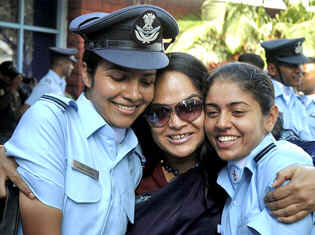 To be in Air Force is about the thrill of seeing formations airborne, bonhomie with fellow colleagues and a deep sense of fulfilment at the end of the day. Working in the Air Force is about being in the middle of supersonic jets, state-of-the-art technology and best of the people. You are where the action is. Air Force provides you with the most modern facilities gives you an unparalleled way of life and creates an environment, where the best in you comes out.
Whether you are a graduate or you have finished your schooling or you have passed your class tenth, Air Force has an exciting career opportunity for you.
As an officer in the Indian Air Force you strategize, lead and manage. Trained in diversified fields and environments you are ready for all the challenges that the fast paced life in the Air Force has in store for you. Be it flying the most advanced combat aircraft or providing technical support, your mission is to always give your best.
Join as an Officer
Career after Intermediate
You can join the Air Force in the flying, technical or the ground branches. You can literally touch the sky by joining the Air Force, not to mention that you’ll be inside a supersonic jet, going at an incredible speed while doing that. Apart from the thrill and adventure, Air Force offers a fulfilling career for life to you.
Selection Process
Candidates, short-listed for Air Force after the initial selection procedure, go through a rigorous three-year training regimen at the National Defence Academy, followed by specialised training at the Air Force Academy. Thereafter, they are commissioned as officers and posted as pilots at any of the Air Force Stations.
To be in the National Defence Academy
You can join NDA by taking the exam conducted by Union Public Service Commission (UPSC). This exam is conducted twice a year in all major cities throughout India.
Eligibility Criteria
To join the NDA you need to fulfil the following requirements:
Age:16 ½ to 19 years
Educational Qualifications: 10+2 with Physics and Mathematics
Advertisement Schedule: March and October every year.
Join as an Airman
SELECTION PROCEDURE
The recruitment of Personnel Below Officer Rank (PBOR) as an Airman in the IAF is conducted through All India Selection Tests and Recruitment Rallies. All India Selection Tests are conducted at the Airmen Selection Centres (ASCs) located all over India as per schedule whereas the Recruitment Rallies are conducted from time to time in selected areas/regions of particular States/Union Territories of the country.
Written Test is conducted for test in English, Physics & Mathematics for Group ‘X’ (Technical) trades and in English & Reasoning and General Awareness (RGA) for all Group ‘Y’ trades.
Written Test is objective type and question paper is bilingual (English & Hindi), except English paper. Written test is based on CBSE syllabus of AISSCE. Candidates for Group ‘Z’ (Musician) trade are tested in English dictation and proficiency to play the musical instrument applied for. You will have to qualify in each paper/test separately.
Physical Fitness Test (PFT): Candidates passing the written tests are to undergo Physical Fitness Test(PFT). The PFT for all trades excluding Indian Air Force (Police) & Indian Air Force (Security) trades consists of a 1.6 Km run to be completed within specified time. The PFT for Indian Air Force (Police) & Indian Air Force (Security) trades includes a 5 Km run & 2.4 Km run to be completed in 30 minutes & 15 minutes respectively. Candidates completing PFT earlier will be awarded additional marks on a sliding scale.
Interview: Candidates passsing PFT will be interviewed by a team of Officers & Warrant ranks. Interview is normally conducted in English. Working knowledge of English is thus essential.
Trade Allocation Test (TAT) : Candidates of Group ‘X’ (Technical) trades who qualify in interview are to undergo Trade Allocation Test for bifurcation into Mechanical and Electronics stream. Specific trade allotment within these streams will be carried out at Basic Training Institute (BTI), Air Force (Belgaum).
Medical Examination: Candidates who are recommended in the interview will be medically examined by the Recruitment Medical Team as per Indian Air Force medical standards. Medical certificates/certificates of fitness from other doctors will not be admissible except for dioptres power as stated in Medical Standards given in detail on this site.
Enrolment is for an initial period of 20 years and extendable up to the age of 57 years. The candidates on enrolment are routed to Basic Training Institute (BTI), Belgaum and Karnataka to undergo Joint Basic Phase Training (JBPT) for a period of 12 weeks. On successful completion of JBPT, candidates will be allocated trades and sent for trade training of specified duration. After successful completion of training, the airmen will be deployed on ground based jobs as per their allotted trades.
The ranks of airmen in the IAF is
Aircraftsman – AC
Leading Aircraftsman – LAC
Corporal – CPL
Sergeant – SGT
Junior Warrant Officer – JWO
Warrant Officer – WO
Master Warrant Officer – MWO
AGE AND EDUCATIONAL QUALIFICATION CRITERIA
One can join rank and file of Indian Air Force as an airman in the category of Personnel Below Officer Rank(PBOR) if he possess following eligibility criteria:-
There are three groups wherein an airman is recruited into namely GP X and Y where age limit is 17-22 yrs except 3 three years more is relaxed in case of GP Y fro musical trade. The education qualification for GP X is 10+2 with Maths and physics with min 50%. For technical trades in this Gp requires 3yrs diploma in engineering (Mechanical/Electrical/Electronics/auto/computer science/IT. For Gp Y eligibility is 10+2 any stream including equivalent vocational courses with 50% marks. For Musician trade min qualification is 10th Pass.
MEDICAL STANDARDS
To get selected as an Airman, the candidate must be physically and mentally FIT to perform duties in any part of the world, climate and terrain. Medical Standards to become an Airman are as follows:-
Minimum height required is 152.5 cm for GP X & Y. However for Auto Technician it is 165cm. For other police and security it is 175/172 cm. The common minimum visual standards acceptable 6/36 for each eye. Indian Air Force (Police) & Indian Air Force (Security) trades require 6/6 vision for each eye unaided and CP-II i.e. no use of spectacles permissible for these trades.
PAY AND ALLOWANCES
PAY & ALLOWANCES. During training a stipend of Rs. 5,700/-pm will be paid. On completion of training, one is placed in the emoluments as under. Promotion to next Pay Band is as per the policy in vogue. The pay scale of Airman is pay band of Rs 5200-20200 with Grade Pay of Rs 2000-2800. Also an allowance of Rs2000 pm as MSP is paid. Various other allowances like Dearness Allowance (calculated on Pay Band + Grade Pay + MSP), Transport Allowance, Composite Personal Maintenance Allowance, High Altitude Allowance; Field Area/Modified Field Area Allowance etc are also admissible as applicable. Perks such as Ration, Clothing, Medical facilities, Accommodation, Educational concession to children, recreational facilities, free transport for school going children and Leave Travel Concession are also provided as per the existing rules. Post retirement benefits include pension, gratuity and leave encashment. Notwithstanding the above, Group Insurance Cover of Rs. 15,00,000/- at nominal premium of Rs. 960/- pm, is covered for all airmen and facility of Group Housing Scheme is also extended. Other facilities by Air Force Wives Welfare Association are also extended for family of airmen.
The initial period of engagement in the IAF is 20 years, which can be extended up to the age of 57 years. Promotion up to the rank of Master Warrant Officer exists to the deserving airmen. Provision for grant of Honorary Commission to the deserving Warrant Officers and Master Warrant Officer. Opportunities to become a Commissioned Officer also exist for the deserving personnel.
World of wonderful pets
Maneka Gandhi
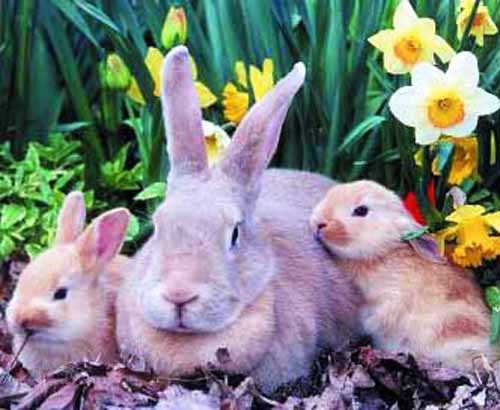 Last week I received an email from a woman who had bought two rabbits, let them turn into twenty five and then left them in the cages built illegally at a public park. Two months later she went to see them and found only three left. The gardener informed her that some had died eating the garbage people threw in and some had been taken away by people to be eaten. My hospital is full of rabbits that have been thrown away. People buy them, do not check out their sexes , allow them to mate and because they breed frequently, get fed up with the numbers and dump them in shelters to rot, sell them to people to kill or leave them in wooded areas where they are killed by jackals or dogs. The rabbit has a sacred space in all mythologies. In Hinduism he is the face of the moon: Shashanka means rabbit faced. The moon rabbit is found in Aztec and East Asian folklore. In Chinese mythology it is the companion of the moon goddess Chang’e, constantly pounding the elixir of life for her and the other immortals; Han Dynasty poets call the rabbit on the moon the “Jade Rabbit” or the “Gold Rabbit” and these phrases were often used in place of the word for the moon. Also associated with the Chinese New Year rabbits are one of the twelve celestial animals in the Chinese Zodiac. Chinese legend has it that there once was a strong, good man who became emperor. He eventually became corrupt and wanted to live forever, so he had special immortality pills made. His wife did not want such a cruel man to live forever, so she took the pills instead and floated up to the moon, taking with her favourite pet rabbit. In Japanese and Korean tradition, rabbits live on the moon where they make Mochi, mashed sticky rice, pounding on an usu, a Japanese mortar . The word for ‘rice-cake’ and ‘full moon’ are both mochi. In Aztec mythology, a pantheon of four hundred rabbit gods known as Centzon Totochtin, led by Ometotchtli or Two Rabbit, represents fertility, parties, and drunkenness. In native American Ojibwe mythology, Nanabozho or Great Rabbit, is an important deity related to the creation of the world. There is a beautiful story about the rabbit which almost every religion quotes as its own. Here is the Buddhist version: In the Buddhist Sasajâtaka (Jataka Tale 316) a monkey, an otter, a jackal, and a rabbit resolved to be charitable on the day of the full moon. An old man begged for food. The monkey gathered fruit for him from the trees and the otter collected fish. The jackal stole a pot of curd. The rabbit, who knew only how to gather grass, offered its own body, throwing itself into a fire the man had built. The rabbit, however, was not burnt. The old man revealed himself to be Sakra and, touched by the rabbit’s virtue, drew the likeness of the rabbit on the moon for all to see. A version of this story can be found in the Japanese anthology Konjaku Monogatarishu, where the rabbit’s companions are a fox and a monkey. In Hinduism, a rabbit, with nothing else to offer a hungry, weary Indra, jumps into a fire, cooking himself for the deity. Out of gratitude, Indra placed the rabbit in the moon. According to an Aztec legend, the god Quetzalcoatl, then living on Earth as a man, started on a journey and, after walking for a long time, became hungry and tired. With no food or water around, he thought he would die. A rabbit grazing nearby offered herself as food to save his life. Quetzalcoatl, moved by the rabbit’s noble offering, elevated her to the moon and told her, “You may be just a rabbit, but everyone will remember you; there is your image in light, for all people and for all times.” Another South American legend tells of the noble sacrifice of Nanahuatzin during the creation of the sun. Humble Nanahuatzin sacrificed himself in fire to become the new sun, but the wealthy god Tecciztecatl hesitated four times before he finally set himself alight to become the moon. Due to Tecciztecatl’s cowardice, the gods felt that the moon should not be as bright as the sun, so one of the gods threw a rabbit at his face to diminish his light. Another story says Tecciztecatl was in the form of a rabbit when he sacrificed himself to become the moon, casting his shadow there. A native American Cree legend recounts the tale of a young rabbit who wished to ride the moon. Only the crane was willing to take him. The trip stretched crane’s legs as the heavy rabbit held them tightly, leaving them elongated as crane’s legs are now. When they reached the moon Rabbit touched Crane’s head with a bleeding paw, leaving the red mark cranes wear to this day. According to the legend, Rabbit still rides the moon to this day. Easter brings the rabbit into focus and strangely links him with eggs.
Easter does not have anything to do with Jesus or the Christians. It is a festival of the moon. The name Easter comes from Eostre (the Phoenician Astarte), goddess of the moon and measurer of time. (Here we can make a connection between the female estrus). The monthly waxing and waning of the moon makes it the Destroyer of Darkness and messenger of new life and immortality. How is the rabbit associated with the moon? One is that the hare feeds by night; another is that the hare’s gestation period is one month long. It was believed that a rabbit could change its sex—like the moon. The Egyptians called the rabbit Un, which means to open, the opener. Un also meant period. Thus the rabbit became a symbol for periodicity in both the lunar and female sense of the word. The hare as “opener” symbolized the New Year at Easter; and fertility and the beginning of new life. And the rabbit carrying Easter eggs? No connection, merely an invention of European bakers in the 19th century who confused the two images. The ancestors of the Easter Rabbit are now lost in the giant machine of commerce. This Easter, adopt a rabbit. They make very wonderful pets.