Formulate projects for setting up Medical, Nursing College
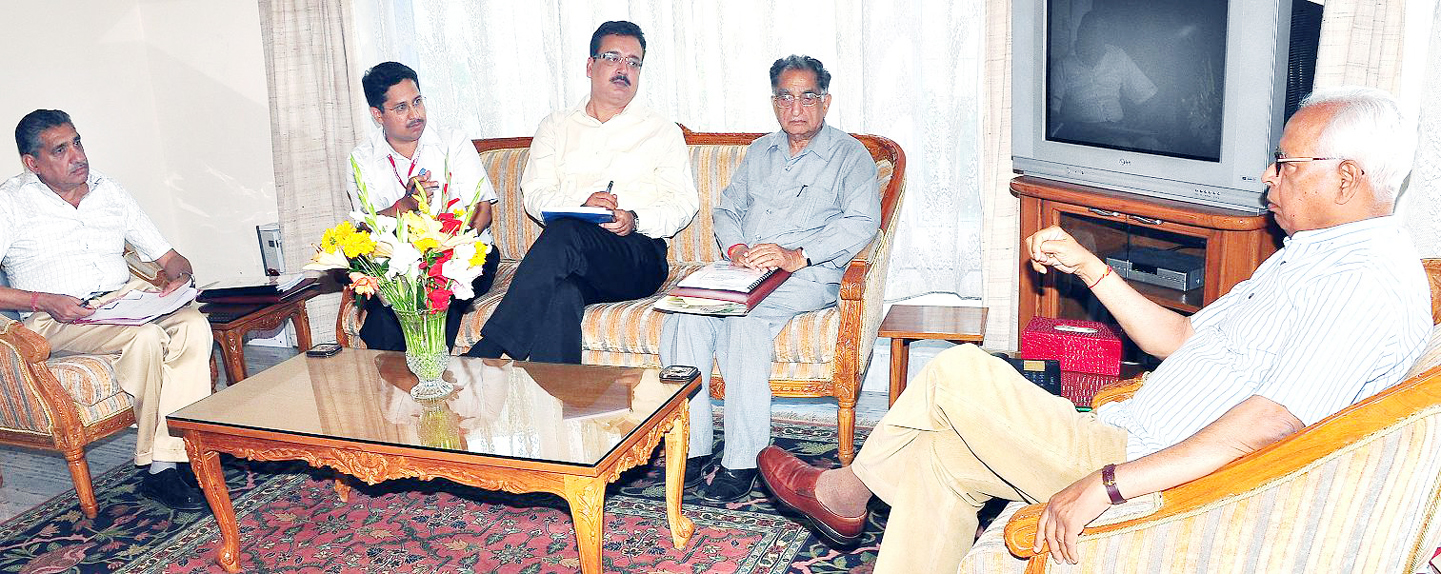
Excelsior Correspondent Governor N.N. Vohra chairing a meeting on Shri Mata Vaishno Devi Shrine Board at Raj Bhawan on Wednesday.
JAMMU, Apr 25: Governor N. N. Vohra, today stressed the need to take immediate steps to ensure the expeditious completion of the upcoming Shri Mata Vaishno Devi Institute of Medical Excellence (SMVDIME) to provide quality medical services to general public of the surrounding areas and, in the course of time to the ever increasing number of Yatris to Shri Mata Vaishno Deviji Shrine. He also issued directions for taking forward necessary steps for establishing a Medical College, a Nursing College and a world class Blood Bank in the coming years for the benefit of the society at large.
The Governor asked for putting in place all the required equipment and tying up other arrangements, particularly those which are crucial for the early commissioning of the OPD services at the SMVDIME in the next few months. He also directed immediate action for commencing the construction of residential accommodation for doctors, para-medics and other staff of SMVDIME, adding that, for this purpose, Master Plan be got finalized on priority basis.
The Governor, who is the Chairman of Shri Mata Vaishno Devi Shrine Board, was extensively reviewing, at a meeting held at the Raj Bhavan last evening, the status of various important projects being implemented by the Shrine Board for meeting the requirements of the ever increasing number of pilgrims to the Holy Cave Shrine of Shri Mata Vaishno Deviji.
H. L. Maini, Member, Shri Mata Vaishno Devi Shrine Board and Technical Consultant of the Board, Navin Kumar Choudhary, Principal Secretary to the Governor and Chief Executive Officer of the Shrine Board, Dr. Mandeep K. Bhandari, Additional Chief Executive Officer, Dr. Vinod Gupta, Medical Superintendent of SMVDIME, Vinay Khajuria, Range Forest Officer, and other concerned officers of the Board participated in the meeting.
Reviewing the security aspects, the Governor directed that the Baggage X-ray machines and the CCTV cameras must remain functional 24×7 and all the required measures must be enforced for effectively ensuring against a stampede or any other avoidable hazard being faced by the pilgrims.
Taking stock of the upgradation of the track from Banganga to Bhawan, the Governor asked the CEO of the Board to ensure immediate improvement of action all the vulnerable stretches of the track install track dividers and retile trook wherever required.
He also stressed for taking all the required steps for addressing the problem of falling stones and cleaning of the track round the clock. Referring to the construction of Dedicated Mule Track from Katra to Adhkwari, he said that the construction of a pony stand, toilet blocks, provision of drinking water supply and other basic requirements must be put in place at the earliest. He also issued instructions to CEO for utilizing the latest technology for manufacturing tiles for relaying the tracks.
Taking a detailed review of the afforestation and beautification programme of the tracks and the adjoining areas, the Governor was briefed that 2.25 lakh plants of forest and flowering species were planted from July 2011 to March 2012 and 1.11 lakh such plants will be planted during the ensuing monsoon season. The Governor asked the Shrine Board Forest Officer to plant such species of trees, flowering plants, creepers and ornamental plants as would beautify the entire area.
So far as the upgradation of existing and construction of new toilet blocks is concerned, the Governor desired that these should be modern structures using the best available technologies to ensure perfect cleanliness. Referring to the recently commissioned Pai Nallah Water Supply Scheme to augment the water availability at Bhawan and Adhkwari, he advised that initiatives must be taken for rainwater harvesting, water recycling and identifying other sources for meeting the long-term water requirements for the Yatra.
The Governor was informed that Helipad near Panchhi View Point and the approach road will be completed by July 2012. The Governor observed that while strictly adhering to the envisaged timeframe for the completion of the Helipad an effort must be made to ensure that this facility is of adequate size for the landing of MI-17 Helicopters to manage any emergent situation in which evacuation may be required.
The Governor also reviewed status of the Material Ropeway Project from Siar Dabri to Bhawan and Passenger Ropeway from Bhawan to Bhairon Temple. He said that an all out effort must be made to start work on these projects at the earliest after procuring all required clearances.
While reviewing the pace of work on the creation of additional accommodation for the pilgrims, the Governor expressed satisfaction at the new initiatives taken in this direction and asked for completion of work on the construction of Ashirwad Complex at Katra, Parvati Bhawan at the main Bhawan, Dormitory Complex at Adhkwari and Kalika Dham at Jammu within the fixed timeframes. He was apprised that Parvati Bhawan will be completed by August and Ashirwad Complex by October this year, while Dormitory Complex at Adhkwari will be completed by March next year and Kalika Dham during the next 24 months.
Other projects which came under review during the meeting included construction of a Stadium at Katra, measures taken for prevention of forest fires, renovation of accommodation in Niharika Complex at Katra and Vaishnavi Dham at Jammu by equipping these with modern facilities and the functioning of the solar water heating system and mule dung based biogas plant.
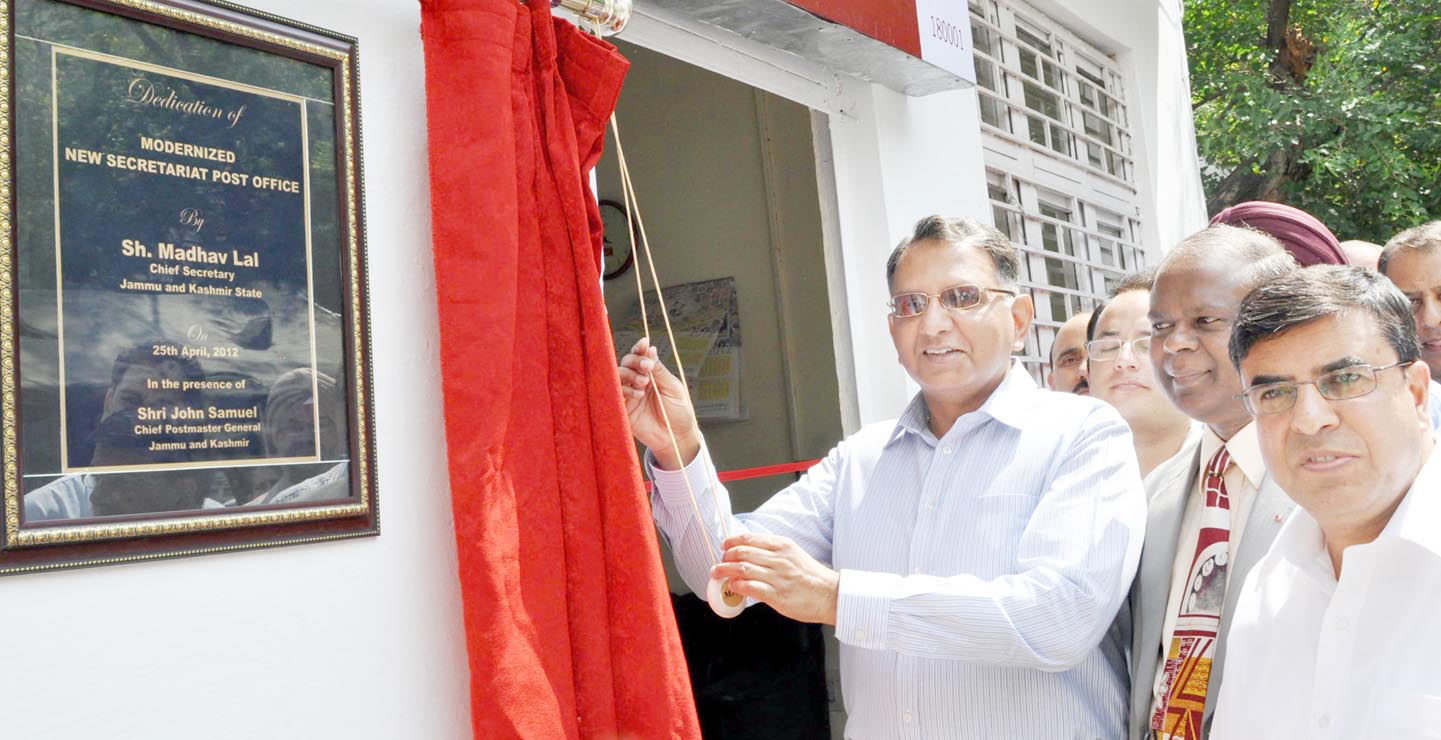
Excelsior Correspondent Chief Secretary Madhav Lal inaugurating Modern Post Office in Civil Secretarieat Jammu on Wednesday.
JAMMU, Apr 25: Chief Secretary, Madhav Lal today highlighted the importance of modern postal service in day-to-day activities and said on upgrading and universalizing this service in the State keeping pace with the technological advancement.
“Technological growth has put greater challenge for postal service”, he said, adding that Postal Department has to modernize and fast track its activities to keep pace with new trends.
The Chief Secretary said this after inaugurating a Modern Post Office in Civil Secretariat premises here this morning.
The Post Master General, Jammu and Kashmir Circle, John Samuel, Commissioner Secretary ARI, Trainings, Ajaz Iqbal, Secretary GAD, Mushtaq Ahmad, Director Estates, Khurshid Ahmad and various officers from postal service were present on the occasion.
Expressing hope that the Modern Post Office in the Civil Secretariat would cater to the needs of both employees as well as those visiting the Civil Secretariat for various works, the Chief Secretary said that one-day delivery facility put in place in the new Post Office is expected to benefit the consumers to a greater extent.
He emphasized the need for upgrading and modernizing other Post Offices functioning in the State in a phased manner. He asked the Postal Department to work out a strategy to reach out the people across the State in prompt service delivery.
The Chief Secretary asked the Postal Department to work out a plan of introducing communication facility in the Post Office.
In his speech, Post Master General, John Samuel said that more than 1700 Post Offices are functioning presently in the State. He said 24 post offices have been identified to be modernized and computerized during the current year. Of these, 12 are in Srinagar and equal number in Jammu.
He said that Jammu and Kashmir Postal Circle has registered a growth of 22.5 percent during the last year. He said that a similar computerized Modern Post Office will be opened in the Civil Secretariat Srinagar next month. He said Lal Chowk Post Office is being converted into Tourist Post Office with post shop facilities.
He said Gandhi Nagar Post Office has already been improved and upgraded and it is being made fully air conditioned in near future. He said a new building has been constructed for the Post Office at Kargil which will be dedicated to public shortly.
Politics of reservation has been continuously present in Indian politics. Our constitution has incorporated several measures for protecting the interests of the members of schedule caste, the schedule tribe and backward classes. The member of constituent assembly decided to reserve for them some seats in the Union Parliament and State Legislature as well as some jobs in the civil services of union and states. Initially reservation was to be for a period of ten year i.e. up to 1960. But period was repeatedly enhanced. In 1993 the reservation in services and jobs were also extended to other backward classes (OBCs) on the basis of recommendation of Mandal Commission Report. The decision of National Front Govt. of PM V.P. Singh in 1990 to implement the recommendations of Mandal commission led strong and anti-Mandal protest. As many as 207 students committed suicide as a protest against the decision.
The historic judgment of Supreme Court directed that OBC will have 27% reservation but this benefit will not be available to the “creamy layer” of the classes. Because identification of creamy layer may pose threat to the political survival to the party taht recommends its abrogation, hence no political party is interested to implement this decision.
It is the open merit candidates who are at their receiving end. The open merit candidates do not get even their own 50% quota which is the violation of Supreme Court judgment. If a reserve category candidate falls in the open merit he is considered an open merit candidate even if he has applied in reserve category. This open merit category has become the mistress of everyone. If this 50% quota of open merit is not protected and is tempered by every reserve category then time will come when open merit candidates will demand reservation on the open merit basis which will be considered downtrodden and deprived category of society and will form a new class i.e. “victims of reservation”. In our country every policy is framed with prior consideration of self survival. Those policies are discarded which endanger their seats and quality takes the back seat. The inability to protect the 50% quota of open merit is due to the fact that open merit candidates do not belong to a particular caste or region so as to form a strong vote bank.
Some members are getting repeated benefits from this policy while many others rather a large majority has been not in a position to draw any benefit. There is need to stop giving the benefit of reservation to those who have already enjoyed its benefits of reservation. The benefit of reservation must reach all eligible persons but within a definite time frame and maximum time limit must also be fixed. Ironically this reservation policy considers the slum dwellers of cities a well off section and a creamy layer worse off section of society. There are many open merit students who could not continue their study due to the poverty but according to lawn of land they are well off because they have taken birth in the family of open merit category. Similar is the case of miserable handicapped people who are not given concession in the written test conducted for the recruitment. They get eliminated before appearing in interview, whereas they deserve every benefit because a handicapped person always lives miserable life and remains away from luxuries even if born in rich family. But due the fact that these handicapped don’t belong to a particular caste or region they are in a scattered form and less in number to form a vote bank that is why they are ill treated by the men in khaki when they raise their genuine demand.
This policy of reservation of job has been violating the merit system of recruitment and has been a source of compromising the quality. At least health and education must be kept away from the ambit of reservation. We should not decrease the eligibility criteria for treating a patent or doing a surgery or to solve the mathematical problem. A problem requires a solution irrespective of caste or region background of a doctor or teacher.
This reservation policy has created discontentment, bitterness, frustration among the open merit candidates. Reserve category employees get promotion and open merit employees remain stagnant for longer period hence there always remain cold war amongst the employees in govt. offices. Govt. has entirely failed in identifying the deserving. Those who have done their schooling and are residing in the cities have been benefitted because their grandfathers belonged to backward areas. Even the declaration of the backward regions has been made on political basis.
Hence govt. should either protect the 50% quota of open merit and exclude the repeated benefit by giving benefit only deserving reserve category candidates so that undeserving candidates may not drive out deserving one; or to give scholarships, free of cost education, hostel facilities, books etc to the deprived people but when it comes to the question of getting job all must be treated equal and same line must be drawn when race starts. Open merit candidates must not be asked to run on one leg as is happening.
(The writer teaches in the Post Graduate Department of Economics, Udhampur Campus University of Jammu).
The miserable plight of the girl child and merciless eradication of female foetus in parts of the country are reported in the media almost daily, but have not provoked public anger to the extent these should in a civilised society. They are all crimes and crimes with an odious stigma of social devaluation of the female population.
Recent incidents like the brutal killing of baby Afreen in Bangalore, and the fight for male baby and abandonment of the girl baby in a hospital in Rajasthan should make heads hang in shame. But, sadly it is not so. Worse, everyone knows that for one incident exposed and legally pursued, there are hundreds ignored and suppressed.
It is common knowledge that catching the culprits and awarding punishment are not enough in gender-related issues without a change in social attitudes. And in India, there are many obstacles in the way of law and justice too. As in many spheres, there is no dearth of progressive laws and regulations, but implementation is tardy. Law must act to change and shape social attitudes also.
It is a sick society that helps under-reporting of incidents of crimes against girl children, that positively protects the offenders and aids suppression of evidence of crimes against women and children, and wants the release or under-punishment of the guilty. The crimes cannot be solely linked with ignorance and privations of the socially-economically backward sections of the population, but travel vertically to cover the well-to-do.
India is a signatory to the UN Convention on Rights of Children (CRC), 1989, and has established the Commission for Protection of Child Rights in 2007 under an Act of Parliament. Interestingly, the same year witnessed a huge increase in crimes against children to an extent of 7.6% of total crimes and an incredible increase of 68.5% in foeticide cases compared to the previous year.
It is a shame that India, that is, the legendary Bharat, tolerates female infanticide/foeticide though traditionally children in any condition are venerated as worshipful objects and embodiment of purity even for those under ceremonial purification. The contradiction is nurtured by social- structural factors and is man-made and not inbuilt in biological and other natural factors.
The CRC views children not as recipients of services but as holders of rights. It upholds the right of children to “self-determination” – a concept that cannot go with Indian patriarchal system. It recognizes the right of children to form associations and participate in decision-making processes at all levels. It contains 54 articles on civil, cultural, economic, political, and social rights. As a signatory to this convention, the Government of India is committed to protecting and ensuring children’s rights and is accountable to discharge this commitment before the international community. The Government of India has adopted a National Charter for Children in 2003 to reiterate its commitment to children and to see that no child remains hungry, illiterate, or sick. The charter makes specific mention about taking appropriate measures to address the problems of female infanticide and foeticide and all other emerging manifestations that deprive the girl child of her right to survive with dignity.
It also provides that all children have a right to be protected against neglect, maltreatment, injury, and trafficking, sexual and physical abuse of all kinds, corporal punishment, torture, exploitation, violence and degrading treatment.
Protection of the girl child is ensured against all forms of discriminatory practices and abuses including child marriage. The charter is so elaborate that it touches every aspect of child life, and if implemented would make the life of children ideal and open a uniformly bright future for all of them.
The Indian Penal Code that is over 150 years old recognizes seven types of crimes against women. Further, a number of special laws have also been enacted to curb the practice of dowry, the atrocity of bride burning, sex-determination tests, rape, sexual harassment at workplace, trafficking in women and children, and eve-teasing. For illegal sex-determination tests, law prescribes punishments for concerned clients and others seeking pre-natal diagnostic tests, medical practitioner, owner or employee of the genetic counseling centre or laboratory or clinic, and for the doctor involved in sex-selection. Punishments vary and go up to imprisonment for three years and fine up to Rs. 50,000 and even suspension of the registration of the doctor. But, we hear of few convictions.
Alas! Despite conventions, charters, legislations, awarding punishments and existence of protective agencies, abuse of children, and prejudice against girl child with corresponding son-preference mentality continue unabated. As a result, census shows alarming decline in sex ratio indicating that in some pockets polyandry may have to be resorted to in view of scarcity of girls for marriage; the National Crime Records Bureau records increasing crimes against women; and newspapers and news channels frequently carry reports of horrifying stories of female infanticide and foeticide committed by parents themselves, aided and abetted by close relatives.
In many western countries, children’s ombudsman is appointed to protect and promote the rights and interests of children in general and specifically for particular categories in need of special care. There is a European Network of Ombudspersons for Children and also sub-regional networks.
The prompt and angry reaction that India expressed against retention of two Indian children by Norwegian authorities is missing in the case of offences against children and the unborn within the country. We have no reason to be proud of our record in child protection.
Is this apathy largely due to failure of legal instruments, or powerlessness of protective agencies, or social-ethical blindness? The first two in our society must engage in social education as part of their activities. Unfortunately, the Children’s Commission’s activism does not meet the urgency and the gravity of the situations. Our law, institutions, and authorities have to take the tasks assigned to them to ensure rights and privileges not as half-hearted social service but as important duties. The Commission must fulfil its mandate – its role and functions and exercise all its powers lest they should lapse by non-use.–INFA
Two good developments took place last week. Finally, the Reserve Bank of India decided to reduce interest rates and the Government’s chief economic adviser Kaushik Basu announced an end to retrograde “reforms.” While one may say hurrah, the two have not put an end to the gloom. The decisions have come amidst continuous rise in consumer – retail – price index and a slowdown in the economy.
RBI governor D Subba Rao feels that 0.5 per cent cut in the interest rate is a small measure to correct many wrongs done in the recent past. The central bank is not happy with some of the populist schemes such as MNREGA for valid reasons: it leads to a drain on Government finance, makes wages dearer and adds further to inflation.
What Basu says is in fact, in tune with Trinamool Congress leader Mamata Banerjee and the Left parties. The “reforms” in Government parlance only means further opening up the retail sector to large Indian and foreign investors, insurance to foreign companies, and a change in labour laws to suit the needs of the corporate at the cost of the workers. It is good that it is being put off as such measures would result in further unemployment and displace many small businessmen.
Importantly, the RBI has virtually admitted that it has not succeeded in controlling inflation through the lone monetary policy measure. Had good sense prevailed earlier, at least the contribution made by the RBI towards the inflationary situation by making investments and business expenses dearer could have been avoided.
The silver lining, however, is that the RBI itself eventually realises its mistake. It even takes a part of the responsibility for the slowdown in industrial and manufacturing growth. Besides, it also admits that fall in credit off take was also the result of its 13-time rise in interest rates. The RBI analysis states that fall in Indian banks’ liquidity resulted because of its tight monetary policy. The statement accepts that this critical gap was filled up by foreign direct investment.
The RBI statement is a cause for concern as well. If the liquidity position does not improve, the next eleven months might not see the expected growth of around seven per cent. The country cannot depend for long on Foreign Direct Investment (FDI).
The FDI has started shrinking, President of the Confederation of Indian Industry Adi Godrej cautions. Worse, the positive environment is not there and brand India image has got soiled, he states adding that “It has hampered long-term foreign investment.” Godrej wants reforms on fast track along with governance. However, this is contrary to what Kaushik Basu has stated.
The big question that emerges is: whether the scenario is confusing? Not really. Godrej is right to the extent that policy paralysis on the part of the Government has put a spanner. Those who want to invest in India are not confident of either the political environment or business atmosphere.
Policy indecisions and bureaucratic flip-flop on taxing businesses almost 50 years in retrospect has shaken the confidence of the business class. The impact of Vodafone decision has deeply affected business sentiments not only within the country but all investors abroad. Nobody wants to invest and then fight with tax authorities, who undeniably have enormous powers to harass.
The Government, under the influence of tax bureaucrats, is trying to introduce more stringent and retrograde rules. This sadly encourages bureaucratic discretion and vitiates the business atmosphere, which the RBI obliquely points out to. In fact, it is a clear hint for the Government that it needs to correct its policies on taxation. The indirect suggestion is that it requires simplification of procedures if it wants growth. The growth and tying of business and financial activities in knots cannot go hand-in-hand.
Another positive aspect of the RBI analysis is that it has also realised that banking services are becoming expensive and cumbersome. Therefore, it seeks to take steps to allow the marginalised section to join the banking system, but these are not enough. Instead, it has made money transfer, pay order and other transactions expensive. Each of these affects the growth of the economy and it appears that while the RBI wants to advise others it is not keen on implementing it for itself.
Expensive banking and other operations have not only increased the cost of business operations but have also resulted in large funds being diverted from the banking system. Contrary to popular belief, this is not black money, but has the potential to siphon those funds from fiscal channels. Undoubtedly, there is need for some policy correction but nobody seems to be interested.
This, one can say safely, is one of the main reasons for the poor liquidity of banks. It requires almost Rs 450 lakh crore of recapitalisation. If the policy framework is not simplified, banking services not made affordable, repayments not streamlined, then the Indian economy may once again be heading for the historical Hindu rate of two to three per cent growth in not so distant a future.
This apart, the monetary policy analysis has also come down heavily on the populist policies such as MNREGA. It has found that though it is providing cash to the workforce, it is creating a class of people who are not contributing to society and is increasing the Government’s fiscal deficit. On the one hand it is increasing the cost of wages and on the other creating shortage of workforce in vast areas, particularly rural India.
Such schemes, the monetary policy notes, are creating higher wages all over. This is turn is triggering a cyclical problem as higher wages are raising production cost and further inflation. The apprehension expressed is that if inflation continues in double digit, then all the projections for growth would remain on paper, unachievable. Further, it suggests that this is not the time to put in money into failing public sector undertakings and the Government must keep a check on it.
In all, the problems posed are many, the solutions simple but the Government unfortunately lacks the political will it should have. The monetary policy statement in toto calls for an easing of the environment. Will it, or else growth would remain a hollow word and Finance Minister Pranab Mukherjee’s effort to add to his coffers would end up in a dream.
The future looks dreadful. Further loss of Government revenue would mean higher borrowings. It would create more problems for governance and liquidity. If the country has to progress it must take decisions as the monetary policy suggests, simplifying procedures and creating, enabling and enticing an atmosphere for both industry and business. —INFA.
Democracy means peoples’ rule and rulers need to be as much close to people as is possible. Closeness helps understand both sides the rulers and the ruled; understand their problems, aspirations, possibilities and impossibilities. It is generally believed that only the people have problems for which they seek solution. But it is less understood that the governments, too, have their problems and hurdles. Much may a democratic government like to do or undo certain things but it is handicapped. After all, democracy is the rule of law and law is all pervasive. There is no aspect of human activity which is not covered by law. Therefore to believe that an elected government is all power and has all the authority to do or undo anything it likes is a misnomer, a misleading proposition. But the fact remains that a forward looking government has no option but to come closer to the people and thus establish its credibility at grassroots level.
The tradition with the State Government is that on the eve of annual Durban move, the chief minister goes on a whirlwind tour of far-flung areas, holds umpteen number of public rallies, meets numerous delegations, receives heaps of petitions, and interacts with district bloc and tehsil level officers who apprise him of the ground situation in their respective areas. Omar Abdullah is not new to this winding up exercise; he is well informed about the needs of remote regions of the State. In the first leg of his four-day tour, the Chief Minister opened account with an impressive address at a mammoth gathering in Kalakot in Rajouri district. His main thrust was on the achievements made by the coalition government during past three years or the first half of the total tenure of six years. The CM listed one by one some of the major achievements which will have far reaching impact on the future of the State and its people. Obviously the most shining feather in his cap is the successful holding of Panchayat elections. This is the first tier in a three tier-democratization process, the other two being the elections to Urban Local Bodies and then to Bloc and District Councils. Elections to these two institutions are underway and hopefully the ULBs elections will be completed by the month of June. The CM has rightly pointed out that once these institutions begin to function, there will be a sea change in the entire administrative culture since 14 departments have already been transferred to the Panchayats. The State will be stealing the march over other States once three-tier process is completed and becomes functional. Panchayats will get not only administrative but also financial empowerment to facilitate their functionality. This is no mean an achievement.
There is no denying the fact that the Chief Minister is a modest man no trying to recommend sensational hype to the achievements of his government as is the culture with our political leadership. It is quite usual in democratic struggle to pick holes in the pockets of political adversaries not out of any personal vendetta but as a matter of rule. Here is one leader who repeatedly says that he believes a Government should be judged by its deeds and not words. That is the reason why in his public address at Kalakot, the CM listed the achievements and then told the people to carry the word to others and convince them that his government is not unmindful of its responsibilities of reaching even the farthest nook of the state. Citing the example of the previous government, the CM made a cogent point by telling people that that government encouraged strong media hype that it was the PDP that had won the credit of opening the Uri-Muzaffarabad road. Doing so served political interests more than the pressing economic interests of the people. On the other hand, his government had many achievements to underline but he was loath to indulge in self-praise. If the Government has done something for the public good, taken certain initiatives and passed new laws, all this will be felt by the people as its benefits reach them. As such there is no need of rushing to the media and projecting himself as a hero.
While the coalition government led by Omar Abdullah is engaged in addressing the problems of various regions and groups of people through just and equitable dispensation, it will be noted that quarters accustomed to be vociferous in bringing charges of regional or sub-regional and other sorts of discrimination have been silenced. Tourism has revived and to a considerable extent normalcy has been restored in most parts of the State. In particular, the issue of uprooting corruption from the State, we have the pro per statutory authority and not only bureaucrats but ministers, MLAs, MLCs and even the Chief Minister come under the purview of these agencies. Public Rights Safeguard Act is an instrument in the hands of the people helping them to get their problems resolved within a time bound frame. People should know the rights which this and other Acts give them.
The CM, after he has been made the Working Chairman of his party, has to shoulder more responsibilities now. Previously it was his father who held that position and thus lessened his burden. But now he has to devote his time to party’s organizational affairs. National Conference has a long and glorious history of political struggle and running the administration of the State after the democratic dispensation set in with the State’s accession to the Indian Union. Its network is widespread in the State but for some time, organizational affairs have received less attention. The CM has to take initiatives of new recruitment to the rank and file of his party, educating and training the new recruits along the party line and ensuring gradual transfer of party positions to the youth leadership. Democracy is taking deeper and deeper roots in the State and against the days when NC was the sole leading political party in the state, we have now many mainstream political parties in the field. Competition has become sharp and the law of survival of the fittest will prevail. The NC will be required to prove its fitness. That is another task before the young Chief Minister.
Rate Cut and Reforms
Welcome, not enough
Shivaji Sarkar
Two good developments took place last week. Finally, the Reserve Bank of India decided to reduce interest rates and the Government’s chief economic adviser Kaushik Basu announced an end to retrograde “reforms.” While one may say hurrah, the two have not put an end to the gloom. The decisions have come amidst continuous rise in consumer – retail – price index and a slowdown in the economy.
RBI governor D Subba Rao feels that 0.5 per cent cut in the interest rate is a small measure to correct many wrongs done in the recent past. The central bank is not happy with some of the populist schemes such as MNREGA for valid reasons: it leads to a drain on Government finance, makes wages dearer and adds further to inflation.
What Basu says is in fact, in tune with Trinamool Congress leader Mamata Banerjee and the Left parties. The “reforms” in Government parlance only means further opening up the retail sector to large Indian and foreign investors, insurance to foreign companies, and a change in labour laws to suit the needs of the corporate at the cost of the workers. It is good that it is being put off as such measures would result in further unemployment and displace many small businessmen.
Importantly, the RBI has virtually admitted that it has not succeeded in controlling inflation through the lone monetary policy measure. Had good sense prevailed earlier, at least the contribution made by the RBI towards the inflationary situation by making investments and business expenses dearer could have been avoided.
The silver lining, however, is that the RBI itself eventually realises its mistake. It even takes a part of the responsibility for the slowdown in industrial and manufacturing growth. Besides, it also admits that fall in credit off take was also the result of its 13-time rise in interest rates. The RBI analysis states that fall in Indian banks’ liquidity resulted because of its tight monetary policy. The statement accepts that this critical gap was filled up by foreign direct investment.
The RBI statement is a cause for concern as well. If the liquidity position does not improve, the next eleven months might not see the expected growth of around seven per cent. The country cannot depend for long on Foreign Direct Investment (FDI).
The FDI has started shrinking, President of the Confederation of Indian Industry Adi Godrej cautions. Worse, the positive environment is not there and brand India image has got soiled, he states adding that “It has hampered long-term foreign investment.” Godrej wants reforms on fast track along with governance. However, this is contrary to what Kaushik Basu has stated.
The big question that emerges is: whether the scenario is confusing? Not really. Godrej is right to the extent that policy paralysis on the part of the Government has put a spanner. Those who want to invest in India are not confident of either the political environment or business atmosphere.
Policy indecisions and bureaucratic flip-flop on taxing businesses almost 50 years in retrospect has shaken the confidence of the business class. The impact of Vodafone decision has deeply affected business sentiments not only within the country but all investors abroad. Nobody wants to invest and then fight with tax authorities, who undeniably have enormous powers to harass.
The Government, under the influence of tax bureaucrats, is trying to introduce more stringent and retrograde rules. This sadly encourages bureaucratic discretion and vitiates the business atmosphere, which the RBI obliquely points out to. In fact, it is a clear hint for the Government that it needs to correct its policies on taxation. The indirect suggestion is that it requires simplification of procedures if it wants growth. The growth and tying of business and financial activities in knots cannot go hand-in-hand.
Another positive aspect of the RBI analysis is that it has also realised that banking services are becoming expensive and cumbersome. Therefore, it seeks to take steps to allow the marginalised section to join the banking system, but these are not enough. Instead, it has made money transfer, pay order and other transactions expensive. Each of these affects the growth of the economy and it appears that while the RBI wants to advise others it is not keen on implementing it for itself.
Expensive banking and other operations have not only increased the cost of business operations but have also resulted in large funds being diverted from the banking system. Contrary to popular belief, this is not black money, but has the potential to siphon those funds from fiscal channels. Undoubtedly, there is need for some policy correction but nobody seems to be interested.
This, one can say safely, is one of the main reasons for the poor liquidity of banks. It requires almost Rs 450 lakh crore of recapitalisation. If the policy framework is not simplified, banking services not made affordable, repayments not streamlined, then the Indian economy may once again be heading for the historical Hindu rate of two to three per cent growth in not so distant a future.
This apart, the monetary policy analysis has also come down heavily on the populist policies such as MNREGA. It has found that though it is providing cash to the workforce, it is creating a class of people who are not contributing to society and is increasing the Government’s fiscal deficit. On the one hand it is increasing the cost of wages and on the other creating shortage of workforce in vast areas, particularly rural India.
Such schemes, the monetary policy notes, are creating higher wages all over. This is turn is triggering a cyclical problem as higher wages are raising production cost and further inflation. The apprehension expressed is that if inflation continues in double digit, then all the projections for growth would remain on paper, unachievable. Further, it suggests that this is not the time to put in money into failing public sector undertakings and the Government must keep a check on it.
In all, the problems posed are many, the solutions simple but the Government unfortunately lacks the political will it should have. The monetary policy statement in toto calls for an easing of the environment. Will it, or else growth would remain a hollow word and Finance Minister Pranab Mukherjee’s effort to add to his coffers would end up in a dream.
The future looks dreadful. Further loss of Government revenue would mean higher borrowings. It would create more problems for governance and liquidity. If the country has to progress it must take decisions as the monetary policy suggests, simplifying procedures and creating, enabling and enticing an atmosphere for both industry and business. —INFA.
Voiceless girl child
Panel can’t stay powerless
Dr S Saraswathi
The miserable plight of the girl child and merciless eradication of female foetus in parts of the country are reported in the media almost daily, but have not provoked public anger to the extent these should in a civilised society. They are all crimes and crimes with an odious stigma of social devaluation of the female population.
Recent incidents like the brutal killing of baby Afreen in Bangalore, and the fight for male baby and abandonment of the girl baby in a hospital in Rajasthan should make heads hang in shame. But, sadly it is not so. Worse, everyone knows that for one incident exposed and legally pursued, there are hundreds ignored and suppressed.
It is common knowledge that catching the culprits and awarding punishment are not enough in gender-related issues without a change in social attitudes. And in India, there are many obstacles in the way of law and justice too. As in many spheres, there is no dearth of progressive laws and regulations, but implementation is tardy. Law must act to change and shape social attitudes also.
It is a sick society that helps under-reporting of incidents of crimes against girl children, that positively protects the offenders and aids suppression of evidence of crimes against women and children, and wants the release or under-punishment of the guilty. The crimes cannot be solely linked with ignorance and privations of the socially-economically backward sections of the population, but travel vertically to cover the well-to-do.
India is a signatory to the UN Convention on Rights of Children (CRC), 1989, and has established the Commission for Protection of Child Rights in 2007 under an Act of Parliament. Interestingly, the same year witnessed a huge increase in crimes against children to an extent of 7.6% of total crimes and an incredible increase of 68.5% in foeticide cases compared to the previous year.
It is a shame that India, that is, the legendary Bharat, tolerates female infanticide/foeticide though traditionally children in any condition are venerated as worshipful objects and embodiment of purity even for those under ceremonial purification. The contradiction is nurtured by social- structural factors and is man-made and not inbuilt in biological and other natural factors.
The CRC views children not as recipients of services but as holders of rights. It upholds the right of children to “self-determination” – a concept that cannot go with Indian patriarchal system. It recognizes the right of children to form associations and participate in decision-making processes at all levels. It contains 54 articles on civil, cultural, economic, political, and social rights. As a signatory to this convention, the Government of India is committed to protecting and ensuring children’s rights and is accountable to discharge this commitment before the international community. The Government of India has adopted a National Charter for Children in 2003 to reiterate its commitment to children and to see that no child remains hungry, illiterate, or sick. The charter makes specific mention about taking appropriate measures to address the problems of female infanticide and foeticide and all other emerging manifestations that deprive the girl child of her right to survive with dignity.
It also provides that all children have a right to be protected against neglect, maltreatment, injury, and trafficking, sexual and physical abuse of all kinds, corporal punishment, torture, exploitation, violence and degrading treatment.
Protection of the girl child is ensured against all forms of discriminatory practices and abuses including child marriage. The charter is so elaborate that it touches every aspect of child life, and if implemented would make the life of children ideal and open a uniformly bright future for all of them.
The Indian Penal Code that is over 150 years old recognizes seven types of crimes against women. Further, a number of special laws have also been enacted to curb the practice of dowry, the atrocity of bride burning, sex-determination tests, rape, sexual harassment at workplace, trafficking in women and children, and eve-teasing. For illegal sex-determination tests, law prescribes punishments for concerned clients and others seeking pre-natal diagnostic tests, medical practitioner, owner or employee of the genetic counseling centre or laboratory or clinic, and for the doctor involved in sex-selection. Punishments vary and go up to imprisonment for three years and fine up to Rs. 50,000 and even suspension of the registration of the doctor. But, we hear of few convictions.
Alas! Despite conventions, charters, legislations, awarding punishments and existence of protective agencies, abuse of children, and prejudice against girl child with corresponding son-preference mentality continue unabated. As a result, census shows alarming decline in sex ratio indicating that in some pockets polyandry may have to be resorted to in view of scarcity of girls for marriage; the National Crime Records Bureau records increasing crimes against women; and newspapers and news channels frequently carry reports of horrifying stories of female infanticide and foeticide committed by parents themselves, aided and abetted by close relatives.
In many western countries, children’s ombudsman is appointed to protect and promote the rights and interests of children in general and specifically for particular categories in need of special care. There is a European Network of Ombudspersons for Children and also sub-regional networks.
The prompt and angry reaction that India expressed against retention of two Indian children by Norwegian authorities is missing in the case of offences against children and the unborn within the country. We have no reason to be proud of our record in child protection.
Is this apathy largely due to failure of legal instruments, or powerlessness of protective agencies, or social-ethical blindness? The first two in our society must engage in social education as part of their activities. Unfortunately, the Children’s Commission’s activism does not meet the urgency and the gravity of the situations. Our law, institutions, and authorities have to take the tasks assigned to them to ensure rights and privileges not as half-hearted social service but as important duties. The Commission must fulfil its mandate – its role and functions and exercise all its powers lest they should lapse by non-use.–INFA
Excelsior Correspondent
JAMMU, Apr 25: The J&K Pensioners Association has expressed strong resentment against the attitude of the Government which in its recent order has directed present themselves personally in the bank and then in the treasury.
In an emergency meeting of the Association held under the chairmanship of Ajit Singh Adyal, it was resolved to invite the pointed attention of the concerned higher authorities towards the sad plight of State pensioners, who are subjected to appear before bank authorities and then treasury and again in the bank to enable drawl of their pension from May 2012 and onwards. This decision has caused embarrassment and strong resentment against the elderly pensioners.
With this order even an old ailing pensioner will be made to be in line and wait for his / her turn to fill up form and get pension document from bank and then again to be in queue in the treasury to get verified from the Treasury officer and again in the bank for depositing the same. They said what will be the fate of ailing and bed ridden pensioners under such circumstances. How is it possible for outsiders who reside with their children in different parts of India and abroad to report to bank/ treasury at such short notice.
The Association urged the concerned higher officials in the Finance department to review this decision to the extent that they may produce life certificate in the bank once a year and also to extend the time limit of May 2012 for the purpose.
Excelsior Correspondent
RAMBAN, Apr 25 : National Conference leader Sajjad Kithcloo today said that infrastructure development, especially that of roads, is necessary for the State’s progress, and the Omar Abdullah led Government in the State has given top priority to it.
Addressing party workers here today, National Conference MLA and Spokesperson Mr. Kichloo said that the state government has taken up several initiatives during last three years to ensure development and upliftment of the far flung areas. “The initiatives have started bearing fruits as there is a visible change on the ground”, he said adding that there was still a lot more to do .
He said with the establishment of Panchayat system, development of far-flung areas as per the requirements and needs of the people would receive considerable boost” .
“The Chief Minister has made regular public rapport as an important feature in the functioning of the administration to ensure good-governance and help address the development problems confronting people in remote areas”, Kichloo said and added that the development works launched in these areas would get a necessary push to this aspect.
Kichloo was accompanied by District president NC Chaman Lal Bhagat, Block President Khursheed Ahmed Salaria, Muhammad Khursheed Mir, Master Romal Singh, Muhammad Gulshan Khokar, Mukal Lal Bandral, Kuldeep Singh Manhas, Ghulam Mohi-ud-Din Mir, Syed Muhammad Mir and Muhammad Ayub Mir.
The NC team also visited various areas of the district including Assar, Cherota, Jathi, Shanthi, Gagla, Kuthyra, Kotli and Kastigarh and interacted with the people to ascertain their problems. The people demands, Degree College at Assar, Botote and Kastigarh, Tehsil status for Assar and Batote, construction of Dak Banglow at Assar, Construction of motorable bridge over Chenab at Makhrifat, PHC at Assar, High Secondary School at Jathi and Gulandpur and construction of Dansal-Lilot link road.
Excelsior Correspondent
JAMMU, Apr 25: Former Union Minister and MLA Prof Chaman Lal Gupta has stressed the need for exclusive revision of the electoral rolls to meet the ends of justice and fair elections in the State.
Commenting on the media reports that summary revision of voter lists has taken place before civic elections, Prof Gupta said that there are not only massive mistakes and discrepancies in voters lists but large number of names of voters are also missing.
In addition to this in certain wards the large number of fake voters have been enrolled with malicious designs, he added.
In this regard Prof Gupta pointed out that in certain wards the number of electorates are more than the census population of 2011, adding in the voters lists of 68 wards of Srinagar Municipal Corporation (SMC), there is increase of one lakh and 55 thousand voters than the last elections while in Jammu Municipal Corporation (JMC) having 71 wards there is only increase of 17 thousand voters.
Prof Gupta also pointed out that amazingly the number of electorates of Jammu district has decreased by three percent than the previous elections but on the contrary the census figures of same district have marked the increase of two lakh.
He said in presence of such glaring mistakes in the elections to the local bodies would not be more than that of a mockery. He also raised the question of increasing of 12 local bodies in Kashmir whose number increased from 34 to 46 and on contrary only four local bodies have been added in Jammu region. This all happened when the Minister of Local bodies belonged to Jammu region, he added.
Excelsior Correspondent
JAMMU, Apr 25: Many areas in Jammu are reeling under severe shortage of LPG cylinders for the last several weeks while the concerned Consumer Affairs and Public Distribution department authorities are least bothered about the sufferings of the general public.
The shortage is not only being felt in the Jammu localities like Janipur, Rehari, Sarwal, New Plots, Bakshinagar, Reshmghar, Ploura and Roopnagar besides old city localities but it has also been reported from Samba, Kathua, Vijaypur, Ramgarh, Bishnah, Bari Brahamana, R S Pura, Domana, Akhnoor and other towns of Jammu region. The consumers even after the wait of two to three weeks are not being provided supply of cooking gas cylinders by the dealing agencies.
While the gas agency dealers of HP, Indian Oil and others allege shortage of gas due to inadequate supply by the oil and natural gas companies, the concerned area officials of the companies, however, claim that since major share of the supply meant for Jammu is being diverted to Kashmir, the Jammu areas have started facing this problem for the past some time. The dealers even alleged that against the demand and their fixed quota of cylinders, hardly fifty to sixty percent of the supply is being maintained by the concerned area plants. Under such circumstances, they are unable to clear the backlog of even 15 to 18 days, they maintained.
Minister for CAPD Qamar Ali Akhoon when contacted told the Excelsior that supply meant for Jammu is not being diverted to Kashmir or Ladakh. He said it was false propaganda by the gas dealers or the plant operators here.