

hello
MGNREGA More hype than jobs
By Onkar Singh
ARGUABLY a path breaking legislation, the Mahatma Gandhi National Rural Employment Guarantee Act has attracted both praise and criticism in equal measures. It has been praised generously because it guarantees 100 days job in a year to all those men and women in rural India who are willing to work, augments income and thereby improves livelihood of families living at the margin, reduces unemployment, increases consumption level and helps build durable assets in rural areas by the locals themselves.
However, criticism of the scheme has been equally scathing. The scheme has been criticized inter alia on account of inordinate delay in the issuance of job cards, assigning much less days of work than guaranteed under the Act, non-payment or delay in payment of wages, bungling in public spendings and substandard nature of work completed under the scheme.
How far has MGNREGA faired in Jammu and Kashmir where the scheme was launched in the year 2006? A survey to that effect was conducted recently in Nowshera village of Basohli tehsil that forms a part of the hilly terrain of Kathua district. The scheme in this village became operative in the year 2009-10 whereby focus of the work was water conservation, drought proofing, irrigation canal works, and renovation of traditional water bodies, land development, flood control and rural connectivity.
A stratified random sample of 31 job card holding households was selected across caste groups and mohallas of the village that houses a total of 247 families for a fair representation of population. Significantly, findings of the study were revealing. Job guarantee is the hallmark of the scheme. However, between 2009-10 and 2010-11, the scheme generated only 892 job days for 31 job card holders as against an estimated 5400 job days had all these workers been provided with 100 days of work each year. It therefore amounted to generation of just 14.4 job days per household per annum as against the promised 100 days! In other words, the much publicized job guarantee scheme could generate in Nowshera only 1/7th of the total jobs against what its policy statement proclaims.
Equally revealing was discrimination in the allotment of job days across income groups. The sample households had an average income of Rs. 2733 per month. There were as many as 26 households (84%) however whose monthly income (Rs.2954) was more than the average figure. The remaining 5 households had a monthly income much below the average; it was Rs. 1581 only. Significantly, while each job card holder in the former group got work for 16 days a year, the corresponding figure for the latter group was 10.5 days only; indicating thereby that implementation of the scheme in Nowshera was not favourable to, if not biased against, the economically more backward population.
Significantly, this discrimination against the poor gets magnified if one relates it with data on land ownership. In the village, as many as 60% job card holders among the lower income group are landless. The corresponding figure for the greater than average income group is 11.5% only. This implies that the economic group which has little job guarantee has also little food security in the form of agricultural land to bank upon for survival; a state of double deprivation to cope with.
Our queries however revealed that more than 87% MGNREGA job card holders in the village were satisfied with the scheme. Why? Two main reasons were given by the respondents; one was nearness of work place. On an average, the site of work was half a kilometer away, which implied that workers could easily reach there on foot. The other reason was payment on regular basis. All payments to the workers were made either within a fortnight or a month. These were also the reasons as to why an overwhelming majority (90%) stated that MGNREGA jobs were better than other jobs. This implies that unskilled rural poor prefer work that is nearer their home and is paid on regular basis.
Popularity of the scheme notwithstanding, the fact remains however that the scheme failed in providing the promised 100 days of work to a household in a year. And since job creation is associated with work, one can safely assume that no worthwhile development projects were completed in the village during 2009-11. That amounted to a betrayal of both the place and its people by the much hyped job scheme; an example of a good policy gone bad. Apparently, the scheme badly needs a revamp in its planning as well as execution at the grass roots both in letter and spirit.
Infusion of substance is what MGNREGA requires in the region. Hype has created only false hope among the hapless country folk.
The writer teaches Geography at the GDC, Kathua
New alternative supply mechanisms versus ‘FDI’
By Dr Mohinder Kumar
Distribution of goods is as important as their production. It has always met with bottlenecks. During Bengal famine under the British feudalism, godowns were stocked with food grains but not reachable by the needy, starving poor as they had no ‘purchasing power’. Any system of storage and distribution goes hand-in-hand with specific kind of production system. Both should be compatible. For instance, small retail shop system suited small producer system as both enjoy independence.
In finance, modern large-scale centralized banking system is yet to strike compatibility with small producers for disbursement of institutional credit. As a result microfinance is making headways as it suits them just as village moneylenders suited small farmers during the British feudal era. It’s a different issue that both big microfinance institutions and moneylenders act as exploitative distribution systems despite being compatible with small producers. Commission Agents as dual point for interlocked credit and trading services in regulated markets are also becoming problematic system. It’s the same story everywhere for all distribution mechanisms.
In agriculture, there are constraints in awareness creation, technology up-gradation, extension networks, input delivery and distribution systems for farmers. Compare it with communist China. Whether our systems of dispensation of services are sustainable though they may be ‘suitable’?
In food, the public distribution system (PDS) centered on Food Corporation of India (FCI), Food & Civil Supplies Agencies, FCI godowns and a network of ration shops has so far suited our poverty stricken socio-economic structure well until recently as some problems propped up. But can it be sustained for the future?
We are at the cross roads, in need of new alternative distribution systems which are adequate and “sustainable”. In the age of globalization, development is defined in terms of sustainability, not subsistence. Whether or not a farmer’s family-subsistence/nutrition is ensured, he must supply maximum for global market! A bit of farce has been imported by history repeating itself, with the invitation of Foreign Direct Investment (FDI) in retail and other businesses. Farmer has to feed far distant foreign markets while food security act promises food for his family-subsistence! There is something amiss which defies logic. As far as practice is concerned it is market-driven, minus planning and human concern.
Producers and consumers lead compartmentalized existence. Our governments have had tough time in maintaining balance between the antithetical small farmers’ interests and consumers’ interests. The systems of minimum support price (MSP), administered price, harvest price, food subsidies have taken a heavy toll on governance. This is the state of affairs in each country, including India. FDI is coming in all businesses under these critical circumstances.
Boston Consulting Group (BCG)’s study findings influenced the expansion of FDI in our retail market. But there seems to have been no study on what alternative distribution mechanisms these developing countries should adopt against FDI. Anyway, the future distribution systems depend upon the outcome of historically continued struggle for existence between FDI and small producers. What should the small consumers do? They should join with small producers.
New social actors to take on the might of FDI and corporates should be the ‘citizens’. ‘Producers’ and ‘consumers’ should not have a separated, atomistic, compartmentalized existence. As small producers and farmers are getting organized in ‘Producers’ Companies (PC), small consumers too can form Consumers’ Cooperatives. Every small producer is a consumer and every consumer is likewise a producer also. This dichotomized existence of citizens is to be neutralized. This is possible through the cooperatives. Citizens, especially the marginalized and vulnerables need to come together, revitalize the local institutions and suffuse them with a renewed cooperative spirit. Upcoming PCs are producers’ cooperatives only. As there are producers’ and consumers’ cooperatives, they will have a level playing field for competition against corporate FDI and multi-national companies (MNC). Individualized farmers, artisans, handicraftsmen, producers and consumers cannot withstand the onslaught of colossal MNCs which are eying everything in the market to be brought under their control -technology, inputs, natural resources, human resources (labor), knowledge, extension, production, procurement, storage, processing, manufacturing, supply, retail, delivery and distribution. And finance too.
It is essential to see that PCs of farmers/producers should not fall under the control and management of big corporates, some of which are operating in collusion with ‘for-profit’ NGOs. Today, distinction between a Corporate and NGO is becoming obscure. To organize and exercise one’s legitimate right of survival is real politics. But we wonder why it is not so for the small scattered consumers and producers? Getting united merely for ‘higher price’ of produce is a small thing. Why they are reluctant in attaining political consciousness of cooperation and unity? Is this a design of the western neo-colonial forces represented by the capitalist corporates and MNCs? They do not want that small producers or consumers of the developing countries should get organized. In the USA, Canada and Europe, small producers are facing the same problem of existence as our producers and farmers. But there, governments keep them aloft by injecting huge amount of subsidy per producer as their numbers is negligible as compared to ours. So, our governments rightly expect our producers to get organized into PCs. Now the greed of FDI driven capitalist MNCs does not allow sparing the PCs from grip, as these are required to sell their produce to them at lucrative price. Initial higher price offered is a trap. When contract farming and forward market arrangement with ‘individual’ farmers for tomato in Punjab failed miserably after initial hype, they (MNCs and corporate agri-business firms) are now vying for sourcing agri-produce from ‘collectivized’ PCs! Now they chase PCs! Let us hope if history of FDI repeats itself ‘third’ time in our production and distribution system, it appears as joy, not tragedy or farce. Joy for each of us to celebrate. Is this possible? New, attractive, efficient, sustainable Consumers’ Cooperative Stores and local ‘bazaars’ is the immediate response. It’s our own, citizens’ social responsibility. Let us promote the idea of lavish consumers’ cooperative stores and producers’ cooperatives.
(The author is AGM (Economic Service) NABARD Regional office Jammu.
National Assessment and Accreditation Council
By Dr J S Dev
Indian higher education system is the second largest in the world. It caters to the needs of about 13 million students through 559 universities and 31324 colleges. After globalisation many countries of standing established their own national councils/bodies for assessment and accreditation of their institutions of higher education for ensuring the quality education in order to compete the world market. Following this global trend the Govt of India also established National Assessment and Accreditation Council with its headquarters at Bangalore in the year 1994. It was established with a mandate to assess and accredit higher education institutions and also with an objective of maintenance and improvement of quality of higher education.
National Assessment and Accreditation Council (NAAC) besides its primary functions of assessing and accrediting the institutions of higher education also performs complementary functions which include preparation of pre and post accrediting strategies, organization of seminars/workshops/conferences to share and discuss education quality related issues, to provide guidance to institutions for preparing their self study report and to promote the establishment of quality assurance units etc. Though in a NAAC has put forth its best efforts to propagate the quality assurance mechanism yet it has faced several challenges and resistance from academia for the assessment process. Many institutions had apprehesions and some of their were indifferent or reluctant to undergo the process of accreditation. As the accreditation process is voluntary in nature. Therefore, NAAC cannot enforce the institutions for the same. And the result is that NAAC has so far accredited about 5000 institutions including 167 universities and 4500 colleges of which 67 universities and 732 colleges were re-accredited because accreditation is valid for five years only.
During the first phase (1999-2002) NAAC adopted 5 grades (ranging from a single star to five stars) methodology for assessment and accreditation. Assessment is performance evaluation of an institution and is accomplished through a process based on self study and poor review using a defined criteria. Accreditation refers to the certification given by the NAAC which is valid for five years. The process of assessment followed by NAAC is in accordance with internationally accepted practice but with certain modifications to suit the Indian system. During the first phase 258 institutions were accredited including 47 universities and 81 colleges.
From initial period of resistance it then moved to acceptance and during the second cycle (2002-2007) NAAC put in practice 9 point scale. Under this system institutions were assessed on pre-determined criteria but were graded on 9 point scale with nine grades viz A++, A+, A, B++, B+, B,C++, C+ and C. About 3500 institutions were assessed under this system. Even though these was normal distribution of grades under this method, yet it was found to have certain inherent limitations. Based on the field experience and to overcome limitations NAAC switched over to a new method effective from Ist of April, 2007.
According to new methodology the institutions have been classified into two groups. Group I includes affiliated and constituent colleges. Group II includes universities, autonomous colleges and colleges with potential for excellence. For institutions falling under Group I a two step process has been introduced where as for Group II a single step approach is in vogue. An intending institution from both groups is first required to submit its letter of intent on the prescribed proforma and Group I institution has also to apply for obtaining Institutional Eligibility for Quality Assessment Status (IQAS). Group I institution successful in earning IQAS moves to next step and those who fail to obtain IQAS can again apply after one year.
Under second step a self study report is submitted as per NAAC manual. Then Peer team is deputed for on site visit to validate the information reflected in the self study report by the particular institution.
As per new methodology the institutions are graded under four categories viz A,B,C and D. The category A denotes very good, B-good, C-satisfactory and D-unsatisfactory. As compared to previous methods it is more rigorous and ensures better reliability. NAAC has also established a committee to look into the grievances of institutions about Peer team visit and accreditation status earned.
The HRD Ministry introduced in Parliament, ”the National Accreditation Regulatory Authority for Higher Educational Institutions Bill, 2010” to make provisions for assessment of institutions of higher education through mandatory accreditation by independent agencies and to establish a statutory Authority for the said purpose. The National Accreditation Regulatory Authority when in place shall register independent accreditation agencies and shall regulate the process of accreditation. It shall also specify the norms and standards to be followed by these agencies for accreditation.
Though the NAAC has been striving hard to inculcate the culture of quality improvement in higher education yet there are many areas to cover. NAAC concentrates mainly on academic programmes only and leaves administrative affairs which are otherwise equally important and without that the process and product of NAAC would certainly be farce.
Conclusively the Philosophy of NAAC is ameliorative and enabling rather than punitive or judgemental. It provides guidance to the institutions of higher education so that their different constituencies are empowered to maximise their resources, opportunities and capabilities.
(The author is former Registrar Jammu University)
Question hour disrupted
Once again the House witnessed amusing and multi-cornered row among the elected representatives of people who are supposed to hammer out issues and frame policies leading to the amelioration of the lot of toiling masses of the State. Accusations and counter accusations, abuses and counter abuses, insinuations and counter insinuations, all make the observers in the gallery laugh in their sleeves on the war of the pigmies. It is here that political theorists have said that by and large people get the Government they deserve. Imagine the Speaker, whose appeals fell on flat ears of the warring members, had to sit in utter disgust to see what the flock was up to. He had even to go to the length of telling one vociferous member to “learn parliamentary proceedings.” “There are 89 members in the House. You alone create uproar on every issue as if you have been the custodian of everything”, the Speaker remarked.
Current ruckus was started by the PDP who repeated the allegation of embezzlement of funds of J&K Cricket Association, a matter that had been earlier notified in the House but was shelved on the plea that allegations were brought against a person who was not a member of the House and would not be able to defend himself. The vigor with which the ruling NC members including its three ministers rose in unison to harangue the House for quite some time clearly showed that their vehement protestation essentially carried the element of personal cult rather than the interests of the state and its people. The demand for expunging the previous day’s remarks of the PDP proved that the NC members were determined to let personality cult supervene the defence of their party president.
After the pandemonium was over the Speaker declared to the satisfaction of NC members that remarks about Dr. Farooq Abdullah would be expunged from the records as he was not a member of the House and unable to defend himself. That certainly is the rule and good that the Speaker took strength from it to silence the opposition. But the fact remains that the alleged scam pertains to the state exchequer and charges of misappropriation have to be answered to the satisfaction of the people of the State. The Parliament has been debating the issue of billions of Indian money stashed in foreign banks by Indian citizens. It has a right to do so. Likewise the money belonging to the State is being discussed and as such those involved will have to answer whether you mention their name or not. What does it mean to raise a hue and cry in the House only to silence the allegations of scam running into crores of rupees in JKCA? The Chief Minister has repeatedly committed his government to stamping out corruption from the administration. Attempts of forestalling an enquiry into the alleged scam is a perilous exercise which NC loyalists of Dr. Farooq Abdullah should be aware of. One can understand the embarrassment of Chief Minister Omar Abdullah. Recent UP election results should be an eye-opener for everybody including our legislators. The era of personality cult has come to an end undoubtedly it has been a bane of State politics. The House cannot be held hostage to the political agenda of one or the other party. It is not a place where personal grievances are to be squared up; it is not a place for giving furious vent to personal vendetta. People have sent their representatives to the House to discuss their economic and other issues that have huge bearing on their day to day life. Ordinary people are reeling under skyrocketing prices of daily consumption. But our legislators are busy coining new phrases and terminology of abuse and disgrace to pull down their rivals.
PDP has certain concrete and serious questions to ask in the context of alleged scam in JKCA. The ruling party should answer these questions with the help of evidence it claims it has in hand. Only that will convince the people and not the hullabaloo in the House. What was the need of opening account in two more branches of J&K Bank and transferring money to them when there was already a bank account of the organization? Why were not the account sheets of the JKCA carrying the entries of these two branches? Why was an FIR registered with the police? Why was the same person chosen as General Secretary for three consecutive terms for the JKCA? The NC needs to come clear of doubts which these questions raise.
NIA files charge sheet
National Investigation Agency, country’s super investigation organization, has filed a 1061- page charge sheet against Wasim Malik of Kishtwar and others involved in the terrorist attack on Delhi High Court premises last year. The charge-sheet reveals that the persons involved in the criminal act had the objective of intimidating the court in the case of Afzal Guru against whom death sentence has been pronounced and is waiting execution after the disposal of his case. Wasim and his brother have been instrumental in hatching the conspiracy and they had got into touch with two Pakistani terrorists who managed to blast the bomb at Gate No. 5 of the Delhi High Court. Now the case is before the Delhi Court for disposal. The story of this big conspiracy revealed by the NIA after interrogating nearly 200 witnesses and also after securing some electronic record leaves no doubt about the involvement of the persons charged with conspiracy. The law should take its normal course but we have seen that owing to political pressures, most of the culprits in such cases go scot free. The fate of Wasim Malik’s case could be nothing different. At the end of the day one just asks a question. If the accused against whom serious criminal charges are proved is to wriggle out of the stranglehold of justice, why then all the exercise of stage managing an enquiry and investigation is undertaken? Let the law of the land prevail in letter and in spirit.
Belt grading test conducted
Excelsior Correspondent
SRINAGAR, Mar 14: The J&K Association of Taekwon-Do under the banner of Taekwon-Do Federation of India today organised a belt grading test here.
SSP Traffic, Haseeb was the chief guest on the occasion. The test was conducted in the presence of president, J&K Association Taekwon-Do, Mushtaq Ahmad Tantray, and general secretary, Arshad Aziz.
Members of Taekwon-Do Federation of India, Javaid Ahmad Khan and Henna Habib were also present on the occasion.
DDC Doda inaugurates JPL
Excelsior Sports Correspondent
DODA, Mar 14: Deputy Commissioner, Doda, Farooq Ahmed Khan, today inaugurated Jammu Premier League T20 Cricket Tournament at Sports Stadium here.
The tournament is being organised by 10 RR in collaboration with J&K Youth Services and Sports Office, Doda, to tap the cricketing talent among the youth of the region.
Speaking on the occasion, DDC said the district has immense sporting talent and these kinds of tournaments have become instrumental to boost the potential of youth so that they could compete at higher levels.
Deputy Commander, 4 Sector, Col D S Sankhyan, CO 10 RR, Major Tanay Kotyal, DySP (DAR), Surjeet Kumar and DYSSO Doda, S R Kotwal were also present.
DGP declares open Police Martyrs T20 Tournament
Excelsior Sports Correspondent
JAMMU, Mar 14: Director General of Police (DGP), Kuldeep Khoda, today inaugurated the 2nd 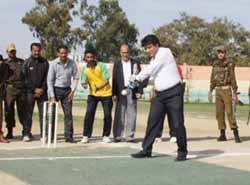 Police Martyrs T20 Cricket Tournament at M A Stadium here.
Speaking on the occasion, the DGP said the objective of conducting the tournament was to channelise the energy of youth to promote sports in the State and enhance police-public relations.
He also declared that a women cricket tri-series between Queen Blues, Queen Reds and Queen Greens will also be held from March 21 at the same venue.
A total of 12 teams drawn from various districts of the State are competing in the tournament being organised by J&K Police under the supervision of IGP Jammu, Dilbagh Singh.
Prominent among others present on the occasion included Additional DGPs Dr S P Vaid and Ram Lubaya, IGPs Dilbagb Singh and Gulzar Singh Slathia, DIGs Farooq Khan, A K Atri, Sulaiman Salaria, Garib Dass and Surinder Gupta, SSPs Parbhat Singh, Vijay Kumar, Bhupinder Singh, Nisar Ahmed Khan, Mujtaba, Joginder Singh, Rupender Kumar Chalotra, Mohammad Amin Khan, Shalender Singh, J S Jowhar, Rajesh Kumar, Ramesh Angral and R K Bhat, Kiran Wattal, Secretary, State Sports Council, Jameel, Sunil Gupta, Atul Sharma, Ravi Singh, Randhir Singh, Naveen Sharma, Dhruv Mahajan, Rakesh Koul and Sameer Khajuria.
Former Ranji player, Rajesh Gill is the organising secretary of the tournament.
In the matches played today, Engineers XI dispatched Aircel XI by 30 runs in a one sided affair.
Batting first, Engineers XI piled up 164 runs in the allotted overs which in reply, Aircel XI could manage 134 runs for the loss of nine wickets in their allotted quota of overs.

Nightingale pre-school celebrates Annual Day
Excelsior Correspondent
JAMMU, Mar 14: Nightingale pre-school today celebrated its Annual Day in its both branches at 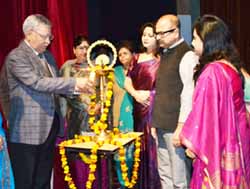 Channi and Rehari respectively.
DIG Jammu-Kathua Range, Farooq Khan, was the chief guest while BJP State Secretary and managing director of the school, Yudhvir Sethi was the guest of honour.
The function commenced with the lighting of lamp by the chief guest and other dignitaries.
Addressing the gathering, DIG, Farooq Khan, said when most of the educational institutions have been converted into an industry, the schools like Nightingale provides a ray of hope for the parents who want their kids to start their basic schooling with quality education and limited resources.
He also appreciated the presentations based on various themes like save girl child, save earth, plant trees, make environment clean and pollution free, make judicious use of water and other natural resources.
Managing director of the school, Yudhvir Sethi said the motive of the institution was to impart good education coupled with inducing patriotic feelings and preparing young kids for future challenges.
Chairman of the school, Priya Sethi presented the annual report and highlighted the achievements.
Earlier, Principal of the school, Priyanaka Kapoor delivered the welcome address.
The students of the school presented various colourful cultural items to mark the occasion.
2nd Rajiv Gandhi Gold Cup Football Tournament J&K Bank demolishes Young Heros
Excelsior Sports Correspondent
JAMMU, Mar 14: J&K Bank produced a flawless performance to topple Young Heros Club by  whopping 7-0 goals in the ongoing 2nd Rajiv Gandhi Football Gold Cup being played at GGM Science College Ground here today.
Rohit Kumar drew first blood in the 2nd minute to dominate the proceedings from the onset.
Bilal Ahmed them made it 2-0 in the 10th minute while Khalid scored a beauty in the 20th minute to put his team in a commanding position.
Young Heros forwards were clueless against the impeccable defense of formidable J&K Bank team.
In the 28th minute, it was the turn of Rohit to showcase his skills as he put the ball in the goal post to make things more difficult for rival team.
At half time, J&K Bank was comfortably placed with 4-0 lead. The second half was no different from the first as J&K Bank continued to dominate their opponents.
Bilal slammed fifth goal of the team in the 42nd minute followed it with another in the 51st minute to make it 6-0.
Jonny struck the seventh goal of the team in the 53rd minute to virtually seal the fate of the match.
Meanwhile, Wasim Feroze and Pankaj Kumar of J&K Bank and Young Heros respectively were shown the yellow cards.
The match was officiated by Rakesh Kumar, Vijay Kumar, Sohan Kumar, Gagan Kumar and Anil Kumar.
Earlier, PAP Jallahdhar got the better of Power Development Corporation by 2-0 goals. The goals were scored by Pawandeep Singh and Jatinder Singh in the 42nd and 65th minute respectively.
Tomorrow, J&K Forest will take on Sainik Colony in the first quarterfinal while J&K Police is to square off with J&K Bank Academy in the second quarterfinal.