

WASHINGTON, may 1: US Secretary of State Hillary Clinton departed on a high-stakes trip to China, where the saga of a Chinese rights activist who has reportedly taken refuge at the US embassy threatens to overshadow high-level meetings between the two governments.
Clinton and Treasury Secretary Timothy Geithner will lead the US team at the “strategic and economic dialogue” on Thursday and Friday, an annual meeting aimed at broadening ties between the world’s two top economies..
But sharp divisions between Washington and Beijing on human rights could dominate the agenda following last week’s dramatic escape of lawyer Chen Guangcheng, who activists say has taken refuge at the U.S. Embassy after a dramatic escape from house arrest.
US President Barack Obama and other officials have declined to answer repeated questions about Chen’s whereabouts, underscoring the sensitivity of the situation ahead of the US presidential election and a choreographed leadership change in China’s ruling Communist Party.
But Clinton yesterday pledged to press China’s leaders on the issue of human rights, which has dropped down the agenda between the two countries in the more than two decades since the 1989 Tiananmen Square crackdown.
Assistant Secretary of State Kurt Campbell was sent to Beijing over the weekend in what analysts say is an effort to forge a last-minute deal over Chen, a blind self-trained lawyer who is one of China’s best known rights advocates.
Current and former US officials say possible solutions include Chen going into exile, something associates say he does not want, or being allowed to live in freedom in China, something which may prove difficult for China’s leaders to accept.
Clinton herself has in prior public speeches highlighted Chen’s case, and both human rights groups and Obama’s presumptive Republican challenger in the November elections, Mitt Romney, have called on the United States to ensure that Chen and his family are protected from persecution.
The Chen case has already distracted attention from the two-day talks, which take place amid some progress in long-standing disputes over currency, trade and market access.
The talks will also give Washington a new chance to win more Chinese coooperation on international issues including pressuring Iran and North Korea over their nuclear programs, halting Syria’s continued crackdown on unarmed protesters and reducing tensions over competing territorial claims in the South China Sea. (AGENCIES)
Clinton departs for China amid dissident controversy
Bo’s wife dressed as Chinese army general after Heywood death- source
BEIJING, May 1: A woman at the centre of China’s biggest political scandal in two decades, wife of deposed political leader Bo Xilai, had once dressed as a military commander last year in a bizarre episode that shines new light on the collapse of Bo’s inner circle.
Bo, ambitious former leader of China’s biggest municipality Chongqing, was sacked in March after police began investigating his wife, Gu Kailai, on suspicion of murdering a former family friend, British businessman Neil Heywood, in a row over money.
News of Bo’s removal and the murder allegation against his wife, who is a lawyer and businesswoman, emerged only a month ago, but new details uncovered by Reuters show the house of Bo was already in chaotic decline at the time of Heywood’s death.
The new details, provided by sources with knowledge of the police case against Gu, include that she is alleged to have poisoned Heywood after the Briton demanded a 10 percent cut for his role in organising a large, illicit money transfer for her.
A few days after Heywood was killed in Chongqing, southwest China in November, Gu strode into a meeting of police officials wearing a military uniform and gave a rambling speech in which she told the startled officials that she was on a mission to protect the city’s police chief, Wang Lijun, the source said.
“First she said that she was under secret orders from the Ministry of Public Security to effectively protect Comrade Wang Lijun’s personal safety in Chongqing,” said the source, adding that she wore a green People’s Liberation Army (PLA) uniform with a major-general’s insignia and bristling with decorations.
“It was a mess,” he said of Gu’s speech, which circulated among some police and officials. “I reached the conclusion that she would be trouble.”
It was not clear to those present why Gu, who had never served in the military, had put on a PLA uniform or what she was trying to convey with her vow to protect Wang, the source said. The incident, on or about November 20, left the officials even more bewildered about her mental state, he added.
At that time, Heywood’s family had been told that there were no suspicious circumstances and that he had died of a heart attack brought on by excessive alcohol consumption.
Only later did Wang begin probing Heywood’s death, treating it as a poisoning and identifying Gu as chief suspect. He revealed his suspicions to Bo at an explosive meeting in January, sources said. The police chief then fled to a US consulate in February, hiding inside for more than 24 hours before leaving into the custody of central government officials.
Wang had been the spearhead of Bo’s anti-corruption drive in Chongqing, a plank in the politician’s barely concealed campaign to enter the topmost ranks of the ruling Communist Party.
HEYWOOD ‘DEMANDED 10 PCT’
Gu’s appearance in PLA uniform was part of a cascade of extraordinary events that have led to China’s worst leadership crisis since the 1989 Tiananmen Square crackdown, months before the party anoints a new generation of top leaders.
There had been rumours circulating in elite circles that Gu had been assigned a military rank, but officials dismissed them as an attempt to brandish her authority and background.
Her uniform was of the same rank as her father’s, a PLA leader who fought the Japanese occupation in the 1930s and 1940s, and might have been given to her out of “respect for her father”, said a second source with knowledge of the incident.
Even if Gu was somehow entitled to the uniform, which the sources doubted, the civilian setting in which she showed her apparent military rank made her performance disturbing and politically troublesome, they said.
“That was clearly a violation of disciplinary rules, a serious one,” said the first source with ties to Bo and his family, referring to talk among officials that Gu had assumed a military title. “Even her background gives her no right to do anything like that.”
Gu and the family’s 32-year-old aide, Zhang Xiaojun, have been named as the main suspects in the murder of Heywood, whose body was found in a Chongqing hotel room on November 15. Chinese authorities say he was poisoned.
Bo, who was suspended from the elite Politburo last month, could later face a police investigation as well.
Neither Bo nor Gu has been allowed to answer the accusations in public. Heywood’s family has also declined to comment.
Chinese government ministries have not responded to written questions about the case against Gu.
A source citing details from Wang’s testimony to investigators said Gu became angry and increasingly distrustful with Heywood after he demanded “at least 10 percent” to move a large sum abroad for her.
Sources had previously said Heywood demanded an unspecified proportion of the deal that Gu considered too large.
“It was a large amount, probably from a dirty deal, and Heywood was also nervous about handling it,” said the source. He said he did not know the size of the offshore transaction.
It remains unclear how Heywood might have helped Gu shift money offshore. Chinese citizens are only allowed to transfer 50,000 dollars out of the country each year.
BO’S MISGIVINGS
Long before Gu’s alleged falling out with Heywood, Bo voiced misgivings about her involvement in business, according to another British businessman who had dealt with Gu and Heywood.
“He hated what she was doing,” said Giles Hall who dined with Heywood and the Bo family on a visit to China a decade ago, recalling a heated conversation overheard between Bo and Gu.
“There was an agitated conversation going on. There were a few threats being made. We were a bit nervous. We were in this restaurant. We said (to the interpreter) ‘What’s the problem?’ and the interpreter said ‘Her husband does not like her business dealings’. So he wasn’t happy with it.”
Hall, who was trying to tempt Bo to set up a tourism venture involving a hotair balloon, said Gu showed a ruthless streak.
“You couldn’t cut her up (cross her) that was for certain. She said to me ‘You cross me – never come to China, you’ll never get out of jail’. There was no mucking about.”
(AGENCIES)
Sees “military-type” response to anti-Wall St demos
UNDATED, May 1: Oakland police used “an overwhelming military-type response” to disperse Occupy Oakland demonstrators and fired at a former Marine and Iraq war veteran who was critically injured in the clashes in October, according to a report issued.
The report by an outside monitor of the Oakland Police Department came one day before anti-Wall Street protesters plan nationwide rallies today, with Occupy Oakland demonstrators vowing to take over San Francisco’s iconic Golden Gate Bridge.
Oakland’s police practices came under intense scrutiny last year when former Marine Scott Olsen was critically injured during a demonstration in October. Protesters said he was hit in the head by a tear gas canister.
The report concludes, for the first time from an official source, that police did fire at and hit Olsen that evening. An Oakland Police Department SWAT team member fired a beanbag round at Olsen, striking him in the head, according to the report.
“We have viewed many official and unofficial video clips of the Occupy Oakland-related incidents,” the report said. “These recordings lead us to ask additional questions as the level of force that was used by OPD officers, and whether that use of force was in compliance with the Department’s use of force policies.”
The beanbag rounds fired that night leave a green residue, which was found on the hat Olsen was wearing that night, later retrieved by police, according to the report.
Olsen’s case reinvigorated the Occupy movement against economic inequality, and the confrontations with police in subsequent protests turned Oakland into a focal point for the movement as demonstrators rallied against what they described as police brutality.
The Oakland Police Department has been subject to court-ordered external monitoring and review since the 2003 settlement of what was known as the Riders case, in which four officers were accused of planting evidence, fabricating police reports and using unlawful force, according to the Oakland police.
Yesterday’s report was the latest in a series designed to monitor and enforce compliance with the court-ordered reforms, known as the Negotiated Settlement Agreement.
“We were, in some instances, satisfied with the performance of the Department; yet in others, we were thoroughly dismayed by what we observed,” police monitor Robert Warshaw wrote in his quarterly report.
The police department announced last week that it was making significant changes to how it trains officers to control large crowds following criticism over its practices during Occupy Oakland protests that sometimes turned violent. It received more than 1,000 misconduct complaints during those protests.
“OPD has turned the corner,” Oakland Police Chief Howard Jordan said in a statement upon the report’s release. “My vision is to make Oakland one of the safer major cities in California.”
(AGENCIES)
Neutrinos ‘may soon be measured accurately’
WASHINGTON, May 1: Planetary scientists claim that their new research would for the first time help astronomers accurately measure neutrinos—the lightest known subatomic particles in the universe.
After more than 200 nights of galaxy-gazing and thousands of calculations, an international team has published their new study that they claim has made a remarkable headway in the way the mass of neutrinos are measured.
The study, published in the ‘Physical Review D Rapid Communication’, concludes cosmological galaxy measurements are more effective than laboratory experiments on Earth when it comes to constraining neutrino mass for measurement.
Neutrinos are the subatomic-sized fundamental particles floating in the universe and the lightest massive known particles, yet they are traditionally treated as not having any mass.
Lead author Dr Signe Riemer-Sorensen at the University of Queensland said their study would allow researchers to gain a more accurate and highly sensitive picture of neutrino mass, and this could lead to new understandings of the universe.
“This research paves the way for more sensitive future galaxy surveys to understand the mysterious workings of the Universe, and will help in new advancements such as improved models of supernova explosions and in designing neutrino telescopes that can probe much more distant objects than classical telescopes,” said Dr Riemer-Sorensen.
Although laboratory experiments on Earth so far have been able to measure the differences in the masses between the various species of neutrinos, these have been unsuccessful in measuring absolute neutrino mass with sufficient sensitivity.
Using the universe as a large particle physics experiment, the team attempted to limit the range of possible neutrino masses by understanding how galaxies form.
“One of the major challenges is that galaxy formation is not well-described theoretically. We have tested a range of previously used theories and demonstrated that most of them are not precise enough to use with present and upcoming galaxy surveys with the much-desired higher level of sensitivity to the neutrino mass,” Dr Riemer-Sorensen said.
Using high-quality data from the team’s WiggleZ Dark Energy Survey – a massive three-dimensional galaxy map of 240,000 galaxies – the researchers in this study applied a mixture of analytical modelling and simulation to achieve their results.
“Despite the modelling challenges, cosmology does a much better job than laboratory experiments when it comes to constraining the neutrino mass,” said Dr Riemer-Sorensen. (PTI)
Sarkozy swing right wins him scant ground in polls
PARIS, May 1: A resurgent French far-right is playing into the hands of Socialist presidential candidate Francois Hollande, who is cruising into Sunday’s runoff vote freed of having to make concessions to a weakened hard left.
Hollande no longer needs to risk losing centrist votes by appealing to hard-left voters after their candidate faded in the first round. By contrast, a campaign by incumbent Nicolas Sarkozy to win back conservative voters after a strong far-right showing seems to be failing.
Far-right leader Marine Le Pen’s surprise 17.9 per cent score in the first-round on April 22 seemed to throw Hollande’s lead over Sarkozy into question, as most supporters of her National Front had been expected to vote conservative in a runoff.
Yet a week on, Sarkozy looks no better off in opinion polls and may have put off many centre-ground voters with his tough talk about immigration and borders so clearly aimed at the far right that it upset many in his own camp.
Hollande, meanwhile, has plodded on with the same tone and the same platform he set out in January.
Humbled by his 11 percent first round score – well below the 14-17 percent he was polling a month ago – leftist Jean-Luc Melenchon has gone from clenched-fist tirades to asking Hollande politely not to overlook issues such as the minimum wage.
“Hollande is much less encumbered by his extreme left than Sarkozy is by his extreme right,” said political scientist Pascal Perrineau. “Hollande doesn’t need to send messages to his extreme wing, while Sarkozy is doomed if he doesn’t.”
With Hollande’s campaign anchoring left-wing and centrist voters, his backers in the business community hope the fading of the far-left will free him to nudge forward structural economic reforms his aides say he is privately keen to carry out.
“If Hollande wins with a big margin he won’t need to pick ministers who are tokens for the extreme left,” said investment banker Matthieu Pigasse, who is close to senior Socialists and was tutored by Hollande in economics years ago.
Pigasse, now CEO of Lazard France and co-owner of the daily newspaper Le Monde, said he believed Hollande would be as much of a reformer as Socialist Prime Minister Lionel Jospin, who sold state-owned firms and trimmed taxes in his 1997-2002 term.
“I am not part of the campaign team so I don’t know what’s inside his boxes, but I am convinced he wants change. He’s being prudent in what he says but paradoxically the French left has always reformed more than the right,” he said. “The labour market needs more flexibility and I think Hollande can do it.”
Latest polls give Hollande a comfortable 6-10 point lead over Sarkozy before Wednesday’s sole television debate.
An OpinionWay-Fiducial survey found 49 percent of voters feel Sarkozy’s campaign was leaning too far to the right. Among centrists, 60 percent felt Sarkozy had tilted too far and 56 per cent judged Hollande’s campaign to be spot on.
“The very right-wing position adopted by the president to seduce National Front voters seems to have been totally counter-productive,” said opinion pollster Gael Sliman of the BVA institute. He said Le Pen voters seemed annoyed he was using “such a thick line to fish them”.
First round National Front voters seem to be splitting in three ways for the runoff. Around half will opt for Sarkozy, but many seem set on abstaining or even voting for Hollande.
CONSISTENCY
While Sarkozy hammered home the need for strong frontiers and a clear national identity, using the word “border” dozens of times in a speech to supporters in southern France on Sunday, Hollande told a rally in Paris he would not stoop to such tactics to chase National Front votes.
“I am not going for flattery or exaggerated seduction. I am about coherence and consistency, that’s what sets me apart in this campaign,” Hollande said as even some conservatives voiced unease at Sarkozy’s embracing of Le Pen’s rhetoric.
A self-styled “Mr. Normal” who sees his calm temperament as a selling point contrasted to Sarkozy’s hot-bloodedness, Hollande was the unexpected Socialist contender after a sex scandal ended former IMF chief Dominique Strauss-Kahn’s chances of running.
He lacks Strauss-Kahn’s intellectual sparkle and Sarkozy’s verbal fireworks, but has held steadily to his ideas of higher taxes to cut the budget deficit and a bigger European focus on economic growth as the president has veered right on immigration and Europe.
Financial markets fretted at first about Melenchon’s influence, particularly after Hollande made a surprise proposal of a 75 percent tax on income over 1 million euros (1.33 million dollars). However, the first round result may have created more room for Hollande to appoint market-friendly ministers.
Hollande had been considered likely to pick Socialist Party leader Martine Aubry as prime minister to keep hard-left voters happy. Many now see him opting for Jean-Marc Ayrault, a German-speaking moderate who has worked on Hollande’s European agenda, or Michel Sapin, his business-friendly economic adviser.
“The fact that Melenchon didn’t get the blowaway score he expected leaves much more freedom of choice,” a member of Hollande’s team told the daily Liberation, asked about Ayrault.
The Left Front coalition headed by Melenchon may still do well in parliamentary elections on June 10 and 17 but analysts doubt Hollande would end up dependent on it for a majority.
If Sarkozy loses, the mainstream right may be in such disarray that Hollande could have a window of opportunity to pass reform legislation.
“If he wants to get reforms done he needs to move as fast as possible to take advantage of the few months the conservatives will be mired in infighting,” said an influential French business chief. “He’s basically got the summer to play with.”
($1 = 0.7542 euros)
(AGENCIES)
12 cases settled in Lok Adalat
Excelsior Correspondent
JAMMU, Apr 30: A Lok Adalat was held at the Court Complex of Sub Judge, Nowshera, in which a total of 20 cases were taken up, out of which 12 cases were decided.
The Lok Adalat was held under the chairmanship of OP Thakur, Tehsil Legal Services Committee, Sub Judge Nowshera and was assisted by Advocate Ajit Singh.
DM issues notice to gangster under PSA
Excelsior Correspondent
JAMMU Apr 30: District Magistrate Jammu has issued notice under Public Safety Act (PSA) to notorious and dreaded gangster Varinder Gupta alias Kaka Chichdi, son of Banarsi Dass of Talab Tillo, who is involved in murder, attempt to murder, assault and land grabbing cases.
According to an official handout, Kaka Chichdi is a history-sheeter, hardcore criminal, desperate character and habitual of indulging in acts of violence.
“He is involved in numerous criminal activities of serious and heinous nature over a period of time and has spread a reign of terror and fear of insecurity amongst the peace loving people of the area”, the spokesman said, adding “the gangster has organized a land grabbing mafia in league with most infamous land grabber of Jammu city namely Ravinder Gupta alias Gola Shah, son of Suraj Parkash Gupta of Greater Kailash, and had gone underground to evade detention”.
The recommendation for the detention of gangster under PSA has been made by District Police Jammu to crush criminal-land mafia nexus.
District Magistrate had ordered the detention of gangster under Public Safety Act but he concealed his presence, went underground and remained absconding to evade execution of the warrant.
In terms of Section 12(b) of the Public Safety Act, 1978, Varinder Gupta has now been ordered by the District Magistrate to appear before him with in 30 days. “The notified order has been pasted outside the residential house of the gangster in presence of the respectables of the area by Nowabad Police and further search of the gangster is also going on”, the spokesman said.
Megh Sudhar Sabha elects office bearers
Excelsior Correspondent
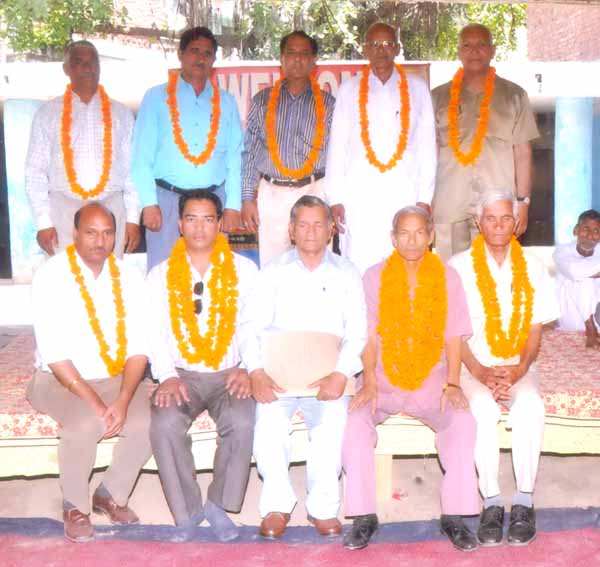
JAMMU, Apr 30: The general body election of All J&K Megh Sudhar Sabha was organised at its headquarter in Old Rehari, under the presidentship of chairman of the Sabha in the presence of Assistant Registrar (retd), High Court, Jammu, Aman Ullah Malik, here today.
During the election, Milkhi Ram Bhagat was elected as president, Behari Lal Bhagat as senior vice-president, Puran Chand Bhagat of Sure Chak and Puran Chand Bhagat of Motta, RS Pura as vice presidents, Narinder Dutt as general secretary and Romesh Lal Bhagat as treasurer-cum-cashier.
Mahant Ram Puri was elected as joint secretary, Amar Nath as office secretary, Sham Lal Bhagat as organising secretary-cum-store keeper whereas Sansar Chand Bhagat of RS Pura and Sansar Chand of Udhaywala were elected as executive members.
Annual function of Mata Bagla Mukhi Ji celebrated
Excelsior Correspondent
JAMMU, Apr 30: All J&K Dharmarth Trust celebrated the annual function of Shree Bagla Mataji by performing Havana and special Poojas at Shree Natraj Ji Temple Complex in Shree Raghu Nath Ji temple, here today.
Besides prominent citizens, all the officers and employees of the Trust joined the celebrations.
Secretary of the Trust, Shashi Khajuria accompanied by prominent citizens and staff performed special pooja and distributed prashad to the devotees.
The Temple was inaugurated on April 29, 1979 by Dr Karan Singh along with his wife and since then a commemorative function is held here every year for peace and prosperity of the State.