

WASHINGTON, May 15: The US has all the ingredients to be successful for the next 200 years, US President Barack Obama has said, hoping that he would get another chance to get the US back on track.
“We’ve still got the finest workers in the world, the best universities in the world, we’ve the best scientists, the best entrepreneurs, we’ve got the best market system in the world, so we’ve got all the ingredients for success for the next 100, next 200 years,” Obama, who is seeking his re-election, told the ABC News in an interview.
“But what’s happened is, is that our politics breaks down we’ve become more obsessed with winning the election than setting things up for the next generation and if we can break through that I could not be more confident or more proud of the this country and the direction we’re headed,” he said.
“It will happen. I believe it. It always does,” said the US President, exuding confidence.
Obama said that what he wants is to spend the next five years doing is recreating that America where if you work hard you can make it, regardless of where you come from, what you look like.
“The one thing, if you don’t mind me taking just a little bit of time on this you know sometimes you hear about America’s declining or we’re weaker or China’s on the rise or this, that or the other,” he said.
“Let me tell you, I travel all around the world and everywhere you go, if you ask people where would you want to be, what country you admire, what cards you would like to have in your hand, it’s what we’ve got,” Obama said. (PTI)
US has all ingredients for success for next 200 years: Obama
UN chief asks Nepali leaders to arrive at consensus
UNITED NATIONS, May 15: United Nations general secretary Ban ki-moon has urged political leaders in Nepal to forge a consensus on their differences in the country’s constitution-making process.
The UN chief expressed concern over the rising tensions and disruption of life across the Himalayan nation.
Through his spokesperson, Mr Ban yesterday said,”With time fast running out before the May 28 deadline for the Constituent Assembly to complete its work, it is imperative for the political parties of Nepal to rise above their differences and reach a consensus. Having taken important historical steps since 2005, they cannot afford to disappoint the Nepali people.”
The South Asian country has been plagued by political disputes since the civil war between Government forces and Maoists, which claimed 13,000 lives, formally ended in 2007, and its monarchy was abolished. Several deadlines to draft a new constitution have been missed.
The spokesperson said,”It is important to adhere to existing agreements to meet the aspirations of traditionally marginalised groups. At the same time, efforts should be made to assuage the concerns of communities who fear they would be disadvantaged under a federal system.”
He also noted that the Secretary-General urges all, particularly those carrying out public protests, to do so peacefully, with full respect for the rights of others and without disrupting humanitarian access across the country.
“Mr Ban calls on the Government to meaningfully address the escalating tensions and respond to the situation in accordance with national and international law,” the spokesperson added. (UNI)
Seven Indian nurses rescued in Saudi Arabia

DUBAI, May 15: Seven Indian nurses stranded in Saudi Arabia without proper documents have been rescued and repatriated following intervention by the Indian Embassy.
The nurses were stranded in two separate cases without papers, an official working with the labour section of the Indian Embassy said.
“In the first case, four Indian female nurses – Ashley, Bindu, Aasha and Shely – came to the Kingdom five years ago to work in Aghsan Aliwy Hospital in Hafr Al-Batin,” M Aleem said.
“The sponsor neither renewed the residence permits (Iqamas) of the workers nor did he allow the nurses to leave during vacations as per the provisions of the work agreements,”
he said.
Once alerted, the Indian Embassy established communication with the hospital officials and involved some local Indian community leaders.
“But, all pleas fell on the deaf ears of the sponsor, which finally led me to decide on a stronger course of action,” Aleem was quoted by Arab News as saying.
According to Aleem, he then took the case to the Hafr Al-Batin deputy governor and the Director General of Health Mutlak Al-Khemyali, who extended full support in rescuing the nurses.
Al-Khemyali raised the issue with the directors of the Passport Department and Labour Office. He then called the Saudi sponsor to endorse the final exit visa and pay the air fares for the nurses.
“And thanks to the efforts of the Saudi officials, especially Al-Khemyali, that these nurses were finally repatriated to India last week,” Aleem said.
In the other case, three nurses – Saramma Varghese, Subadhra Omana Kuttan and Sree Latha Vasudevan Nair – were rescued and repatriated.
These nurses were allegedly stranded after the new owner of a clinic closed down the organisation without giving any prior notice.
He also turned down requests to extend validity of their Saudi ID papers. These nurses had been working for the last 18 years and their clinic was handed over to another third Saudi citizen on an operational contract basis after their sponsor died.
The embassy succeeded in convincing him to grant the nurses final exit documents, said Aleem.
The nurses were later sent back to India. (PTI)
‘Jindal has chance to be selected as Romney’s running mate’
WASHINGTON, May 15: Indian American Louisiana Governor Bobby Jindal has a good chance of being selected as vice-presidential running mate of Mitt Romney, the presumptive Republican presidential nominee, a media report has said.
“Though the nation’s first Indian-American governor may be flying a bit under the radar in the VP speculation game, his chance of being selected may be as good as any of the more buzzed-about prospects,” RealClearPolitics.Com has said.
“He’s certainly on the short list as far as qualified people that could be a complement to Governor Romney,” Utah Governor Gary Herbert, who endorsed the now-presumptive nominee in early February was quoted as saying.
Jindal, who is serving a second term as Governor, himself has denied having any vice presidential ambition, and have gone on record several times in the past few weeks that he is currently focused on his job of being the Governor of Louisiana.
“Governor Romney’s hallmark is his ability to turn things around, whether the Olympics here in Utah, or turning around Massachusetts when he was governor, or turning around businesses from failure to success—that’s certainly going to be a big part of his platform, and Bobby’s done that as governor of Louisiana,” Herbert told RealClearPolitics.
The news portal said Jindal’s dismal shows in 2009 when he addressed the nation soon after Obama’s State of the Union Address is unlikely to play any major role in his selection as Romney’s running mate.
Mississippi Governor Haley Barbour, who considered a presidential bid last year and remains one of the most well-connected members of the national Republican establishment, said he had “no idea” whom Romney would pick as his running mate but praised Jindal as “extremely capable” and “genuinely knowledgeable about public policy.”
“Plus he’s a very nice guy—pretty family and a good person,” Barbour said.
“He’s just got a tremendous capacity,” Barbour was quoted as saying.
Though he is only 40, Jindal is already one of the more experienced Republican governors in the country, having been in office for 4 and half years after serving three years as Louisiana’s 1st District representative in the US House, RealClearPolitics.Com said. (PTI)
Oil falls to 5-month low near USD 94 on Europe fears
SINGAPORE, May 15: Oil prices fell to near USD 94 a barrel today in Asia, extending a two-week sell-off that has brought crude to a five-month low amid concern about Europe’s debt crisis.
Benchmark oil for June delivery was down 44 cents to USD 94.34 a barrel, the lowest since December, at midday Singapore time in electronic trading on the New York Mercantile Exchange.
The contract fell USD 1.35 to settle at USD 94.78 in New York yesterday.
Brent crude for July delivery was down 45 cents at USD 110.55 per barrel in London.
Crude has sunk about 11 per cent from USD 106 earlier this month amid signs of slowing economic activity in the world’s two biggest oil consumers, the US and China.
This week, traders are worrying that Greece’s inability to form a government after recent elections could worsen that country’s debt crisis and deep recession, and undermine confidence throughout Europe.
“Greece’s struggle to form a new government has moved to center stage,” energy trader and consultant Ritterbusch and Associates said in a report. “The possibility of a significant economic slowdown in European economic activity is prompting contagion fears.”
Oil investors are also taking their cues from global stock markets, which have slumped so far this month. The Dow Jones industrial average fell 1 per cent yesterday and most Asian stock markets were down today. (AGENCIES)
Bodies of Nepal crash victims to be handed over to families
KATHMANDU, May 15: The bodies of 13 Indian pilgrims who died in a plane crash in northern Nepal will be handed over to their relatives today after the process of postmortem is completed.
The bodies were airlifted to Kathmandu yesterday, according to Agni Air staff.
The Indians were among 15 persons who were killed when a small plane with 21 people on board crashed in northern Nepal yesterday after hitting a hill top while attempting to land at a high-altitude airport.
Six others, including three Indians and two Danish nationals, miraculously survived the crash of the Dornier 9N AIG aircraft belonging to the private carrier Agni Air.
The bodies are now at Tribhuvan University Teaching Hospital in Kathmandu and the process of postmortem has been initiated, the airlines sources said.
Once the postmortem completes, the bodies will be handed over to the kin of the victims under the supervision of the Indian Embassy, they said.
The plane, which flew from the resort town of Pokhara on its way to Jomsom, crashed while landing at the mountain airstrip.
The engine failure is said to be the cause behind the crash, according to the preliminary investigations.
Three Indians, including two children, who survived the accident are currently under treatment at Manipal Teaching Hospital in Pokhara and are out of danger, an official said.
They will be discharged after 4-5 days from the hospital, he said. (PTI)
JP Morgan loss to be investigated; Wall St needs reform: Obama
NEW YORK, May 15: US President Barack Obama has said the USD 2 billion trading loss by “one of the best managed banks” J P Morgan will be investigated and it demonstrates the need for reform at Wall Street.
Had a bank not as strong as J P Morgan made the losses through betting, the government would have had to step in, said Obama, who was in the city to give the commencement address at Barnard College and attend fundraisers event.
Despite J P Morgan being run by one of the “smartest” bankers, it still lost money, making a strong case for Wall Street reform, he added.
“J P Morgan is one of the best-managed banks there is. Jamie Dimon, the head of it, is one of the smartest bankers we got and they still lost two billion dollars and counting,” Obama said in an interview with ABC’s ‘The View’. The full episode will air on Tuesday.
“We don’t know all the details. It’s going to be investigated, but this is why we passed Wall Street reform,” said the President.
Obama said Wall Street reform is “important” as financial giants like J P Morgan are able to weather an error that the bank’s own CEO called “egregious,” but smaller institutions would not be able to take such huge hits.
“This is the best, or one of the best-managed banks. You could have a bank that isn’t as strong, isn’t as profitable making those same bets and we might have had to step in,” Obama said, adding, “That’s exactly why Wall Street reform’s so important.”
While touting his efforts to rein in the Wall Street behaviour that led to the massive taxpayer bailout of the banks following the 2008 financial crisis, he said his administration is still fighting for tough reform. (PTI)
Prof Gani Bhat’s 2012 truth: compulsion or admission?
Excelsior Special Correspondent
JAMMU, May 14: With his first ‘independent’ public rally in hometown Botengo, near Sopore, senior leader of the Mirwaiz Umar Farooq-led faction of the Hurriyat Conference and former head of the separatist conglomerate, Prof Abdul Gani Bhat, has stirred a hornet’s nest across the Valley’s political spectrum. Cynics in the separatist camp have gone to the extent of drawing parallels between Sheikh Mohammad Abdullah’s return to the mainstream political arena in 1975 and Prof Bhat’s truth in 2012. Both happened on completion of 22 years of “secessionist wilderness” of the two Kashmiri leaders.
Sheikh, popularly known as Sher-e-Kashmir, was dismissed in August 1953 as the independent state’s first ‘Wazeer-e-Azam’ (Prime Minister), arrested and tried for treason. He returned to power in 1975 and agreed, under the Indira Abdullah Accord, to work as Chief Minister of Jammu and Kashmir. Bhat has been spearheading the separatist movement since 1990. It is for the first time, in 2012, that he has described over sixty-year-old UN Security Council resolutions on J&K as “not practicable” in resolution of the Kashmir problem in current circumstances.
Intelligentsia from Srinagar and Jammu to New Delhi seems to be reading too much in Prof Bhat’s paroxysm. Characteristic of one time teacher of the Persian language and literature in Degree Colleges of Sopore and Baramulla, high political ballooning has been remarkably witnessed from him in the last few years. In the Persian classical ‘Gulistaan’, Sheikh Sa’adi Sheerazi reveals that he learned all the wisdom from the unwise. He did exactly the reverse of what the unwise did, says the saint.
In his recent sailing against the wind, is Prof Bhat outpouring his wisdom and thus rewriting the tenets of “correct politics”? Time will tell. At this stage, one would have to sit fingers crossed as this academic politician has a history— much like almost all of his colleagues in the Hurriyat— of succumbing to pressures and making somersaults. Even after his Botengo balloon, when Bhat found himself lonely at the oar, he lost no time in making “clarifications”. He thumped the tables to say it loud and clear that ‘Azadi’ was the goal and there were two ways of achieving it—second being the ‘tripartite talks’ between New Delhi, Islamabad and the Kashmiri leadership (read Rajbagh). He drove short of “clarification” that Farooq Abdullah’s National Conference and Mufti Sayeed’s PDP could have a role in facilitation of the ‘tripartite talks’.
As he would like to call them, the ‘untold truths’ have been intermittently coming out of Prof Bhat. In January last year, he sprang a surprise across Valley buy admitting publicly, after 21 years of the guerrilla warfare, that “almost everybody of our intellectuals, political and religious leaders was eliminated by our own boys”. Coming from the proverbial horse’s mouth, Bhat’s confession, on occasion of the assassination ceremony of the Kashmir University’s Professor of Law Dr Abdul Ahad Wani, literally shut the mouth of the protagonists who shouted for decades that every single intellectual in the Valley had been eliminated by the Indian security forces and the counter-insurgents attached to them.
Groups aligned to Syed Ali Shah Geelani’s radical faction of the Hurriyat have raised a storm over Bhat’s “loose talk” but, significantly, Islamabad does not seem to have taken ill of his assertion. This has, to an extent, emboldened Bhat’s “moderate” colleagues in the Mirwaiz-led Hurriyat. With a marked shift on their traditional track, cleric-politicians like Mirwaiz and Aga Syed Hassan of Budgam have delivered more of their sermons on governance and development than their clichéd subject of Azadi and resistance in the last two weeks. Even before that, Mirwaiz hogged headlines over inaugurating a commercial complex belonging to a non-Muslim in downtown Srinagar.
Interestingly, of late, Mirwaiz has shown tremendous concern over the mushroom growth of canines and the increasing numbers of humans being bitten by pariah and rabid dogs in Srinagar every day. He has been speaking about the condition of roads and the quality of air and drinking water besides rising prices, traffic jams and the ‘cruel’ school timings. For 22 years, Mirwaiz and his colleagues viewed such mundane issues and demands as “gameplan of the Indian agencies to distract attention from the real issue of Azadi”. Will this reasoning, they called for massive protests and enforced boycott to Assembly and Parliamentary elections.
In fact, saying something in Srinagar is more courageous than saying the same in New Delhi, Muzaffarabad or Islamabad. Even the men like JLKF Chairman, Yasin Malik, have been demonstrating that “courage” every month. One would even refer to many of Mirwaiz Umar’s “courageous” statements delivered outside Kashmir. When, nearly a decade ago, Jihadist guerrillas took exception to Mirwaiz Umar’s purported remarks in his interview to Time magazine [in which he blamed militants of looting the Kashmir Azadi funds] and they wanted him bend, he crawled with a “clarification” at Jamia Masjid. He “clarified” that “renegades and Ikhwanis” had been “looting the Kashmir Azadi funds”! Were the renegades supported by Pakistan and holding key to the Azadi funds? Nobody dared to question.
In current scenario too, Mirwaiz has exhausted his energy since last week to make it clear to Prof Bhat’s critics that the Hurriyat, as a separatist umbrella, was holding the UN resolutions on Kashmir sacrosanct.
Not long ago, none other than Mirwaiz, said at a conference in Karachi that the Kashmir problem could not be resolved on the basis of majority: minority (read UN resolutions). As reported by then Srinagar Bureau Chief of Daily Excelsior, Ahmed Ali Fayyaz, from Karachi in March 2006, Mirwaiz made the courageous statement on a platform which had veterans like the former PoK President and ‘Prime Minister’ Sardar Abdul Qayoom Khan, as the key speakers. NC’s veteran, Mohammad Shafi Uri, PDP stalwart and then Forest Minister, Tariq Hamid Karra, CPM leader Mohammad Yousuf Tarigami and political commentator Balraj Puri were also present.
As reported in Excelsior and never contradicted by anybody, Mirwaiz asserted in his speech that the future of the multi-culture, multi-faith and multi-language state of Jammu and Kashmir could never be determined on the pattern of vote counting. He emphasized on the ‘all inclusive’ resolution and made it clear that there was no way of an exclusive resolution.
Mirwaiz is not expected to repeat his own Karachi statement of March 2006 and thus second his colleague Prof Bhat, more so when the UN Secretary General Banki Moon’s recognition of the Kashmir resolutions in New Delhi is still live. But, even at this stage, it is unmistakably clear that many men of consequence in Kashmir’s separatist camp have afresh begun to read the writing on the wall post 9/11 (terror strikes on America that turned the world against terrorism), post-26/11 (Mumbai strikes that forced change in New Delhi’s softness towards terror) and post-2010 (street violence that left over 100 dead in Valley without any achievement).
All to be watched with interest is whether Prof Gani’s boat would sail smooth or it would be rocked by hardliners like Geelani. In their attempt to keep themselves “politically correct” in Srinagar, Bhat’s own colleagues or the pseudo-separatist parties in the mainstream fold could also play the spoilsport.
HS to review trade, security scenario
Singh visiting J&K on May 16, 17
Sanjeev Pargal
JAMMU, May 14: After canceling his visit ending last month, Union Home Secretary R K Singh is visiting the State on May 16 and 17 to review security scenario and discuss cross-LoC Confidence Building Measures (CBMs) especially giving a boost to trade on Poonch-Rawlakote and Uri-Muzaffarabad routes.
Mr Singh’s visit comes ahead of Home Secretary level talks between India and Pakistan on May 24 and 25 at Islamabad, Pakistan.
Mr Singh was scheduled to visit Uri and Poonch in the last week of April but had deferred his visit as Chief Minister Omar Abdullah was on a tour of twin border districts of Rajouri and Poonch for four days during the same time.
Official sources told the Excelsior that Mr Singh now would be visiting Salamabad on Uri-Muzaffarabad route in Kashmir on May 16 and Chakan-Da-Bagh on Poonch-Rawlakote route in Jammu on May 17 for on spot review of arrangements made for cross-LoC trade and more facilities and infrastructure required to give boost to it.
Accompanied by top civil and police officials of the State, Mr Singh would be meeting the traders dealing with cross-LoC business at both the places (Chakan-Da-Bagh and Salamabad) and listen to their demands to take up some of them during talks with his counterpart at Islamabad.
Two major demands of the cross-LoC traders, which have also been backed by Chief Minister Omar Abdullah, for opening of banking channels on either side of cross-LoC routes to end barter system of business between two parts of divided State and communication system, would be taken up by the traders as well as the administration with the Union Home Secretary.
The issue of communication channels and currency system for the trade was expected to figure during the Home Secretary level talks.
Sources said Mr Singh would also review security scenario in the State at a high level meeting in Srinagar on the evening of May 16. Top brass of civil and police administration, para-military forces and Intelligence agencies would attend the meeting and share their perception of situation with the Home Secretary.
Security arrangements for upcoming Amarnath yatra from June 25-August 2, peaceful summer in Kashmir Valley, keeping a check on militancy, hawala transactions, money laundering and infiltration attempts on the border would be discussed at the high level security review meeting, sources said.
The cross-LoC traders of Poonch, Rawlakote, Uri and Muzaffarabad had recently floated first ever Cross LoC Traders Federation of 44 members to vigorously pursue their demands with their concerned Home Secretaries so that they were discussed during May 24-25 meeting at Islamabad and taken to logical conclusion.
Sources said the Union Government wanted to take up the issue of converting cross-LoC trade from barter system to currency based. The ways and means for switching over to new system would first be discussed with civil and police administration besides Intelligence and other agencies engaged with conducting cross-LoC trade followed by representatives of the State Government before the Home Secretary took up the issue with his counterpart of Pakistan in Islamabad.
In the present barter system of trade, the businessmen had been facing a lot of problems to maintain their accounts and currency of both the countries keep on fluctuating.
The lack of communication system between Jammu and Kashmir and Pakistan occupied Kashmir (PoK) was another issue, which was being discussed by the Union Government on the request of the State Government. It may be mentioned here that ISD link from J&K to any part of Pakistan besides PoK has been barred for past quite a long time as a security reason following apprehensions by security agencies that the militants could misuse the communication facility.
Sources said upgradation of infrastructure at Trade Facilitation Centres at Poonch and Salamabad including installation of full truck scanners and providing other facilities to the businessmen was also under consideration of the Centre Government. Increase in number of items from present list of 21 for trade between two parts of the divided State was also on agenda of the Union Government.
Chief Minister Omar Abdullah had recently said in the Legislative Assembly that the Union Government should open the banking system for the trade instead of present barter system and facilitate communication channels to boost the trade.
Sources said representatives of the State Government, civil and police administration and other agencies connected with the trade besides the businessmen dealing with cross-LoC trade would take up the demand for increasing number of 21 items to 50 for the trade besides facilitation of banking system and opening up communication channels.
Terming cross-LoC trade as a major confidence-building measure between India and Pakistan, sources said there was a need to further ease it so that its benefits trickle down to the trading partners.
“There is a need for restoration of telephonic links between Jammu and Kashmir and Pakistan-Occupied Kashmir (PoK) and putting in place a proper institutional arrangement by replacing the current barter system of trade which will also address the security concerns,” they said.
They said the Union Government was required to take up the matter with the Ministries concerned so that the trade can flourish in real terms.
The cross-LoC trade on Uri-Muzaffarabad and Poonch-Rawlakote had recently been increased from twice a week (Tuesday and Wednesday) to four days (Tuesday to Friday). However, in the absence of increase in number of items and use of currency, the trade had not been picking up, sources said.
It may be mentioned here that the trade between India and Pakistan through the land route has soared by 44 per cent in 2011-12 to Rs 2,341 crore from Attari-Wagah route.
Though the balance of trade is still in India’s favour, the import from Pakistan through land route rose by over 100 per cent to Rs 965 crore in 2011-12 against Rs 453 crore in the previous fiscal.
Transportation of 32 more coaches for Valley begins
Four reach Udhampur Rly Stn, 8 stationed at Jallandhar
Mohinder Verma
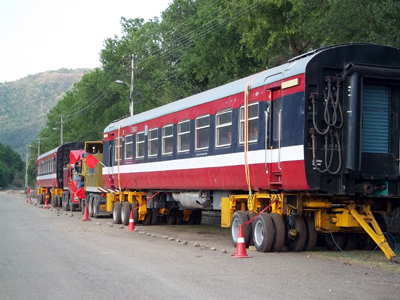
JAMMU, May 14: Keeping in view the growing public demand and opening of Qazigund-Banihal railway line by the end of current year, the transportation of 32 more coaches for the Kashmir valley has begun. Presently, four coaches have reached Udhampur Railway Station while as eight are stationed at Jallandhar.
Official sources told EXCELSIOR that following the approval of the Railway Board in the month of November last year and completion of other formalities, the Northern Railways approached Integrated Coach Factory (ICF) at Chennai and projected the demand for 32 specially designed coaches for being used in the Kashmir valley.
The ICF has so far made delivery of 12 coaches to the Northern Railways and four of them have reached Udhampur Railway Station while as eight are stationed at Jallandhar. The remaining coaches would be moved towards Udhampur from Chennai only after the transportation of already delivered 12 coaches from Udhampur for Kashmir valley.
Stating that beyond Udhampur the coaches would be transported in specially designed trawlers by road, they said that this responsibility has been entrusted to the IRCON India International Ltd, which has engaged Mumbai-based ABC Transportation Company keeping in view its expertise in handling this type of job.
It is pertinent to mention here that the coaches which are presently being used for public transport on Baramulla-Qazigund railway line were also transported by ABC Transportation Company only.
In response to a question, they said that IRCON India International had earlier obtained permission from the SSP Traffic National Highway for transportation of coaches by road but now the company has been asked to seek approval either of Police Headquarters or Inspector General of Police (IGP) Jammu as well as Kashmir Zones as specially designed auto trailer would have to cross the jurisdiction of five districts.
At present two coaches have been placed on the trailer and their transportation beyond Udhampur would begin as soon as PHQ gives its nod.
Responding to another question, they said, “coaches would have to be shifted to Budgam Railway Station as unloading facility is not available at Qazigund”, adding that transportation of each coach from Udhampur to Budgam would take two to three days and Northern Railways has planned to shift all the 32 coaches to Kashmir valley during the current summer.
With the transportation of 32 coaches, the Northern Railways would be able to increase the number of coaches in each train to eight from the existing number of six.
“At present, around 6000 people are traveling in four pairs of trains between Qazigund-Baramulla every day and this number will increase considerably following the extension of train service up to Banihal by the end of current year”, sources said, adding with the transportation of 32 more coaches, the Northern Railways would be able to cope up with the increasing requirement of the passengers.
When contacted, Divisional Railways Manager, Ferozepur Division said, “we are intending to increase the train services in Kashmir valley as such the additional coaches are being transported”, adding “I will be visiting Kashmir valley for four-five days from tomorrow to chalk out schedule in this regard”.