

Excelsior Correspondent
JAMMU, Mar 5: More trouble could be in store in the Legislative Assembly tomorrow when Finance Minister Abdul Rahim Rather presents annual budget for 2013-14 at 12 noon as the PDP has moved an adjournment motion for Wednesday to suspend entire business tomorrow and discuss the situation arising out of the killing of a youth in firing at Baramulla.
Sources said the PDP moved the adjournment motion this evening seeking suspension of tomorrow’s business, which includes presentation of annual general budget by Mr Rather at 12 noon.
The PDP MLAs including Mehbooba Mufti have submitted copies of the adjournment motion to the Speaker, the Law Minister and the Assembly Secretary.
Mr Rather tabled pre-budget economic survey in the Assembly today.
Tomorrow’s business in the Assembly included Question Hour from 10 am to 11 am, Zero Hour from 11 am to 12 noon and presentation of budget at 12 noon.
PDP moves adjournment motion as FM presents budget today
Kashmiri student committed suicide: DCP
HYDERABAD, Mar 5:
Even as the EFLU students demanding action against the faculty member allegedly responsible for the death of a Kashmirir student Mudassir kamran, Hyderabad East Zone police today clarified the kashmiri student had a fight with his room-mate hours before he committed suicide.
In the back ground of the case is that, Mudasir and Vasim Salim Tamboli are close friends and room-mates.
On examination of Vasim Salim Tamboli, it is revealed that the deceased Mudasir had made several physical advancements by touching his body, kissing, hugging. Over which Vasim got annoyed and shifted to another room, police said in a release here.
The deceased Mudasir was very possessive of Vasim and used to say that he is in love with Vasim, he cannot survive in the campus without Vasim. The deceased Mudasir used to assault Vasim demanding him to stay with him only and not to mingle with others.
Three or Four times , the Kashmiri student has assaulted Vasim over which he has submitted representations to the Dean Hostels, Dean Ph D and Proctor, the petitions of Vasim were under examination and Proctor issued memorandum and warning letter to Mudasir in connection with the petitions submitted by Vasim Tamboli, the release said.
The release also said in the late evening of March 1, Mudasir followed Vasim wherever he went near F-wing hostel Mudasir picked up quarrel with Vasim, assaulted Vasim and tried to throttle him.
Vasim along with students Gopal and Deepesh came to the Police Station and lodged a complaint at about 2230 hours.
Prof Vijra, Prof. Maya Pandit and Prof. Chanchala Naik also reached the Police Station and based on their complaint, the on duty Sub-Inspector A.Madhu Sudhan Reddy proceeded brought Mudasir to Police Station for enquiry.
In the presence of Vasim, Gopal, Deepesh, the SI advised and counseled Mudasir.
The students of EFLU namely D Kotesh, P Sandeep, G Seetharam, H Krishna, Satish along with Prof Vedasharan, Dean Campus Development came to Police Station and requested the SI to hand over Mudasir to them and assured that the issue will be resolved in the University .
In this regard Prof Vedasharan along with Satish gave an undertaking stating that they will take responsibility of Mudasir and arrange protection to Vasim.
They left the Police Station at about 2345 hours on March 1.
The students of EFLU namely D Kotesh, P Sandeep, G Seetharam, H Krishna, Satish are monitoring and observing the movements of deceased Mudasir ever since he was brought from Police Station, the release said.
On March 2 at about 2120 hours, H Krishan a close friend of Kashmiri student went to his room and knocked the door.
When there was no response he peeped inside through the window and found Mudasir hanging to the ceiling fan.
Immediately, he alerted security persons and mess workers and with the help of varsity security guards and other students broke open the door of Room No D-5 and took the deceased to Andhra Mahila Sabha Hospital at Nallakunta in the Ambulance, but the doctors at the hospitals opined that he was brought dead.
Post Mortem Examination was conducted and the body was handed over to his cousin Shammi Malik for final rites, the release added.
At about 2330 hours on the same day, received a joint complaint from the student organizations of EFLU led by N.Satish (TSA) , wherein he stated that one Muddasir Kamran(30), a first year research scholar in ELE has committed suicide by hanging to the ceiling fan in his room bolting from inside.
In the complaint, he also stated that the Ph.D student committed suicide as he was continuously harassed by Prof. Harish Kumar Vijra, Proctor, EFL University by saying ‘Mentally disorder Rascal,’ the release added. (UNI)
Economy to grow at 7.01%
Excelsior Correspondent
JAMMU, Mar 5: The State economy is targeted to grow at 7.01% during the current financial year as compared to 6.22% in 2011-12 and 5.96% in 2010-11 and the expected higher rate of growth is in line with the projections made for the 12th Five Year Plan.
This has been revealed in the Economy Survey tabled in the Legislative Assembly by the Minister for Finance, Abdul Rahim Rather today.
“While it is expected that the Indian economy will turn around and revive its growth momentum, the J&K has not only maintained the increasing growth trajectory since 2009-10 but accelerated it further to new heights especially during 2011-12 and 2012-13 when the growth rate clocked to over 6%, better than the national level”, the Economic Survey said.
“As per the advances estimates of Gross State Domestic Product (GSDP) at constant prices (2004-05), the State economy is expected to grow at 7.01% during 2012-13, which is in line with the projections made for the 12th Five Year Plan”, the Survey said, adding “the 12th Five Year Plan envisages growth rate to move up over the years starting with 7% in the first year of the plan and reaching to 8% in the fifth and terminal year thereby achieving average growth rate of 7.5% during the entire plan period”.
At disaggregated level, the trend growth of 2012-13 comprises 3.84% growth in agriculture and allied activities, 3.17% in industry and 10.10% in services as compared to growth of 3.69%, 2.1% and 9.38% respectively during 2011-12 (quick estimates).
The per capita income of J&K at current prices has been worked out at Rs 50806 in 2012-13 (advance estimates) as against Rs 44533 in 2011-12 thereby expected to grow at 14.09%. However, at constant (2004-05) prices, it is expected to rise to Rs 30889 in 2012-13 as against Rs 29215 in 2011-12 thereby expected to witness an increase of 5.73%, the Economy Survey said, adding the State has collected a record own revenue of Rs 4745 crore during 2011-12 and the percentage increase was 36.23 % over the figures of 2010-11.
“While the size of annual and five year plans is on steep increase with liberal central assistance, the need for ensuring a regular vigil on the quality parameters of developmental expenditure has surfaced more strongly than ever”, the Survey said, adding “conduct of evaluation studies across the State on wide spectrum of development projects/schemes is a regular feature of the Directorate of Economics and Statistics. In a recent evaluation study on Indira Gandhi National Old Age Pension Scheme conducted in two sample districts with wide sample base, it has come to the fore that 18% of the reported beneficiaries were not traced in the field which puts a question mark on the genuineness of the beneficiaries. The promptness in weeding out the expired and other ineligible beneficiaries from the live list of beneficiaries too was lacking”.
According to the Economy Survey, transmission and distribution losses in the State have remained stagnant and are very high of the order of 61.61%. “The gap between receipts from power consumers and expenditure on power purchases has continuously been rising. From Rs 275 crore in 2002-03, the deficit has grown to Rs 1993 crore during 2012-13”, it added.
The Survey further said, “the State had a committed liability of estimated Rs 3368 crore on account of four installments of 6th Pay Commission arrears as on March 31, 2012 which are to be paid in four yearly installments”.
Budget 2013
Sir,
That is demeaning for a soldier. So, the Govt must consider paying the pension to its our basic sustenance.
The Govt also owes it to the people to provide commodities at the affordable prices. It can not afford to outsource its responsibilities with regard to the prices, be it eatables or fuel. Inflation has to be controlled so that atleast the poor man can eat two meals.
The UPA Govt now must ensure execution of the budget, and reforms suggested, in letter and spirit. The real test of the economy is when every Indian can atleast have a roof and eat two meals. That will be actual inclusive growth.
Colonel Ripu
Daman Singh (retd)
Defence Colony Ambala Cantt (Haryana)
Empowerment of VDCs
Sir,
The proposal for empowerment of Village Defence Committees (VDCs) as envisaged in the Draft Police Bill is more than welcome. It has been a long demand of VDCs members who played a key role in combating militancy in far flung areas of this region, particularly, during the early phase of militancy. They suffered terribly during the course of time. Despite numerous hardships and penury they did not succumb to pressure of militants. They fought bravely against the heavily armed militants.
But, unfortunately, their service was not acknowledged in a way it should have been. They got salary which was not sufficient to run their homes smoothly. They had to face hard times fighting militants on one hand and Government apathy on the other hand.
By granting statutory powers to VDCs in the Bill it is expected their living condition will improve besides being encouraged.
Yours etc…
Anil Verma
Kaluchak
Update JKSS site
Sir,
It is very annoying that the JKSSB site has not been updated by the concerned officials. The un-updated site has become troublesome for the candidates working outside the State and want to apply for Government jobs in the State.
It is requested to the SSB authorities to get it updated for the convenience of unemployed youth of the State.
Sanjit Kumar
on email
‘Private estate’ of JKTDC
Sir,
The editorial ‘Private estate’ of JKTDC does not roll out any tangible details except some facts placed in the LA by the Tourism Minister. However, in order to create an international tourist infrastructure, there need to be basic structural changes which could attract more foreign tourists. Besides, domestic tourist is also a valuable contributor unlike the past and some of them are even more income potential components than the foreign tourists. Importantly, a high voltage tourism environment requires many facilities in addition to usual rooms at Chemashahi which the article has not been able to identify. For example, a high value tourism culture would need commensurate food and beverages which are absent in state run TDC hotels. If this is not done, attracting tourists is not going to be easy.
Yours etc….
Vinay Wangnoo
On email
Traffic jams in City
Sir,
Traffic jams are one of the serious problems which we are facing now-a-days. It is rapidly going to worsen with time. In the morning when most of the people have to go to offices, they have to face these traffic jams resulting in wastage of precious time. Sometimes patients requesting immediate medical help also suffer from traffic jams.
Traffic jams are prevalent all over in Jammu but the worst hit areas are Janipur, Ambphalla, Rehari Chungi, Bus Stand, Jewel and Canal road and other areas falling in their vicinity. It has umpteen times been brought to the notice of the concerned authorities. But it seems, that no one is paying any attention to this serious problems. Some time back, the Government sanctioned flyovers in Janipur, Ambphalla and Jewel areas for doing away with this menace but unfortunately these things haven’t seen the light of the day for the reasons best known to the concerned authorities. In Sidhra, flyover has been built at a rapid pack and it will definitely bring respite to the people of that area from traffic jams. I therefore, want to request to the concerned authorities to do the needful so that the things don’t go from bad to worse.
Yours etc….
Er P S Upadhyay
Janipur, Jammu
Glum faced Chief Minister Omar Abdullah in two different emotional moods in the Assembly on Tuesday. —Excelsior/Rakesh
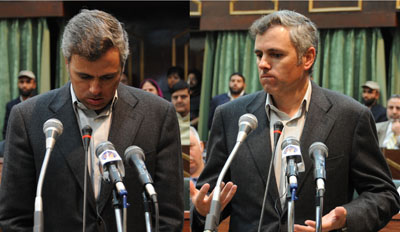
Glum faced Chief Minister Omar Abdullah in two different emotional moods in the Assembly on Tuesday. —Excelsior/Rakesh
Electoral reforms
Ram Rattan Sharma
India is known to be a democratic republic but there are far too many ugly spots in the Indian-polity. Elections form the base of any democratic set up, and if the electoral process becomes anomalous and maligned, the whole edifice of democracy will get infected and crumble. Unfortunately, elections infested with all sorts of anomalies and maladies have become common in India. One may go further and call India a functioning anarchy rather than a democratic republic. Many people fear that anarchic element has multiplied to such an extent that Indian democracy might soon find it impossible to function in accordance with the rules of the concept. Despite the preventive measures taken such as posting security personnel paramilitary forces and other armed units, electoral malpractices like booth capturing, rigging, impersonation and bogus voting are common. All these prompted one Chief Election Commissioner to remark that Judging from recent events, it would seem that the country would have to live with electoral malpractices for a long time. It has become common place to fret about the links between politics and organized crime. The very nature of these crimes has changed in recent years, in the past criminals were content to supply funds and muscle power to politicians in return for some guarantees about their security. The criminals would be left free to commit their crimes without inviting the attention of the law. Now the crime lords have become VIPs: a new culture has developed on the basis of the gun and the bomb. The criminals have come out into the open, freely contesting elections and in more and more instances, sitting in legislatures and in parliament. From the criminalization of politics, we have moved to the politicization of crime. One can imagine the situation when criminals are entitled to legislate for the land.
There are many cases of voter intimidation, rigging and booth capturing. Fear and panic are spread because of the hire goondas and gangsters. Voting amidst fear and panic can by no means be regarded as fair & free. Elections become a force, and democracy a mockery. The present cost of elections in India does not offer equal opportunities to all the citizens to fight elections. The roaring election expenditure virtually queers the pitch for candidates having limited resources. The well-off individuals and political parties having ample financial resources of whatever colour have bright prospects of getting elected.
The people commanding fat purses themselves or enjoying the support of rich businessmen, profiteers, smugglers and black marketeers, alone can afford, to contest elections, state funds of elections and payments by cheques are some of the suggestions which have been aired from time to time. But from all accounts, there are no takers for such pious suggestions. Elections are fought and won on the basis of caste and religion. Everyone ignores the devastating impact that the exploitation of casteist and religious feelings has had on the political system. In such elections, the interests of the nation and the society on the whole are altogether ignored. To expect caste and religion to be wholly absent in a profoundly caste and religion ridden society is to hope for the impossible. However, this should not prelude efforts to keep caste and religion to a restricted domain, recent trends point to a multiplication of parties on the basis of caste, religion or linguistic region. A major lacuna in our electoral system has been that the electoral verdict is not effectively mirrored in the composition of the legislature. The present electoral system has resulted in an alarming and disproportionate gap between the percentage of votes polled and the percentage of seats won by the various political parties. In all the general elections held so far, on no occasion has the party that assumed power after the elections polled more than 48 percent of the votes. But the percentage of seats won by the ruling party was significantly much higher. What matters really in whether the political class can rid the system of its flaws, not out of partisan interest, but because such flaws erode the spirit of the only thing that keeps the nation and the people in one place i.e., our republican constitution once the constitution becomes a dead letter. Then the institution it has spawned lose their legitimacy. Then we may as well bid adieu to the independence, we so laboriously won in 1947. Various committees and commissions have been constituted from time to time to suggest reforms and eminently practiacable electoral packages have also been represented by the election commissions, but for one reason or the other the suggestions have not been implemented.
Some of the suggestions made by the intellectuals are, firm action against the defaulters and offenders. Propagation of the sound principles under lying the concept of election & fair play, reform of the electoral system so as to make it more equitable and less expensive, elimination of the use of black money, all out measures to end the nexus between criminals & politicians, neutral and efficient administration during the elections, deterrant punishment to those who indulge in malpractices. It needs to be emphasized here that if the process of electoral reforms is to be meaningful, It must involve a comprehensive overhaul of the multi track dimension of the electoral system. These reforms should among other things, take a second look at the electoral process itself and examine alternative systems of representation, restructure the election commission and redefine the powers, overhaul the election machinery and formulate a comprehensive election code, measures like introduction of electronic counting machines, issuance of identity cards to check impersonation, compulsory registration of political parties, compulsory maintenance of accounts of every party and compulsory audit through the medium of the auditor general once in two years at least. Some of these measures have already been adopted. One may also make internal democracy and elections with in political parties a condition of registration. Above all persons with criminal records should be disqualified from being candidates. The crisis our election system is facing today, there is need for a deep determination both among the politicians and the people, to erase the malaise.
(The author is former Deputy Librarian, University of Jammu)