

Sir,
Traffic jams are one of the serious problems which we are facing now-a-days. It is rapidly going to worsen with time. In the morning when most of the people have to go to offices, they have to face these traffic jams resulting in wastage of precious time. Sometimes patients requesting immediate medical help also suffer from traffic jams.
Traffic jams are prevalent all over in Jammu but the worst hit areas are Janipur, Ambphalla, Rehari Chungi, Bus Stand, Jewel and Canal road and other areas falling in their vicinity. It has umpteen times been brought to the notice of the concerned authorities. But it seems, that no one is paying any attention to this serious problems. Some time back, the Government sanctioned flyovers in Janipur, Ambphalla and Jewel areas for doing away with this menace but unfortunately these things haven’t seen the light of the day for the reasons best known to the concerned authorities. In Sidhra, flyover has been built at a rapid pack and it will definitely bring respite to the people of that area from traffic jams. I therefore, want to request to the concerned authorities to do the needful so that the things don’t go from bad to worse.
Yours etc….
Er P S Upadhyay
Janipur, Jammu
Traffic jams in City
Glum faced Chief Minister Omar Abdullah in two different emotional moods in the Assembly on Tuesday. —Excelsior/Rakesh
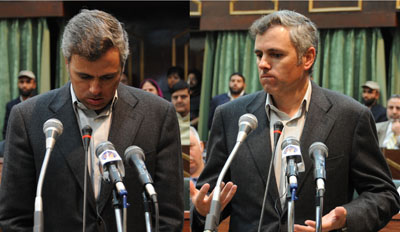
Glum faced Chief Minister Omar Abdullah in two different emotional moods in the Assembly on Tuesday. —Excelsior/Rakesh
Electoral reforms
Ram Rattan Sharma
India is known to be a democratic republic but there are far too many ugly spots in the Indian-polity. Elections form the base of any democratic set up, and if the electoral process becomes anomalous and maligned, the whole edifice of democracy will get infected and crumble. Unfortunately, elections infested with all sorts of anomalies and maladies have become common in India. One may go further and call India a functioning anarchy rather than a democratic republic. Many people fear that anarchic element has multiplied to such an extent that Indian democracy might soon find it impossible to function in accordance with the rules of the concept. Despite the preventive measures taken such as posting security personnel paramilitary forces and other armed units, electoral malpractices like booth capturing, rigging, impersonation and bogus voting are common. All these prompted one Chief Election Commissioner to remark that Judging from recent events, it would seem that the country would have to live with electoral malpractices for a long time. It has become common place to fret about the links between politics and organized crime. The very nature of these crimes has changed in recent years, in the past criminals were content to supply funds and muscle power to politicians in return for some guarantees about their security. The criminals would be left free to commit their crimes without inviting the attention of the law. Now the crime lords have become VIPs: a new culture has developed on the basis of the gun and the bomb. The criminals have come out into the open, freely contesting elections and in more and more instances, sitting in legislatures and in parliament. From the criminalization of politics, we have moved to the politicization of crime. One can imagine the situation when criminals are entitled to legislate for the land.
There are many cases of voter intimidation, rigging and booth capturing. Fear and panic are spread because of the hire goondas and gangsters. Voting amidst fear and panic can by no means be regarded as fair & free. Elections become a force, and democracy a mockery. The present cost of elections in India does not offer equal opportunities to all the citizens to fight elections. The roaring election expenditure virtually queers the pitch for candidates having limited resources. The well-off individuals and political parties having ample financial resources of whatever colour have bright prospects of getting elected.
The people commanding fat purses themselves or enjoying the support of rich businessmen, profiteers, smugglers and black marketeers, alone can afford, to contest elections, state funds of elections and payments by cheques are some of the suggestions which have been aired from time to time. But from all accounts, there are no takers for such pious suggestions. Elections are fought and won on the basis of caste and religion. Everyone ignores the devastating impact that the exploitation of casteist and religious feelings has had on the political system. In such elections, the interests of the nation and the society on the whole are altogether ignored. To expect caste and religion to be wholly absent in a profoundly caste and religion ridden society is to hope for the impossible. However, this should not prelude efforts to keep caste and religion to a restricted domain, recent trends point to a multiplication of parties on the basis of caste, religion or linguistic region. A major lacuna in our electoral system has been that the electoral verdict is not effectively mirrored in the composition of the legislature. The present electoral system has resulted in an alarming and disproportionate gap between the percentage of votes polled and the percentage of seats won by the various political parties. In all the general elections held so far, on no occasion has the party that assumed power after the elections polled more than 48 percent of the votes. But the percentage of seats won by the ruling party was significantly much higher. What matters really in whether the political class can rid the system of its flaws, not out of partisan interest, but because such flaws erode the spirit of the only thing that keeps the nation and the people in one place i.e., our republican constitution once the constitution becomes a dead letter. Then the institution it has spawned lose their legitimacy. Then we may as well bid adieu to the independence, we so laboriously won in 1947. Various committees and commissions have been constituted from time to time to suggest reforms and eminently practiacable electoral packages have also been represented by the election commissions, but for one reason or the other the suggestions have not been implemented.
Some of the suggestions made by the intellectuals are, firm action against the defaulters and offenders. Propagation of the sound principles under lying the concept of election & fair play, reform of the electoral system so as to make it more equitable and less expensive, elimination of the use of black money, all out measures to end the nexus between criminals & politicians, neutral and efficient administration during the elections, deterrant punishment to those who indulge in malpractices. It needs to be emphasized here that if the process of electoral reforms is to be meaningful, It must involve a comprehensive overhaul of the multi track dimension of the electoral system. These reforms should among other things, take a second look at the electoral process itself and examine alternative systems of representation, restructure the election commission and redefine the powers, overhaul the election machinery and formulate a comprehensive election code, measures like introduction of electronic counting machines, issuance of identity cards to check impersonation, compulsory registration of political parties, compulsory maintenance of accounts of every party and compulsory audit through the medium of the auditor general once in two years at least. Some of these measures have already been adopted. One may also make internal democracy and elections with in political parties a condition of registration. Above all persons with criminal records should be disqualified from being candidates. The crisis our election system is facing today, there is need for a deep determination both among the politicians and the people, to erase the malaise.
(The author is former Deputy Librarian, University of Jammu)
Urban development
Dr. Sudhir Krishna
In 2005, Ministry of Urban Development launched the Jawaharlal Nehru National Urban Renewal Mission (JNNURM). The Mission was launched with an aim to encourage urban level reforms and fast track planned infrastructure development of identified “mission cities”. These cities were selected on the basis of population or them being State capitals, or having certain additional features. A cluster of 63 mission cities was identified each having a minimum of one million population including the seven metropolitan cities with more than four million population and twenty eight cities that were State capitals or had historic, religious or tourist importance. Later on, two more cities were added to the set of mission cities taking the total to 65 cities. The duration of JNNURM has been kept as 7 years beginning from 2005-06.
Under JNNURM, financial assistance is being provided to each of the cities for specific project planning, development and implementation for projects of water supply, sewerage, drainage, solid waste, urban transport, urban renewal, heritage preservation and slum improvement. However, amongst all other infrastructure sectors, urban transport demanded special consideration, as indicated by the extraordinary growth in urban traffic conditions, depleting public transport services and the impact of road pollution to the urban environment.
JNNURM has been instrumental in rejuvenating the urban space in the country. Post independence, JNNURM has been the country’s first national flagship programme of this nature and size for the urban sector. It is for the first time that the central government is providing assistance of this kind for what is classified as a State subject as per the Constitution. One of the Mission’s objective is to break the vicious circle of poor cost recovery – low investment – poor service delivery. JNNURM has managed to provide a strong impetus to investments in urban sector and incentivized cities to develop sustainable investment frameworks through service delivery reform and cost recovery of services provided.
The Mission has definitely helped raise awareness and concern about problems of urban growth and management. Urban matters are talked about more widely and more frequently these days than before. Getting on to the JNNURM bandwagon, has become both important and useful for the State and City officials as well as political leaders. For the first time the largesse from the Centre is claimed to be contingent upon various reforms. Mission seeks a different kind of identity, because it is contingent on reforms. The mandatory reforms also provide for a public disclosure law and a community participation law to institutionalize transparency and enable citizen’s participation.
The Mission has actively advocated the role of Public Private Partnership (PPP). With the launch JNNURM, both the macro-environment as well as project-level micro environment is becoming more and more congenial for PPPs in the urban sector. Many of the JNNURM-supported reforms have created favorable governance and institutional framework for private sector to feel more confident to venture into the urban sector. Also, the ‘4P’ framework—People-Private-Public Partnerships are being promoted as experience across the world indicates that in urban renewal and management, the role of ‘People’ in design of projects and partnerships is crucial. Therefore, best practices and models for ‘PPPP’ must be evolved and deployed for India’s urban management agenda to succeed.
In urban centres, JNNURM has led to improved quality of life of the populace as better connectivity within the city and improved transport infrastructure has helped in reducing traffic congestion, improved accessibility and safe mobility along with safe and comfortable circulation in city by affordable public transport for all. In many parts of the country, JNNURM has led to beautification of transport corridors in city which would increase the visual beauty and decrease visual pollution.
Direct project benefits include expanding sewage collection, treatment, and sanitation to obtain a more hygienic environment. The JNNURM projects have also increased the city’s capacity to handle rainwater through better drainage. The project improved drinking water quality by protecting groundwater and surface water sources. The Mission promotes a sound solid waste management system in which disposal is being conducted safely and hygienically, preventing blockage of drains. JNNURM has led to improved environment and public health in the project areas while promoting sustainable urban development. Without the project, environmental quality and public health will remain the same or worsen with a rapidly increasing population and associated unmanaged domestic wastes. Development of water, sanitation, and solid waste management infrastructure under this project aimed to enhance the overall urban environmental quality and public health of Indian cities and upgrade the parameters of quality of life like housing, natural environment, health, recreation and leisure time, social belonging, community life, public services and transport which includes water and other basic services which provides mobility and connectivity, and leads to upgrading quality of life of the citizen of India.
Many initiatives undertaken in different cities have showed that with political will and planning, our urban spaces can become liveable again. Notable of these initiatives include 24X7 water supply in Hubli-Dharwad, Ahemdabad Bus Rapid Transit System, water supply project in Nagpur and property tax collection mechanism in Bangalore. The JNNURM project has also partially contributes to achieving the Millennium Development Goals (MDGs) like providing sustainable access to safe drinking water and basic sanitation, ensuring environmental sustainability and the eradication of slums and to achieve significant improvement in the lives. JNNURM has made a quantum change in size of investments and breadth of coverage across cities and sectors. JNNURM has beyond doubt given a considerable fillip to urban infrastructure investments. Cities have come forward and benefitted immensely under this programme. The JNNURM definitely has transformative impact on the urban infrastructure of the country.
National Conference MLAs protesting against PDP MLA for his remarks against Chief Minister in Assembly on Tuesday. —Excelsior/Rakesh
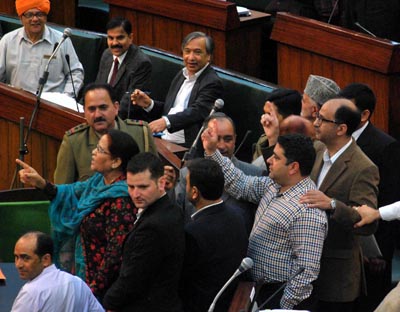
National Conference MLAs protesting against PDP MLA for his remarks against Chief Minister in Assembly on Tuesday. —Excelsior/Rakesh
More needed to tackle terror
Obja Borah Hazarika
The curtain finally rang down on Independent India two most audacious terrorist attacks, Parliament House in December 2001 and Mumbai’s 26/11 2008 with the hanging of December 2001 Parliament House main conspirator Afzal Guru on 9 February. Three months after Mumbai’s lone surviving gunman Ajmal Kasab was sent to the gallows on 21 November last year. Underscoring, the Manmohan Singh Government would no longer be soft on crimes against the State and was firm in its resolve of zero-tolerance on terrorism.
Pertinently, the change of heart is primarily because with the General elections due in 2014, the UPA is keen to silence the Opposition’s stringent criticism over the delay in Guru’s execution thereby exposing itself to attacks of its inherent weakness in dealing with terrorism along-with sending a stern warning to future terrorists that it would brook no nonsense.
Recall, post both attacks India broke off diplomatic relations with Pakistan. Although, every time ties were restored in the hope of perceived normalcy, notwithstanding the underlying suspicions and trust deficit which hovered over talks. Thereby, rendering it difficult for the neighbours to make much progress.
Undoubtedly, with both India and Pakistan being nuclear countries, the Indian sub-Continent is considered a potential military and even nuclear flashpoint by many nations. Also, continued regression of relations between the two, bodes ill for the future of South Asia in particular and the world in general. Given that worsening of relations between the neighbours has the potential to have a ripple effect in several countries and even Continents. More so in today’s age of globalization, characterized by time-space compression which has rendered political boundaries meaningless.
Indeed, despite attempts made by both New Delhi and Islamabad to strengthen ties with each other, progress has been sluggish. The main perpetrator of 26/11 LeT founder Hafiz Saeed remains at large in Pakistan, despite the US and India putting pressure on Islamabad to convict him for his alleged involvement in planning the Mumbai attack. Needless to say with New Delhi’s determination to portray a tough stand on terrorism, as evident by Kasab and Afzal Guru’s hanging, demands for Saeed’s extradition would grow louder and non-compliance by Islamabad could ratchet up tensions between the neighbours.
All this is very well, but despite Kasab and Guru’s hanging, sadly India’s counter-terrorism policy continues to be weak and in dire need of reform. Given that the two terrorists attacks targeted the political and financial hubs New Delhi and Mumbai speaks volumes about our security apparatus weakness.
It is no secret that the country’s internal security system remains highly fragmented and poorly coordinated. Policing responsibilities is under jurisdiction of the States, worse not only are these local forces poorly staffed, but also fall behind in standards of training and are poorly equipped. Add to this duplicity in investigation and law enforcement among State and Central intelligence agencies.
Further, at the Centre the Home Ministry has the Intelligence Bureau, Central Reserve Police Force, Indian Police Service, and the National Investigation Agency under its watch. The Research and Analysis Wing and Central Bureau of Investigation under the Prime Minister are also responsible for detecting and solving national security threats.
Additionally, both the State and Central authorities are coordinated through joint committees and task forces. These coordinating mechanisms synchronise intelligence gathered by all the components of the Indian security establishment and aim to formulate threat perceptions and responses. Alas, these are often slow thereby making them ineffective.
Importantly, methods to anticipate and combat terrorist attacks need to be strengthened. Given that increase in resources and strengthening infrastructure is a necessary prerequisite for the Indian security establishment for ensuring a policy of effectual responsiveness to terrorism.
In addition, organizational challenges abound, with the States and Centre wrangling over autonomy and control of counter-terrorism apparatus, as revealed by the latest debate over the National Counter-Terrorism Centre (NCTC). Several Chief Ministers have virtually vetoed the NCTC on the grounds that it would undermine the federal structure of the Constitution.
Thus, in order to more effectively combat terrorism it is necessary to formulate a strategy that is inter-Ministerial, inter-agency and inter-departmental which must balance the interests of the Central and State Governments. A strong legal infrastructure is also needed in order to ensure an efficient counter-terrorism policy.
India must learn from the best practices of other nations to ensure that an effective counter-terrorism policy is instituted. Cooperation with international partners would also buttress New Delhi’s counter-terrorism efforts. Additionally, coordination between all domestic agencies involved in combating terrorism should be a priority.
Clearly, executing those accused in terrorist cases sends a strong message to potential terrorists. However, unprepared security agencies and a shoddy counter-terrorism infrastructure make India vulnerable to further attacks. Terrorism continues to remain a grave national security threat, rendering it absolutely necessary for the Government to construct an effective counter terrorism infrastructure. INFA
Rather gives final touches to Budget
Excelsior Correspondent
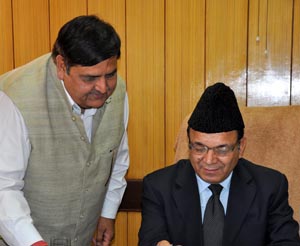
JAMMU, Mar 5: Minister for Finance and Ladakh Affairs Abdul Rahim Rather gave final touches to the Budget 2013-14 at Civil Secretariat today.
It is the 5th budget in a row of the present Coalition Govt. to be presented in the Legislative Assembly by Mr Rather tomorrow at 12 Noon.
This will be the 13th Budget to be presented by A.R.Rather in the State Legislature so far in his political career. Before this, he has presented budgets in year 1983, 1984, 1987, 1988, 1989, 2000, 2001, 2002, 2009, 2010, 20011, and 2012. Mr. Rather has also presented vote of account on two occasions.
Speaking on the occasion, Mr. Rather said that budget proposals to be presented by him tomorrow will be discussed threadbare by the members of the legislature, adding that good and genuine suggestions of the legislators will be given due consideration to make next year’s budget representative to the urges and aspirations of the people. He said every member will be given an opportunity to express his views on the budget and present his suggestions for further betterment of different departments as well as development of their respective constituencies.
Mr. Rather said, before formulating next year’s budget, he has undertaken an exhaustive pre-budget exercise with all stakeholders including trade, industry , transporters, intellectuals, academicians and progressive farmers of both Jammu and Kashmir divisions to get first hand appraisal of their demands and suggestions.
The Economic Advisor to Govt. Jalil Ahmad Khan and Principal Secretary Finance B.B Viyas were also present on the occasion.
Ensure strict adherence to UGC norms by Pvt colleges: Lone to JU
Excelsior Correspondent
JAMMU, Mar 5: Minister for Higher Education Mohammad Akbar Lone has asked the Jammu University authorities to ensure strict adherence to the University Grant Commission (UGC) norms by the private colleges affiliated to the varsity.
Speaking at a high level meeting held here to discuss and review overall performance of the recognized colleges, the Minister stressed on system improvement, quality of teaching, besides streamlining and regulation of the colleges.
The Minister also stressed on introduction of job oriented courses in private recognized colleges, while asking the JU authorities to make it sure that all these colleges have required infrastructure and qualified staff to meet the quality standards of the education. He said private sector has contributed a lot towards the improvement of education standards, but at the same time stressed on close monitoring and regulation of such educational institutions in the larger interest of the public.
The representatives of Forum of Recognized Colleges (FORCE) apprised the Minister about their problems and sought early redressal of the same. The Minister gave a patient hearing and assured them that their genuine demands would be looked into.
The Minister directed the Management of the Private Colleges to strictly adhere to the prescribed University Grant Commission (UGC) norms, cautioning that any lapse in this regard will be dealt seriously.
On the occasion, the Minister also reviewed working of 7 Jammu University Off -site Campuses of Kathua, Udhampur, Kishtwar, Poonch, Reasi, Ramban and Bhaderwah.
Threadbare discussion was held on temporary budgetary support for teaching staff, rent of buildings, office expenses, creation of minimum teaching and non-teaching staff for at least three courses in each campus.
It was decided in the meeting that the matter will be taken up with the Finance and Planning Departments to finalize the requisite formalities.
Former Minister R. S. Chib, MLA Ch. Zulfikar Ali, MLA Aijaz Ahmed Jan, Vice Chancellor University of Jammu, Prof M P Singh Ishar, Special Secretary Higher Education Heemat Sharma, Director Colleges, Nalini Kohli President FORCE Jammu, Harbans Singh, Registrar University of Jammu, Prof Naresh Padha, Coordinator for all Campuses, Dr. Dawood Iqbal Baba and other concerned officers attended the meeting.
Sagar reviews implementation of NBA, attaches DPO for poor performance
Excelsior Correspondent
JAMMU, Mar 5: Taking strong note of poor implementation of the Centrally sponsored scheme Nirmal Bharat Abhiyan (NBA) in Udhampur, the Minister for Rural Development and Panchayati Raj, Ali Mohammad Sagar today attached the Panchayat Officer of the district to Administrative Department.
The Minister issued the directions while reviewing the achievements recorded in the Jammu region districts in the implementation of centrally sponsored, Nirmal Bharat Abhiyan(NBA)- a scheme aiming at to improve sanitation in the rural and far flung areas by constructing latrines including community, individual household and at the educational Institutions.
The scheme works are executed at Panchayat level and is implemented through the district Panchayat officers.
Reviewing the district wise achievements, the Minister constituted a committee headed by Commissioner Secretary, RDD to conduct on the spot inspection of the works done in each district under the scheme.
The Committee was asked to furnish the report to the Minister’s office soon after completing the inspection in all districts mentioning both physical and financial achievements. The Minister said that the officers of the districts with good performance would be honoured by Nirmal Gram Purskar.
The Minister asked the officers to put in best efforts to ensure effective implementation of the scheme so that the targeted lot gets the desired benefits. He warned the officers against any laxity and said that the quality of the work on the ground would be benchmark for assessing their performance. He asked them to give their best or face music as the Government would not compromise at the cost of the interest of the general public.
Among others, Commissioner Secretary Rural Development Department Farooq Ahmad Peer, Director Rural Sanitation J&K Tufail Ahmad Matoo, Deputy Director Sheraz Malik, Divisional Field Officer of Jammu Abdul Rashid Khawaja, District Panchayat Officers of Jammu, all Block Development Officers of Jammu Division and other field officers of the Rural Sanitation Department attended the meeting.
NYC volunteers protest for regularization
Excelsior Correspondent

JAMMU, Mar 5: Police foiled the bid by National Youth Corp volunteers, who were trying to take out a protest march towards the Civil Secretariat, here today.
In the melee between cops and protesters, three NYC volunteers got fainted even as police maintained maximum restraint and did not resort to lathicharge.
The protesting NYC volunteers were demanding their regularization on the pattern of Rehbar-e-Talim (ReT) and enhancement of their honorarium from Rs 2500 besides converting the same into monthly salary.
Earlier, a number of NYC volunteers assembled in front of the Press Club Jammu under the banner of All Jammu Kashmir National Youth Corp Volunteers Association. Carrying placards and shouting slogans in support of their demands, the protesting NYC volunteers held a strong demonstration there.
While addressing the protesters, State vice president of the Association, Asif Ali Bhat alleged that the Government was not taking their demands seriously and trying to suppress their voice. He warned to further intensify their strike if no action is taken on their demands.
The protest demonstration was also addressed by Mudassar, Wakir Ali, Jafar, Mushtaq, Opinder Charak, Jagdeep, Aijaz, Smriti, Mamta, Deepika and others.