

NEW YORK, Mar 15: The stars are aligning for U.S. Dollar bulls.
For more than a decade, good times in such markets as stocks and real estate were bad news for the greenback. Investors tended to use the U.S. Dollar only as a life jacket when storms raged in risky markets.
Now, though, rather than serving as a hiding place, the dollar is benefiting from the stock market’s surge to new highs and the improvement in U.S. Economic data. The dollar nudged down a tad from a seven-month high against a basket of currencies on Thursday even as the Dow Jones industrial average surged to another record high despite interest rates remaining at record lows.
For instance, the dollar has gained fairly steadily against the yen. In January, it was trading at 86.67 yen to the dollar; on Thursday it was trading at 96.06 to the dollar. Likewise, the British pound has fallen from 1.62 to 1.51 to the dollar so far this year.
The moves suggests the dollar has entered a multi-year bull cycle, and marks a major shift in its behavior against other asset classes.
‘Certainly, all the pieces are slowly coming into place for a bull market for the dollar,’ said Paresh Upadhyaya, director of currency at Pioneer Investments in Boston, which had assets under management of $204 billion as of the end of last year.
The dollar has outperformed eight out of nine major G-10 currencies so far this year. Political uncertainty in Italy has re-ignited fear about the euro zone’s ongoing debt crisis. Weak economic growth and the prospects of aggressive monetary easing in Japan and Britain have driven the yen and sterling to multi-year lows.
To be sure, there are those who caustion that spending cuts from Washington could put a damper on economic growth and the Federal Reserve has pledged to keep interest rates low for the foreseeable future.
Still, capital flows and futures positioning bears out the attitude to U.S. Assets.
Cross-border inflows into U.S. Stocks are tracking at about $100 billion to $150 billion for 2013, compared with a net neutral level in recent years, according to Nomura Securities. Futures activity shows increased bets on the dollar from speculators.
And stocks are not the only U.S. Asset drawing in overseas capital. A recovering commercial property market, where transactions have rebounded by more than four-fold from their post crisis-low in 2009, is also enticing foreign investment.
Purchases of commercial real estate by foreign buyers totaled $24.18 billion in 2012, according to Real Capital Analytics, which tracks the commercial real estate market. That’s up 1.6 percent from the year before and the highest annual total since 2007, a year when the dollar index fell 8.4 percent.
Another undercurrent is the shrinking U.S. Current account deficit, the difference between what the U.S. imports and what it exports in goods and services and money transfers, and a measure of how much the United States relies on foreign lenders to fund its economic growth.
The gap, a major headwind for the dollar, narrowed to $110.4 billion in the fourth quarter, or 2.8 percent of gross domestic product, down from a peak of 6.5 percent of GDP in 2005. Analysts expect the shortfall to hit around 2.5 percent this year and next.
For Stephen Jen, a managing partner at London-based hedge fund SLJ Macro Partners, the move confirms a long-held theory that the dollar outperforms when the United States either leads the world into a deep recession or a sustained recovery.
The theory, which Jen developed with economist Fatih Yilmaz when both were at Morgan Stanley, is called ‘the dollar smile,’ because it creates a U-shaped line on a graph when charted against the relative U.S. Growth rate. The dollar would hit the trough of the smile when the global economy is highly coupled and there’s little difference in growth between economies.
‘The dollar seems to have started to smile again, after being debased by the Fed in the past years,’ said Jen, who believes the currency is undervalued and ‘has the potential to stage a broad-based rally against a wide range of currencies.’
LIABILITY NO MORE
Strong appetite for U.S. Assets from overseas investors has driven the rally in the dollar and stocks in 2013. Foreigners have poured money into U.S. Equities in recent months while U.S. Demand for foreign assets has waned, in part due to the improved outlook for the U.S. Economy.
The 25-day correlation between the U.S. Dollar index and the S&P 500 stood at 0.53 on Thursday, so the two indicators are moving in tandem more frequently. In late 2012, the correlation was -0.9, almost a perfect inverse relationship.
Net inflows into U.S. Equities surged in the second half of 2013. The four-month moving average of net equity inflows rose to $17 billion at the end of 2012, highest since January 2008, according to Nomura Securities.
Jens Nordvig, global head of currency strategy at Nomura Securities in New York, said the shift in cross-border flows in favor of U.S. Equities is notable because it is not a response to risk aversion.
‘The underlying trend is starting to be U.S. Dollar bullish on the private flow side,’ he said. ‘In the past, this has been important for dollar direction. Hence, one should take note.’
Investors had become accustomed to the dollar as a hiding place, as its last major rally came when the financial crisis raged in 2008 and 2009. But the last two major bull markets for the U.S. Dollar – 1995-2000 and 1980-1985 – came at a good time for stocks, said Greg Anderson, North America head of FX strategy at Citigroup in New York.
BETTING ON THE DOLLAR
Speculators boosted bets in favor of the dollar for a third straight week to $23.57 billion in the week ending March 5, data from the Commodity Futures Trading Commission showed. That’s still below a high of nearly $40 billion in June, suggesting positioning is far from extreme levels.
Of course, that’s not to say the dollar won’t wobble a bit in the short-term. Hefty government spending cuts tied to the sequester could dampen economic activity later this year. For all of the fanfare behind recent moves, the dollar index has still not surpassed levels seen in the summer of 2012, and previous rallies were short-lived.
In addition, a major move in the dollar may still be months away until the Federal Reserve sends a clear hint that it intends to taper its bond purchases.
Bilal Hafeez, global head of FX strategy at Deutsche Bank, said the dollar’s surge against the yen makes him think the U.S. Currency may be starting a ‘multi-year uptrend.’ Since 1995, the yen has always been the last currency to peak or trough against the dollar, he said.
With Japan ramping up monetary easing, investors may revive the yen ‘carry trade,’ borrowing with Japanese assets to finance purchases of higher-yielding stocks or commodities. The dollar is up 11 percent against the yen this year and has gained nearly 30 percent from a record low of 75.35 yen set in October 2011.
Ken Dickson, investment director of currencies at Standard Life Investments in Edinburgh, with assets under management of $263.9 billion, said his firm is ‘very heavily overweight’ the dollar, especially against the yen.
‘Our positive stance has been maintained for a number of quarters but became more significant in the second half of last year,’ he said.
(AGEMCIES)
Stock market gains, growth smile on U.S. Dollar
Cardamom futures marginally up on pick up in demand
NEW DELHI, Mar 15: Cardamom prices traded marginally higher by Re 1 at Rs 931.80 per kg in futures market today as speculators enlarged their positions, driven by pick-up in demand in the spot market,
Tight supplies positions following less arrivals from producing belts further supported the uptrend.
At the Multi Commodity Exchange, cardamom for delivery in March traded marginally higher by Re 1, or 0.11 per cent, to Rs 931.80 per kg in business turnover of 76 lots.
Similarly, the spice for delivery in April edged up by 90 paise, or 0.10 per cent to Rs 915 per kg in 842 lots.
Market analysts said fresh positions created by speculators following rising demand in the spot markets, influenced cardamom prices at futures trade here. (PTI)
Mentha oil futures decline on weak demand
NEW DELHI, Mar 15: Mentha oil prices declined by Rs 9.80 to Rs 1,216.10 per kg in futures trade today due to weak demand from consuming industries in the spot market.
Adequate stocks position following increased arrivals from Chandausi in Uttar Pradesh also put pressure on mentha oil.
At the Multi Commodity Exchange, mentha oil for delivery in March declined by Rs 9.80, or 0.80 per cent, to Rs 1,216.10 per kg in business turnover of 960 lots.
In a similar fashion, the oil for delivery in April shed Rs 7.60, or 0.62 per cent, to Rs 1,222 per kg in 211 lots.
Market analysts attributed the decline in mentha oil futures to subdued demand from consuming industries in the spot market against adequate supplies from Chandausi in Uttar Pradesh. (PTI)
‘Lou Grant’ actor Ed Asner released from hospital
LOS ANGELES (Reuters) Actor Ed Asner was released from a Chicago-area hospital yesterday, two days after leaving the stage during a performance and receiving treatment for exhaustion, the publicist for the former “Lou Grant” television star said. Asner, 83, was on his way to Los Angeles and was told by doctors to get some rest, Charles Sherman said.
(agencies)
Argentina’s Pope Bergoglio a moderate focused on the poor
BUENOS AIRES, Mar 15: The first Latin American pope, Argentina’s Jorge Bergoglio is a theological conservative with a strong social conscience, known for his negotiating skills as well as a readiness to challenge powerful interests. He is a modest man from a middle class family who declined the archbishop’s luxurious residence to live in a simple apartment and travel by bus. (agencies)
Scurvy debate in the Assembly
A View Point
K.N. Pandita
The tone and tenor of the debate on adjournment motion on Monday last was most disgusting. It dealt with the hanging of Afzal Guru.
Should legislative assemblies initiate a debate on the verdict of the Apex Court of the country? This question was raised by one of the members. The house was not prepared to react to the constitutional propriety of a debate on SC verdict; it rushed on to the debate itself.
Is the assembly a place where elected representatives come to ventilate their pent up anger and angst or to speak about the problems of the people and suggest ways and means of solving these?
Should an assembly and its elected members consider themselves above the nation and fundamental national interests? Do they enjoy the freedom of denigrating prestigious national institutions in assembly debates just to cater to regional or sub-regional, narrow and parochial interests?
The debate was on the hanging of a person who belonged to Kashmir valley. He was indicted for conspiring attack on the parliament which took the precious lives of at least nine guards. The criminal case was established by going through the full judicial process over a period of eleven years. Death penalty was announced by the Apex Court which had given Guru all facilities and time to defend himself before the law of the land.
Any debate on the adjournment motion had to remain confined to the subject of execution of a criminal. There was no need to dabble in extraneous issues and arouse the sentiments of the legislators.
The opposition had the freedom granted by the Speaker to react on the event. They misused it by stepping out of the limits of this debate. Ordinarily, it was a matter of point of order which the house including the Speaker should have resorted to.
Most unfortunately, the opposition tried to deal with it from myopic communal prism and went to the extent of saying that the Indian government was targeting a particular community. Democratic governments do not and cannot target any one community but more often than not according to political scientists minorities are generally made to bear the brunt of the tyranny of majoritarianism. 1990 events testify to this statement.
Bringing imagined allegation against the judicial pyramid of the state is tantamount to the contempt of Supreme Court, and deliberate attempt of violating the Constitution of the country.
The opposition and those who joined their voice with it cast subtle if not tacit aspersions on the central government, the judiciary, the judges of the Supreme Court and the entire structure of the Union Home Ministry. In the process, they targeted the Chief Minister accusing him of not intervening for “saving the life of a Kashmiri”-a curious and most irrational accusation. These are seditionist trends because there is not any reflection of an iota of national interests in these utterances. A political party that has become so parochial does not at all qualify to be called the real voice of the people.
Here is a Kashmiri proved through sustained prosecution by a court of law to have worked as the key person in a conspiracy aimed at blowing up the Parliament and killing the MPs. If 20 or 25 opposition MLAs in the assembly feel it their right to question why a key conspirator was hanged, the 540 members of the Parliament, including 4 from J&K whose life was attempted at, have the right to ask why the culprit should survive.
The opposition has denigrated the Parliament that has constitutionally accorded special status to Jammu and Kashmir. It is the same parliament that is protecting Article 370 against erosion. It is the same parliament that sanctions enormous grants in the shape of annual budgets and plans for the development of the State of Jammu and Kashmir. It is the same parliament that has helped J&K raise its income per capita as the highest in the country.
And it was a terrorist who wanted to blow up the same parliament, and decimate the parliamentarians. And now it is the opposition in J&K Assembly that wants to project the assailant as a hero and freedom fighter. That, in short, is the content of the assertions of the opposition in the assembly.
Not a single word was uttered against terror unleashed by Afzal Guru and his terrorist background. Not a word was said about the killing of nine guards of the parliament’s protective force by the terrorists. Not a word of sympathy was uttered for the families of those victims. But yes, there was hard breast beating for Guru and his family.
We know that these antics are all fake and nothing more than a mask. There is no sincerity at the root. It is only to whip up the sentiments of the people and to win political mileage by sensitizing electoral constituencies to communal, parochial, and sub-national sensitivities. For six long years as the PDP remained out of power, it did not rake up the issue of parliamentary attack. It could not because it knew it would be standing on very slippery ground.
Now that the event has happened, the opposition finds a pretext to nail down the ruling coalition. This is called politics on the dead bodies. Kashmir medieval history is replete with such accounts of sycophancy and blackmail. The opposition demands the resignation of the Chief Minister. There is no reason for the CM to resign but there is every reason for the opposition to resign en mass from the assembly.
Prosecution of Afzal Guru stretched over nearly eleven years. During all these years, J&K assembly never raised the issue, never asked for a debate on the subject and left it to the natural course of law.
Why this hullaballoo now? Where were these supporters all these eleven years? Obviously, sections of political class had been waiting for an opportunity that would be handy to stir public commotion. This is the repeat of past experience, the 2009 Amarnath yatra and the 2010 stone pelting incident.
How long will be Kashmiri masses misled and duped by half-baked politicians? How long will they allow these ambivalent politicians play with their sentiments?
The case of execution of Afzal Guru is a case of law and order. The law comes down with a heavy hand when and where it must. In political parlance, its precise name is the might of the state. The State cannot allow unreasoned commotion to happen by projecting a criminal as a martyr.
J&K is an integral part of the Indian Union, and it shall remain so till eternity. Yes, we have internal issues and problems. These have to be resolved through rational and logical debates by stakeholders in the assembly and the parliament where opinions are to be expressed not anger.
Search for PM material Ongoing poll year tamasha
Dr S Saraswathi
A growing demand on the two major national parties – the Congress and the BJP — to announce their prime ministerial candidate before elections is getting shriller. In fact, it has become a point of confrontation between them sounding like both a challenge and a provocation to each other.
Recall that such a demand was not heard as a serious poll year issue in the last 15th Lok Sabha elections though the race for prime ministership was not absent and at times was even bitter.
General elections 2014 in India has already become “the” forthcoming event most talked about everywhere from Kashmir to Kanyakumari. Theoretically modeled on the Westminster pattern but with a carefully drafted written Constitution drawing many ideas from other democracies, the Indian parliamentary democracy is unique in its own way. It has made some original contributions in running a parliamentary system which shows that the system can work in ways other than the model it has copied.
The post of the Prime Minister does not emanate from any law in Britain. Like other members of the House of Commons, the Prime Minister is also one elected to represent a constituency. This is in sharp contrast to the direct election of the President in the presidential system of the American democracy.
The Indian Constitution provides for a Council of Ministers with the Prime Minister as the head to aid and advise the President in the exercise of his functions. And, the Prime Minister is appointed by the President.
Since the beginning of the 20th century, all the Prime Ministers in Britain have been members of the House of Commons. Prior to 1902, some had come from the House of Lords. With the reduction of the powers of the House of Lords in 1911 under the Parliament Act, the convention is for the Prime Minister to be drawn from the Lower House only.
In India, however, the Prime Minister can be a member of either House of Parliament. If a non-member is appointed, he should become a member within six months.
At the recent BJP National Council meeting held in Delhi, Gujarat Chief Minister Narendra Modi stated a real but ignored fact that the question of the talk about who would be the Prime Minister was futile. Ever since his powerful development-centred speech earlier in a prestigious college in the Capital, and the subsequent eloquent oration in the National Council meeting, interesting and provocative rumours are making the rounds of his growing chances of being named as the prime ministerial candidate of the BJP or a BJP-led coalition government at the Centre. No wonder, such rumours are instantly received with approbation by approvers and with suspicion by others.
On the other side, the elevation of Rahul Gandhi to Number 2 position in the Congress as Vice-President, behind his mother as the President is interpreted by many as a prelude to his candidature for prime ministership for the Congress or a Congress-led coalition government after elections. In fact, this elevation within the party, which only confirms officially the existing de facto position according to some independent observers, is not a necessary stepping stone for entry into Government.
Rahul Gandhi’s denial since then that he is neither in the race for this post nor has an ambition for power and position has introduced an interesting new situation. It nullifies the expectations raised earlier in the statement of some party loyalists about “prime ministerial material” in this young leader.
Importantly, the Prime Minister is not a figure head in the Indian democracy. He is the real head of the Government. In the present atmosphere of highly complex politics, and extremely difficult economic conditions to cope with, being head of the Government is not an easy job or an attractive position. That person must be extraordinarily resourceful keeping abreast of what is happening around and must be conciliatory in approach. He must enjoy not only the support of his/her party and alliance partners but also the confidence of the entire nation.
In this era of uncertain electoral verdicts and post-poll alliances of parties to form governments, many Presidents have faced problems in identifying a leader who can form the Government. President R Venkataraman wanted to establish a rule of inviting mechanically the largest party in the Lok Sabha which meant in 1989 a ridiculous situation of inviting the leader of the defeated party. The same principle followed in 1996 led to the fall of the Vajpayee government in 13 days.
The principle has since been altered and the practice of ascertaining the ability of the leader to show convincing majority support in writing has been evolved. The coalition governments headed by Deve Gowda in 1996, LK Gujral in 1997, Vajpayee in 1998 and 1999, and of Manmohan Singh in 2004 and 2009 have been formed on the written support of majority in the Lok Sabha.
The difficulty in selecting a leader acceptable to all the coalition partners has not been an easy job for the alliances. This is what led Vajpayee in 1999 after his defeat in the confidence motion by one vote, to challenge the Opposition Congress eager to form an alternative government to name their Prime Minister.
The Congress which was then averse to coalition government wanted to form a minority government with outside support. But, a prospective ally backed out on the leadership issue. It was the difficulty of alliance partners to agree on their leader that compelled President K R Narayanan to agree to dissolve the Lok Sabha and call for a fresh mandate in 1999.
Selecting the Prime Minister is fraught with serious consequences to the longevity of the Government itself in coalitions formed by numerous small parties with no acknowledged leader. Indian democracy has witnessed this several times – in the Janata rule, National Front and United Front governments. Perhaps, India’s search for a Prime Minister in 2014 may not start and stop with the two national parties as party politics stands today.
In this background, it is certainly futile to talk of prime ministerial candidate or the material with which he/she is made. There is no constitutional or conventional obligation on the parties to project any candidate as their Prime Minister. Why all this fuss then? INFA
Need for dynamic leadership
Men, Matters & Memories
M L Kotru
Call it a quirk of Indian politics if you like, but the fact remains that, as of now, opposition parties seem to have a vested interest in the sound health of Dr. Manmohan Singh and his Government. They are so uncertain of the present or of the immediate future that they would very much like the Manmohan Singh government to continue until they are able to consolidate their strength.
Right now there is a general realization that unless the situation changes radically, there is no hope of this country acquiring a genuine two or three-party system. The ‘Khichri’ at the Centre, repeated very largely in the States as well, must for the present, continue to be the lot of the country.
Whatever their anger, annoyance or inconvenience the people may not want to do anything that rocks the Manmohan Singh boat until they are assured of the existence of a viable alternative. The Bharatiya Janata Party’s desperate attempts to project itself as a viable alternative, perhaps with a newer NDA in tow, seems unlikely to see fruition. The best bet, therefore, for the parties may be to bide time and meanwhile consolidate their position.
There is an intimate relationship between politics and astrology in this country, and there is no dearth of forecasts about what would happen to the UPA Government and when, but the more rational politicians seem to concede that there is nothing to suggest that its term of five years would get short-circuited which as the Congress party is reassured is still a year away. Wait for the magic wand that will in all probability put the opposition parties where they belong: out of office. This may be wishful thinking on the part of those who have put their eggs in the Gandhi parivar basket – what with Rahul Gandhi promising not to marry to put an end to the dynasty theory – and are indeed thinking of a return to power.
What about developments in the States with the mother party’s fortunes looking downwards, the numberless scams with many more threatening to come to light, the farmers’ agitations, the dissatisfaction with the law and order, rape at the top of the list, rising prices and growing disenchantment with the Gandhis and their party?. Add to these, movements like the one led by Anna Hazare and his former followers including Arvind Kejriwal. And taking on from Hazare, there are movements not organized by political parties which are hard to control because of the absence of disciplined cadres.
There are enough indications that agitations, some of them being old caste-based or the one in Telengana or by the farmers of Maharashtra, are set to spread, causing multiple problems for the Central and local governments which may affect the fate of one State government or another.
The Manmohan Singh Government did during the last few months show greater dispatch in trying to undo the damage which it itself had done to the economy – a part no doubt of the world economic meltdown – via some course correction but given the gloomy economic growth rate it may only do more harm than good. The economists and the corporates may have hailed the decision to unwind the regime of subsidies of the past few decades, but so far as amelioration of the lot of the people goes it is unable to do anything to control inflation triggered among other things by depleting foreign reserves and the economic slump accompanied by rising oil prices.
And since oil prices will keep rising the Manmohan Singh Government has not much manoeuverability. The stark reality though is that it singularly failed in containing the price spiral.
Administratively, the UPA Government is on a worse wicket and there seems to be a great dearth of talent around the ageing Prime Minister. There is little evidence of mature decisions or even of the existence of high-powered think tanks unless we are asked to believe that the huge toothless UPA Chairman’s advisory committee is doing the job; it rarely meets. Perhaps not without reason, there is a growing tendency to blame all policy failures on the international economic slump. Maybe because the situation borders on the grim and some of the problems are at the moment insoluble, there is a tendency both in the ruling party and the Opposition to take a long-term, almost historical view of things and derive solace from it.
The ruling party would seem to be drawing consolation from the fact that it has managed to keep a country larger than Europe together in spite of numerous threats, is by itself an achievement and that there is food in abundance to the extent that the Government continues to overlook the need for building up storages or the even grimmer one about people continuing to starve even in an era of abundance.
The theory is that everybody may not be having two square meals a day but nobody is dying of starvation. Not everybody may be well clothed but nobody is going naked. Not everybody has a house but everybody has some kind of shelter.
There is only partial truth in these statements. It is common knowledge that hundreds of thousands of people sleep in the open in metropolitan towns and the big cities. And at today’s inflationary rate what kind of a life can family of five, living in a metro on an income Rs. 2 to 3 thousands lead?
Not to speak of the families below poverty line or those unable to get the so-called minimum wage or those who must look up to a hundred days of employment in a year under the much wonted rozgar yojna losing much of it to the middlemen not necessarily excluding elected representatives of the area.
The refrain from the Manmohan Singh Government and its various spokesmen, including from the Planning Commission is dismissive of what they believe to represent the brainchild of some dark minds which refuse to see the ‘silver-lining’ hanging thereabouts in the periphery of various well-meaning projects. To convince you that the reality is not what you encounter in the market place every day of your existence, but is there hidden in the heart-warming official figures which quote at random. They will talk to you on the necessity of having hygienic toilets (very rightly) when malnutrition or farmer suicides should be the main concern.
The slackness in providing infrastructure – energy, roads, transportation among these – continues to be regarded as a bottleneck but little is mentioned of the time lost in clearance of projects, land acquisition etc. Resurgent India continues to be the “mool mantra” just when we seem to be semi-stagnant. The new mantra is we must expand the manufacturing sector and do it in a big way. Even Indonesia, Vietnam and Bangladesh have turned to it with profit. Not to speak of China. Profiteering may continue to be at a high but that certainly is not the case with investment, domestic or foreign.
Time indeed for a dynamic, decisive, new forward-looking leadership in our country, one that does away with the fuddy-duddies of the existing lot of “leaders”.
Medical health service
Ministers are seldom prepared to open the skeletons in the cupboards of their departments. They usually leave this job to be done by the opposition. And the opposition is always on the prowl to look for discrepancies and make these a subject of their criticism. But the case with the State Medical Health Department has been somewhat different. As the Speaker allowed the concerned ministers to present the budget for their department, the Minister of Medical and Technical Education, Youth Services and Sports Taj Mohi-ud-Din did not mince words and frankly admitted that criticism leveled by the opposition members about the sordid and disgusting situation of Government Medical Colleges in Srinagar and in Jammu could not be challenged. It was a reality that on a number of counts, health services in the hospitals attached to the medical colleges was dismal and far below the expected standards.
The Minister has tried to absolve himself of any responsibility on account of the bad condition in the hospitals by arguing that he had inherited it from his predecessors and could not be held responsible. In the same breath he tried to convince the house that soon after taking over the charge of the ministry, he had taken big steps to bring about drastic changes in the existing condition in hospitals and then enumerated what he had initiated to do. Be he has rightly said, the people are not much concerned with personalities but with the situation on the ground. What he has said on the floor of the house vindicates the sentiments of people who have been making regular complaints about poor sanitary conditions in the Government hospitals and lack of facilities. Nobody is prepared to listen to the public cry and still we claim that this is a peoples’ Government.
The Minister for Medical and Technical Education has found that the important reason for inefficiency, non-delivery and insanitary conditions in the Government hospitals in both the capital cities is that there is a big shortage of faculties, para-medicos, nurses and safai karamcharis etc. We are unable to guess why there is such a large scale of shortage of manpower in these hospitals when year after year grants are sanctioned and departmental budgets are passed. Is it not the duty of the Department to propose the additional manpower both professional and non-professional in order to make the functioning of the hospitals smooth? Shortage of 800 doctors is not a small number and we should know that it takes many years for one to become professionally qualified to become a doctor and to be posted in a hospital. True the minister has suggested that there should be a drastic reformation of medical policy in the State and recruitment rules should be made less complicated. It will require a long range policy to do so.
The Minster for Health, who also spoke on the occasion of presentation of the budget for the department, has not said anything about the condition of the hospitals but enumerated in detail what his ministry has done to improve medical services in the state especially in rural areas. Obviously, the department is trying to improve the conditions and provide better medical facilities to the people and larger number of rural people has been brought under medical facility umbrella. There is no denial of that story. It has to be appreciated. But the point is of efficiency and competence that often make health services a target of public ire. Expansion of medical facilities or opening of new healthcare centres and dispensaries is not enough. Their efficient functioning and responding to the difficulties of the patients is of much serious concern. It has to be remembered that there is growing trend of mobility from rural to urban areas in the state. Both capital cities have witnessed influx of rural people leading to rather haphazard expansion of both Srinagar and Jammu cities. It means tremendous pressure on medical services also. Medical department needs to focus on its futuristic requirements and do the planning accordingly. If the Minister feels there is need of reforming medical policy, let it be initiated. It will be good service to the State.
New pope urges Church to return to its Gospel roots
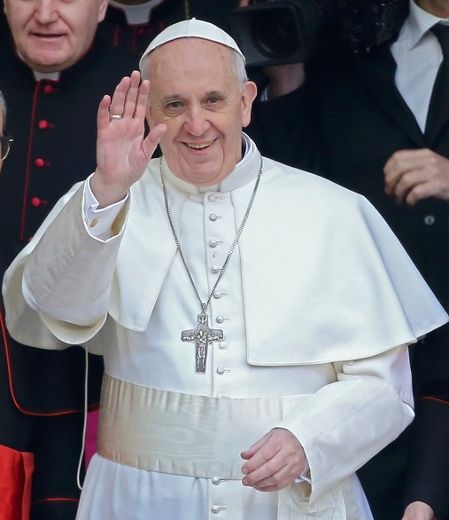
VATICAN CITY, Mar 15: In his first public Mass, Pope Francis urged the Catholic Church yesterday to stick to its Gospel roots and shun modern temptations, warning that it would become just another charitable group if it forgot its true mission. In a heartfelt, simple homily, the Argentinian pope laid out a clear moral path for the 1.2-billion-member Church, which is beset by scandals, intrigue and strife. (agencies)