

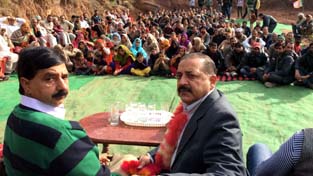
Dr Jitendra Singh during public meeting at Udhampur on Sunday.
Dr Jitendra Singh during public meeting at Udhampur on Sunday.
Jubilant players of Trikuta Korfball Club posing for a photograph while receiving winners trophy from the chief guest on Sunday.

Jubilant players of Trikuta Korfball Club posing for a photograph while receiving winners trophy from the chief guest on Sunday.
Tough tussle between footballers to get hold of the ball during a match of Christmas Soccer Championship in Jammu on Sunday. — Excelsior/ Rakesh

Tough tussle between footballers to get hold of the ball during a match of Christmas Soccer Championship in Jammu on Sunday. — Excelsior/ Rakesh
Judokas of BSF School Paloura who bagged galaxy of medals in Open Judo Championship.

Judokas of BSF School Paloura who bagged galaxy of medals in Open Judo Championship.
Int’l drug cartel busted; 49kg drugs recovered
NEW DELHI: Special Cell of Delhi Police has busted an international drug cartel operating across Southeast Asia and the Gulf countries with the arrest of an alleged drug trafficker and recovery of 47kg of heroin and 2kg of cocaine, valued at Rs 150 crore on the international market.
According to police, Autar Singh (48), a resident of Delhi, was arrested yesterday following a tip-off.
Three other members of the gang, A Venugopal Reddy (29), a resident of Kadapa district of Andhra Pradesh, Ragmeet Singh (25) and Shurbir Singh (28), both residents of Delhi, were arrested earlier this month and 9kg of heroin, worth Rs 30 crore, recovered from them.
Piecing together the information collected from the above trio and that which was gathered from various other sources, police were able to close in on Autar.
“A trap was laid yesterday near the red light in Sanjay Gandhi Transport Nagar and Autar was apprehended in the early hours. On a search of his Hyundai Santro car, a total of 32kg of fine-quality heroin and 2kg cocaine was found neatly packed in polythene bags,” said DCP (Special Cell), Sanjeev Kumar Yadav.
Following his arrest, Autar was produced before court and placed in police remand. During interrogation, he disclosed that there was a consignment of 6kg heroin at his residence, Yadav added.
He was then taken to his Tilak Nagar residence where the additional 6kg heroin was recovered. A total drug haul of 49kg has thus so far been recovered during the operation.
The Hyundai car he was driving at the time of his arrest has been confirmed as having been stolen from the Shalimar Bagh area.
Information was received a few months back by police about a drug syndicate operating out of Delhi which was engaged in receipt and onward distribution as well as transnational peddling of high-quality Afghanistan-made heroin, Yadav said.
“It was also learnt that the syndicate was being run by one Ali, based in Kuwait, and one Samiullah, who was based in Afghanistan, and that there were several Pakistani, Indian and Sri Lankan nationals who were engaged in the trade.
“The syndicate was engaged in trans-border smuggling of heroin from Pakistan through the Punjab border into India and in its onward movement to Sri Lanka and other foreign destinations,” Yadav added.
During investigation, it was learnt that several conduits for the cartel hailing from Andhra Pradesh would frequently visit Delhi and meet certain Sikh families who had migrated from Afghanistan over two decades back to settle here.
On December 18, a tip-off was received that Reddy would come to Shankar Road here to collect drugs from the suspected suppliers for the syndicate.
“A trap was laid and Reddy was apprehended and 3kg heroin seized from his possession. By the time he was located, identified and apprehended, the supplier had managed to leave the scene,” said Yadav.
During questioning, Reddy disclosed that he has been into the illegal trade for the last six months along with some associates. Reddy also revealed that during this month alone, he had received two big consignments from a man known to him as ‘Mr Singh’ and another person known to him as ‘Arun’, both residents of Delhi.
Reddy provided inputs about the identities of two persons who were coordinating the trade and living somewhere in the Mahavir Nagar area.
While efforts were on to locate the above duo, a team of Punjab Police on Thursday arrived at the office of the Special Cell and sought assistance to arrest a suspect known to them as Shurbir of Delhi. (AGENCIES)
CM wants 7 to 10 days to address problems of people in Delhi
GHAZIABAD, Dec 29: A day after assuming office, Delhi Chief Minister Arvind Kejriwal today said he does not want to give false assurances to people in the capital and wanted seven to 10 days time to put a system in place to address their problems and grievances.
Kejriwal said he would accept the applications of people visiting him for redressal of their grievances only after a system is in place.
“I don’t want to give you false assurances. I will take the application when we put a system in place to resolve the problems,” said the leader of the Aam Aadmi Party(AAP), which has interests of the common man at the core of its agenda.
He assured the visitors, who gathered in large numbers at his Kaushambi residence for his Janta Darbar, that he needed the support of the people to establish such a system and without their backing, he would not be able resolve issues.
“We have just assumed power. It will take us sometime, seven to ten days to put a system in place to resolve your problems,” he said, addressing a gathering which included DTC employees and people from the Valmiki community.
Contractual employees of DTC and muncipal corporations had come to put forward their demand to end the contract system in these bodies. They also wanted that those working for several years should be made permanent.
Around 1,000 drivers and conductors of the Delhi Transport Corporation (DTC), working on contractual basis, shouted slogans “Arvind Zindabad”, hoping that the new Chief Minister would work towards ending contractual employment.
“About 14,000 drivers and conductors have been hired on contractual basis by DTC. We have been working on contractual basis for around 10 years. Despite after such long service, DTC has still not made us permanent,” said Ramesh, a DTC driver.
“Kejriwal during election campaign promised that he would finish “Thekari Pratha” (contractual service) in Delhi after becoming Chief Minister. We are very hopeful that Kejriwal would direct DTC to make us permanent,” said Deshpal, a driver.
As a large number of people make a beeline to Kejriwal’s residence, Delhi and Uttar Pradesh Police force have made special arrangements to manage the influx of visitors.
The UP Police will manage traffic and crowd influx outside the premises of Kejriwal’s residence while a team of Delhi Police in plain clothes will remain inside the housing society to manage the crowd and to prevent any untoward incident, a senior UP police official said.
The Ghaziabad police have installed a doorframe metal detector at the main gate of the society where Kejriwal lives. (AGENCIES)
Govt clears proposal for buying 15 Israeli-made UAVs
NEW DELHI : Boosting surveillance capabilities of the army along the borders with China and Pakistan, the government has cleared the procurement of around 15 unmanned aerial vehicles (UAVs) from Israel at a cost of around Rs 1,200 crore.
A proposal to procure these Heron UAVs was approved by the Cabinet Committee on Security headed by Prime Minister Manmohan Singh at its recent meeting, sources told PTI here.
The around Rs 1200-proposal for procuring the UAVs will bolster the Israeli-origin Heron and Searcher fleet of the force which deploys them on both the eastern and western sectors, they said.
The force has a fleet of more than 40 such vehicles, which are expected to undergo upgrades in the near future.
The IAF flies the Israeli-made Searcher II and Heron UAVs for reconnaissance and surveillance purposes and about 100 Searchers are in operation on Indian borders in western, northern and eastern regions.
After the upgrades, the air force would be capable of operating these aircraft from far-off distances and control them through satellite communication system.
The army also operates a sizable number of UAVs and has deployed them in borders along the western and eastern fronts.
The army was the first to induct UAVs in the 90s starting with Searcher Mark I and Searcher Mark II which could operate at an altitude of 15,000 feet and finally the Heron, which can operate at 30,000 feet.
Army’s Northern Command had recently issued a global tender for procuring latest miniature unmanned aerial vehicles for gathering intelligence and carrying out reconnaissance of areas along Line of Control (LoC) with Pakistan and Sino-India border.
The Navy has also three operational squadrons of the Israeli UAVs deployed along both the eastern and the western sea boards. (AGENCIES)
One BSF jawan dies, another untraceable after falling in gorge
SRINAGAR : A BSF jawan died and another went missing after they slipped from a mountain ridge in Macchil sector near Line of Control (LoC) in Kashmir, a senior official of the force said today.
“The two jawans slipped into a deep gorge on Friday afternoon in Macchil sector,” the BSF official said.
While one jawan was rescued by his colleagues in an injured condition, the official said the other jawan is still untraceable.
“The injured jawan, Avtar Singh, was taken to a hospital but was declared dead on arrival. He had suffered head injuries,” the official said.
He said efforts were on to trace the other jawan, Satish Kumar, but rescue operation is getting hampered due to inclement weather. (AGENCIES)
Rice basmati strengthens on increased demand
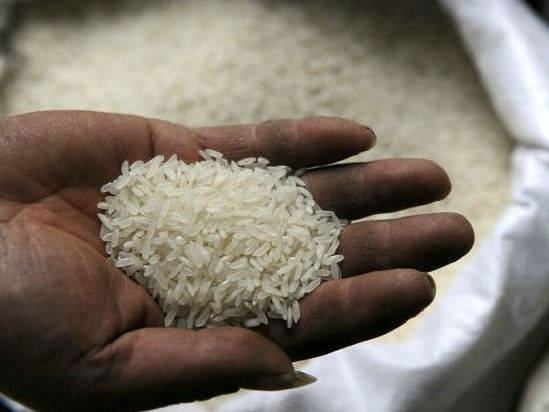
EW DELHI, Dec 28: Rice basmati prices firmed up to Rs 100 per quintal in an otherwise steady wholesale grains market today on increased demand against restricted supplies from producing belts.
However, other grains held steady in limited deals.
Traders said besides increased demand, restricted arrivals from producing regions mainly led to rise in rice basmati prices.
In the national capital, rice basmati common and Pusa-1121 variety rose by Rs 100 and Rs 50 to Rs 8,700-8,900 and Rs 8,000-8,500 per quintal respectively.
The following were today’s quotations per quintal:
Wheat MP (deshi) 2,070-2,270, Wheat dara (for mills) 1,670-1,675, Chakki atta (delivery) 1,675-1,680 Atta Rajdhani (10 kg) 220, Shakti bhog (10 kg) 220, Roller flour mill 920-930 (50 kg), Maida 970-990 (50 kg) and Sooji 1,010-1,030 (50kg).
Basmati rice (Lal Quila) 10,400, Shri Lal Mahal 10,000, Super Basmati Rice, 9,500, Basmati common new 8,700-8,900, Rice Pusa-(1121) new 8,000-8,500, Permal raw 2,100-2,200, Permal wand 2,275-2,300, Sela 2,950-2,975 and Rice IR-8- 1,875-1,900, Bajra 1,300-1,305, Jowar yellow 1,400-1,450, white 2,300-2,500, Maize 1,405-1,410, Barley 1,400-1,410, Rajasthan 1,080-1,090. (AGENCIES)
1000-year-old vineyards discovered in Spain
NEW YORK, Dec 29: Archaeologists have discovered traces of ancient vineyards, that date back 1,000 years, in the terraced fields of a medieval village in Spain.
Researchers from the University of the Basque Country in Northern Spain found evidence that fields within the medieval settlement of Zaballa were once intensely used to grow grape vines.
In the study published in the journal Quaternary International, researchers stressed that the terraced fields built in the 10th century – still perfectly visible in the landscape – in Zaballa were devoted to the intensive cultivation of vines.
“Archaeo-botanical studies of seed remains found in the excavations and pollen studies have provided material evidence of the existence of vine cultivation in a relatively early period like the 10th century,” said study author Juan Antonio Quiros-Castillo.
This evidence is also supported by the metal tools discovered and which had been destined for this very use, and the study of the agrarian spaces, “which owing to the nature of the crop spaces built and the agrarian practices developed, they are not compatible with cereal crops but they are with vines,” he added.
Quiros-Castillo and his colleagues also studied another abandoned settlement in Araba-Alava called Zornotegi, ‘LiveScience’ reported.
They discovered that the terraced fields in this village were devoted to cultivating cereals and grains.
“Zornoztegi has a completely different history,” Quiros-Castillo said.
“Even though it was founded at more or less the same time, it is a much more egalitarian social community in which such significant social differences are not observed, and nor is the action of manorial powers which, in some way, undermined the balance of the community,” he said. (AGENCIES)