

Dhurjati Mukherjee
The Reserve Bank of India Deputy Governor K C Chakrabarty recently made a significant presentation, wherein he pointed out that the banks had sacrificed around Rs one lakh crore by writing off bad loans to corporates which is much higher than Finance Minister P Chidambaram’s farm loan waiver in 2008. Recall that the farm loan waiver, which was criticized by pro-industry analysts, was only around Rs 60,000 crores.
At the annual bankers’ conference, Chakrabarty had stated: “In the last 13 years, banks have written off Rs 1 lakh crore and 95 per cent of these are bad loans. Everyone talks of the farm loan write-off but it is the medium and large enterprises segment that has a 50 per cent share in NPAs (non performing assets)”.
The RBI official regretted the increasing NPAs of banks and the technical write-offs resorted to by them. “Restructuring of loans with retrospective effect has credit quality in banks”, Chakrabarty observed. In this connection, it may be mentioned that, as per RBI sources, banks added Rs 4.95 lakh crores in their bad debts between 2007 and 2013.
During the same period, they reduced NPAs to the extent of Rs 3.50 lakh crores. This was mainly because loans worth Rs 1.40 lakh crores were written off, while another Rs 90,887 crores were upgraded to repaying loans status and Rs 1.18 lakh crores were recovered.
The Deputy Governor was squarely critical of large loans to big corporate houses. According to him, between 2007 and 2013, credit to ten large corporate groups has more than doubled. “We have seen that whenever credit growth has been higher, the NPAs are also higher”, he elaborated.
Lately, the Finance Minister blamed ‘tardy’ State-run banks for the high level of NPAs and noted that their boards and not the Government should be held responsible. “If the banks’ boards cannot perform their duty, blame should rest with the boards,” Chidambaram observed at the 20th anniversary of the National Stock Exchange.
Statistics reveal that the United Bank of India (UBI) has an NPA of over 7 per cent while the State Bank of India has 5 per cent bad assets. But though the Minister said the RBI and the Government had taken serious note of the issue, no specific measure towards aggressive recovery was enumerated by him. It is, however, understood that the Government is contemplating taking some action or doing something to tackle the NPAs, which totals around Rs 1.70 lakh crores presently.
It is quite apparent that India has been alarmed by the rise in soured loans, especially of the State lenders (nationalized banks) that dominate the banking system. Tackling the problem of wilful defaults is difficult in a country that lacks a bankruptcy law and has notoriously clogged courts where getting justice takes a very long time, if not forever.
Stressed loans of banks are estimated to be at least 10 per cent of all loans. Fitch Ratings expects this to rise to 15 per cent by March 2016 (or within another two years.) The bad loan ratio of 5 per cent for State banks is more than double that of private sector lenders.
Let us take the case of Kingfisher Airlines which has closed down for quite some time now.
The controlling shareholder, Vijay Mallya, a liquor baron, former Member of Parliament and an enormously rich man with a flamboyant lifestyle. He was unsuccessful in his efforts to revive the airlines and find new investors for Kingfisher but he openly stated that it is the Company and not him personally that owes the money to the banks.
It is generally agreed that Mallya was not interested to revive the airlines as he had borrowed an extraordinarily high amount from a consortium of banks, specially the State Bank of India. The question then remains is what action has been taken by the banks to recover the amount? At best there has been a move to take possession of his “Kingfisher House” property in Mumbai to realize part of the debts, which is a pittance, due to them from the airlines. But it has got embroiled in claims made also by the Income Tax department. At the same time, the question is why were the loans sanctioned without a proper mortgage and assessment of his huge assets?
Though it is understood that the Central Bureau of Investigation (CBI) was scrutinizing the 30 biggest defaulters of Indian banks, not much headway is in sight. The so-called fast track courts typically take five years to resolve a bad debt and lenders go to any length to defer the process by various means by using political sources to get leeway.
According to the chairperson of a leading nationalized bank, most companies are quite big and when it is known that the recovery process has been initiated, they transfer the assets of the Company in the names of friends and/or relatives or get stay orders from courts by hook or crook.
Moreover, State lenders are constrained from moving quickly to pursue bad loans due to bureaucratic hurdles and a culture where it can be considered safer not to take a decision on recovery fearing political intervention.
While a certain section of industrialists are interested to siphon off bank loans, this should not deter the financial institutions to extend help and support to the industry, specially the micro and small enterprises. In fact, a task force on Micro, Small and Medium Enterprises (MSMEs) set up by the Prime Minister, has recommended a 20 per cent year-on-year growth in credit to this sector.
At a recent meeting, Union Minister of MSMEs K H Muniyappa stated that the banks would be directed to increase lending to these enterprises. Earlier at an ASSOCHAM meeting in New Delhi the Minister informed that he expected the share of medium and small units in total export to go up to 50 per cent for which the banks have to come forward and lend on easy terms.
Thus, while lending to the deserving must be encouraged for enterprises to grow – and help in industrial rejuvenation – the banks would too need to be judicious in ensuring that the money would be returned. Undeniably, the recovery process has to be strengthened and a fast mechanism evolved for which both the RBI and the Finance Ministry has a critical role to play. Also there is need to publish in annual reports of banks the names of big corporate borrowers as well as ensure strict measures taken to mortgage their property to pay off their debts. Some system must be put in place. -INFA
Rising NPAs Banks sheilding defaulters?
An Army jawan recovers arms from under snow at LoC in Kupwara district. (Inset) GOC Maj Gen J S Sandhu (UNI).

An Army jawan recovers arms from under snow at LoC in Kupwara district. (Inset) GOC Maj Gen J S Sandhu (UNI).
PM’s concerns
In his right as a distinguished academic with a stint at the UGC as its Chairman way back in 1991, Dr. Manmohan Singh’s concerns regarding the quality of research and higher studies in the universities and technical institutes in the country is not unfounded. At the University Grants Commission’s Diamond Jubilee, the Prime Minister expressed his concern about the shortage of faculty and lowering of the quality of research in higher educational institutions. He is very right in pronouncing inter-disciplinary studies as the corner stone of modern research. Naturally he has asked the educationists and the University Grants Commission to add courses and bring about reforms that would promote researches of high quality. He has many times in the past lamented that not a single university in the country occupies place among world’s best and superior most universities. Who in the country would not want that we have the best and topmost faculties that would be instrumental in leading quality research? While we appreciate the sentiments and concerns of the Prime Minister, we will not hesitate to point out that regrettably our politicians have polluted the academic atmosphere on the campuses of universities thereby trying to politicize education and student community. This is one of the main reasons of downslide in our research standards. There should be some legislative riders that would work in obstructing politicians from using student community as their constituencies for election and party politics. Secondly, great deal of inertia has crept into the academic and administrative wing of the UGC. This needs to be looked into by the Union Ministry of Human Resource. How sad that Indian scientists, educationists and academics are wanted and requisitioned by foreign educational institutions. How come that they are not shown the same recognition by national institutes and universities? We have no dearth of efficient academics. The point is that they need to be provided congenial atmosphere free of coercion and callousness so that they are able to show their merit to the maximum of their capacity. Our educational system lacks proper recognition and incentives for excellent contribution to improving educational standards.
PRESS RELASE
NRHM Employees frame NRHM Employees Welfare Association Jammu, J&K.
Jammu 29/12/2013.
An extraordinary meeting of members of NRHM Employees of Jammu Province was today held at Jammu, in which Medical, Paramedical, & Prog. Mgt. staff members participated in large numbers and elected office bearers of body of NRHM employees by the name and style of “NRHM Employees Welfare Association Jammu, J&K”. Dr Rakesh Kotwal proposed the name of Dr Pradeep Singh Rathore for the post of President and Dr Raman Sharma for the post of Gen Sect, who were elected unanimously besides other office bearers who include Dr Mehjoor Khalid as Sr Vice President, Ms Naazish, Mr Swaran Deep Singh and Dr Adil Irshad as Vice Presidents, Dr Rohit Gupta and Mr Wasim Akram as Treasurers, Mr Riaz as Auditor, Dr Sadeeq Wani as Jt Sect, Dr Tahir Khan as Organizing Sect, Dr Bhagwati Prashad as Chairman, Dr Javed Wani and Dr Rashid Ali Wani as Member Secy.
It was unanimously decided in extraordinary meeting in presence of office bearers of the body- NRHM Employees Welfare Association Jammu, J&K that the matter of regularization of NRHM Staff will be perceived vigorously with H’onble Health Minister Jb Shabbir Ahmed Khan along with other burning issues and grievances like payment of salary on monthly basis instead of 4 to 6 months late as is in vogue in many Dists of state, grant of E/L and maternity leave in favor of NRHM employees.
Inept handling of drug cases
Drug addiction among the youth of the State has increased alarmingly. The trend is not a sudden development. It has been creeping into society stealthily. Left uncared and unattended, the malaise has now spread wide assuming threatening dimensions. Functioning of anti drug authorities desired in accordance with the provisions of Narcotic Drugs and Psychotropic substances Act (NDPSA) is under question. Increase in drug addiction is attributed to many reasons like unemployment among youth, school dropouts, fragmented families, uncared for kids, persuasion by drug cartels and easy access to drugs etc. Keeping these factors in mind, the primary responsibility rests with the family and the parents.
But there is another aspect to drug proliferation equally important and also sad and disheartening. It is dismally low conviction combined with shoddy investigation by anti-drug police paraphernalia. From the records of the courts, one finds that owing to very poor quality of investigation conducted mostly along unscientific and obsolete lines the courts are unable to establish a case and pronounce punitive measures by way of deterrent. Investigation of drug related cases needs technical training which the law enforcing agencies in the State do not have at present. The police deployed to prosecute drug paddling cases is inept in handling them with the result that prosecution is hampered and no positive results are obtainable. State authorities have unfortunately relegated the importance of technically sound investigative agency to the back burner and thus allowed a creeping disease hold the youth by the neck. Manpower is an asset of the society in the State but if squandered, the consequences will be dire for the entire State and for the nation. For example the mandatory provisions of the NDPS Act vis-à-vis mode and time limit for dispatch of samples of psychotropic substances for chemical analysis are flouted with impunity which creates doubts about the veracity of the prosecution version and appellant gets the benefit of doubt.
It has also to be noted that the equipment and paraphernalia needed for proper testing to obtain correct results is missing. We are told that specialized equipment was provided to the Forensic Science Laboratory but during the past quite long time it developed a snag and has become non-functional. Now the FSL is awaiting funds from the Police Headquarters for rectifying the same. This is not the way how things can work. There is no reason why the equipment should become dysfunctional and then the authorities wait for years at end to receive funds and then get the machines repaired and reinstated. Nobody will buy flimsy arguments like that. Police Department is well aware that for some years in the past, drug paddling has become more frequent and the youth involved in the drug mafia are flocking to it. This is a serious social aberration and of all the persons it is the State police that are expected to be fully knowledgeable about it. Why then did not the officers on spot raise the issue with superiors to provide funds to make the laboratory equipment functional? All that can be said without a shadow of doubt that inefficiency and ineptness are eating into the vitals of investigative machinery. Superior authorities are hardly evincing any interest in dissuading misled elements of society to retrace their steps back to the path of conscientious citizenship.
We find it unavoidable to caution the authorities of serious consequences of a policy of complacency in containing drug addiction and drug cartels from spoiling the youth for their pecuniary benefits. It must make arrangements for providing specialized training to relevant police force that will be deployed to handle the case of drug paddling and drug addiction etc. If such training is not available in the State arrangements should be made to requisition the services of expert from other States.
Provincial President NC Devender Singh Rana and Swami Gurdeep Giri Singh Ji Maharaj during Manav Kalyan Sant Samelan at Jammu on Sunday.

Provincial President NC Devender Singh Rana and Swami Gurdeep Giri Singh Ji Maharaj during Manav Kalyan Sant Samelan at Jammu on Sunday.
Sikh community people during Nagar Kirtan at Mishriwala on Sunday.
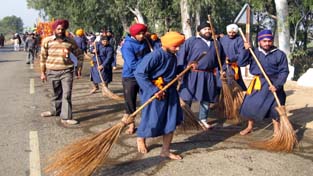
Sikh community people during Nagar Kirtan at Mishriwala on Sunday.
Saint Rakesh Sethi inaugurating Bal Samagam at Sant Nirankari Satsang Bhawan, Shastri Nagar on Sunday.
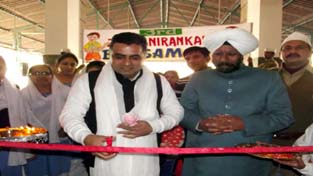
Saint Rakesh Sethi inaugurating Bal Samagam at Sant Nirankari Satsang Bhawan, Shastri Nagar on Sunday.
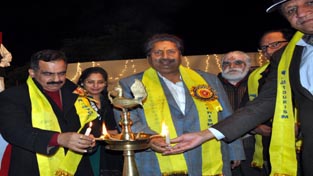
Minister for Housing, Raman Bhalla and others lighting traditional lamp during a function at Jammu on Sunday.
Minister for PHE, Sham Lal Sharma addressing one-day convention of INTUC at Udhampur on Sunday.

Minister for PHE, Sham Lal Sharma addressing one-day convention of INTUC at Udhampur on Sunday.
Minister for Planning Ajay Kumar Sadhotra addressing public gathering on Sunday.
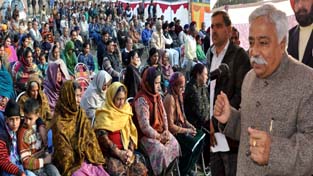
Minister for Planning Ajay Kumar Sadhotra addressing public gathering on Sunday.