

ADDIS ABABA, Jan 3: South Sudan’s warring parties opened negotiations in Addis Ababa today to strike a ceasefire deal and ending nearly three weeks of conflict, Ethiopia’s foreign ministry said, although face-to-face talks are yet to begin.
“Negotiation started,” the ministry said in a statement, adding that the regional East African bloc IGAD “was committed to support in any way possible”.
The two sides are meeting with special envoys from regional nations, with sources suggesting the rivals may not meet directly until at least tomorrow.
Government and rebel negotiating teams had begun arriving on Wednesday at a luxury hotel in Ethiopia’s capital Addis Ababa, but the start of talks had been delayed until the full teams arrived.
“All members of the negotiating team from both the Government and opposition of South Sudan (have) arrived,” the ministry added.
Thousands of people are feared to have been killed in the fighting, pitting army units loyal to President Salva Kiir against a loose alliance of ethnic militia forces and mutinous army commanders nominally headed by ex-vice president Riek Machar.
Aid workers have increased warnings of a worsening crisis for civilians affected by the conflict, which some observers have warned risks deteriorating into full-blown civil war.
Fighting erupted on December 15 when Kiir accused Machar of attempting a coup in the world’s newest nation. (AGENCIES)
South Sudan rivals open ceasefire negotiations: Ethiopia
Senior JCC member Abdul Qayoom Wani addressing press conference in Jammu on Friday. —Excelsior/ Rakesh
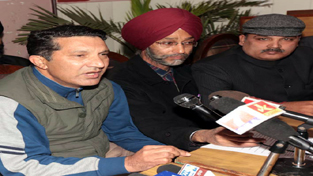
Senior JCC member Abdul Qayoom Wani addressing press conference in Jammu on Friday. —Excelsior/ Rakesh
Ancient stone bridge revealed after Chinese lake dries up
BEIJING, Jan 3: A stone bridge dating back to the Ming dynasty has been discovered after water levels plunged at China’s largest freshwater lake, a media report said today.
The remains of the 2,930-metre-long bridge, made entirely of granite and dating back nearly 400 years, appeared at Poyang lake in the central province of Jiangxi, the Beijing News reported.
The lake, which has been as large as 4,500 square kilometres in the past, has been drying up in recent years due to a combination of low rainfall and the impact of the Three Gorges Dam, experts say.
State broadcaster China Central Television reported in November that drought had shrunk the lake to less than 1,500 square kilometres, threatening the plankton, fish and other organisms that inhabit it and the livelihoods of the nearly 70 percent of local residents who make a living by fishing.
By lowering the level of the Yangtze river, the vast Three Gorges dam project has also caused an increased outflow of water from both Poyang and Dongting, another lake in neighbouring Hunan province, experts told the Beijing News last year, decreasing the water levels of both bodies.
In 2012, Chinese authorities air-dropped shrimps, millet and maize over Poyang lake to feed hundreds of thousands of birds at risk of hunger due to the drought. (AGENCIES)
Pak origin gay denied partnership visa in Australia
MELBOURNE, Jan 3: A Pakistani origin gay will be deported from Australia next week after his application for a partnership visa was rejected, a media report said today.
Ali Choudhry who grew up in the US had been living in Brisbane for four years after having a relationship with a Brisbane doctor Matthew Hynd, ABC reported.
He and Hynd were one of the first gay couples in Queensland to register their civil union on March 12, 2012.
His application for a visa recognising his relationship with Hynd was refused. He said he cannot understand why theirs is not considered a legitimate long-term partnership.
“We applied for a partnership visa to try and keep me here, and keep us together,” he said adding “For us, for whatever reason, it took about two years, and then even after all that time, it came back as a no.”
He was notified two weeks ago that he must leave Australia following his visa review application to Immigration Minister Scott Morrison was also rejected, the news report said.
Choudhry has now lodged an appeal to the Migration Review Tribunal, but may not find out if that application is accepted before his deportation, it said.
Choudhry faces risk of harassment and possible life imprisonment in Pakistan for being gay. (AGENCIES)
AAP Ki Sarkar
Men, Matters & Memories
M L Kotru
Arvind Kejriwal’s Aam Admi Party appears to have taken to power like a duck to water; never mind the tokenism, like a party MLA turning up at the assembly in a self driven electric three-wheeler or some others hitching rides to take their oath as newly elected legislators. All 28 of them were there, looked on by survivors of the BJP and Congress who had made it to the assembly with the odds heavily set against them.
Their white Gandhi caps with the familiar AAP legend written on the sides may have looked odd but who cares at a time when seasoned MPs rush into the well of the house flaunting placards, shouting slogans. Yokel-like they may have looked but these on the face of it were earnest men and the odd woman who sat on the ministerial benches.
The uppity BJP and Congress MLAs did try to score on the novices by asking them not to clap but thump their desktops when oaths were administered to the newly elected members. For a moment the older lot looked like it was trying to enforce some club-like discipline but better sense seemed to prevail, reminded perhaps, as the veterans must have been, of the horrors they themselves have perpetrated in the these very chambers.
I am writing as Kejriwal’s ministry is seeking the vote of confidence which the Lt. Governor had asked it to obtain within a week. There was no last minute change of heart (which would have been a disaster for the grand old party) on the part of the 8- member Congress legislative party, which had pledged it support to the AAP. Everything looked honky dory as the vote was done. So far, forgetting the dramatics, the going appears to have been rather smooth but fraught with consequences. Predictably, the AAP did not waste a minute in declaring its intent to redeem the pledges it had made during the poll campaign. Kejriwal down with a severe attack of diahorrea and high temperature had converted his Ghaziabad home into his office, monkey cap and all, to deliver on one of his biggest promises : 667 liters of water a day for nothing, “the life-line water” of AAP’s description.
Delhi Jal Board top brass was summoned to his home to make “a common claim to essential resources” a reality. In its hurry to come good on the promises it has made the AAP seems to have overlooked that despite the easy appeal of the policy (50% rebate on power consumption) it may fiscally be unwise, short-sighted, and ignoring the poor who lack access to metered water through pipes-nearly half of Delhi, given there are only 17 lakh meter connection in Delhi.
In the event the announcement will lavish free water upon those who can afford to pay and should pay given that there are costs involved in constructing reservoirs, maintaining pipe-lines, providing infrastructure and human resources; one shudders to think of the water tanker mafia, highly politicized and waiting in the wings, as it were, to come into the reckoning yet again.
With almost half the population yet to be assured of its need of water, the AAP risks being caught out. The water tanker mafia is a highly organized phenomenon and most unreliable, too. I have known of thousands of instances where water contracted to be delivered to waterless populations was diverted by the unscrupulous pliers of the trade to building sites, sold at a premium. There is no limit to human greed.
A small digression to the mid 90s seems to be in order. In the early 90s I was visiting the Kashmiri Pandit refugee camps outside Jammu city when a couple of water tankers appeared, come deliver to the camp inmates there needful of water. Only half of the residents of the camp had barely received their fill of water before the tankers, followed by another, moved on, the bulk of the water in their bellies. I and my cameraman followed the tankers and sure enough saw the water being unloaded at building sites. Have seen the same phenomenon repeated many times over at numerous construction sites in Delhi and the National Capital Region-over the years.
The AAP, intent on keeping its promises, has misunderstood the very nature of Delhi’s at water crises. It may create temporary good will among the middle classes and impresses the future voters but it will also create large costs for the Delhi Jal Board to manage down the line and actively encourage profligate use of water.
In affect the tab will now be picked up by the State and could involve cutting back public spending or imposing taxes on the average citizen. In the new water policy any drop that exceeds the free amount in the next slab of the 20 to 30 kilometers would entail a higher bill of Rs. 870. Given that water meter readings are not difficult to manage, this is a steep tariff climb, an invitation to distortion and waste. An effort must be made instead to manage demand and to expand the water grid to those who are not currently served.
Delhi is perennially short of water; it’s parched. It is dependent for its water on neighboring Harayana, Punjab, Uttar Pradesh and Uttarakhand. What makes it worse is the systematic mismanagement of the resourse-roughly 52% of water is lost because of leaky pipelines which somehow come to abound in the Delhi Jal Boards domain. Genuine reform as experts have pointed out would involve bulk metering systems, technology-aided monitoring at every stage, investment in treating and recycling water, improving pipelines. And switching to a graded model that imposes a minimal cost on everyone and climbs higher, depending on usage.
It would mean to bring water to the many lakhs of households which are now left out and dependent on an extractive tanker mafia, and making supply more reliable.
Having “fulfilled” his promises to supply “free” water AAP Chief Minister has followed it up by slashing the cost of electricity supply. Simultaneously he has asked the Comptroller and Auditor General of India to have the accounts of the distribution companies audited, obviously to assess profitability of the three companies engaged in distribution. He announced a 50% subsidy on power consumption upto 400 units a month involving some 28 Lakh households in addition to weaker sections of the society. Here again if the idea is to help the genuinely poor, the first priority should have been to provide for the infrastructure. I don’t believe that it will help the needy living in poorer colonies/shanties who must of necessity depend on stealing power directly from the mains. It does, of course, offer relief to the middle class among whom the AAP I believe has its base.
A lucky winner being given prize at IOCL outlet at Narwal on Friday.
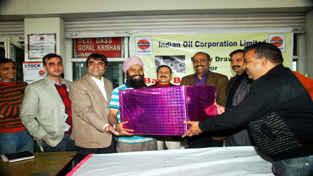
A lucky winner being given prize at IOCL outlet at Narwal on Friday.
Decade of development
Development is a comprehensive and time consuming process; it is not just the questing of funding. Building requisite infrastructure essential for floating projects of macro and micro dimensions is the first requirement. It is a matter of careful planning based on need and availability options. We would wish that development of the State takes rapid strides to catch up with other states which are much ahead of us in development area. This cannot happy strictly according to our wishes and desires.
The Union Government has been paying special interest to J&K State knowing its geographical and physical constraints and also knowing that the State has gone through very difficult period of armed insurgency. It is this realization that made the Prime Minister, Dr. Manmohan Singh to announce a special package called Prime Minister’s Re-construction Plan (PMRP), of Rs 24,467 crores to be expended over a period of ten years. Part of the programme of reconstruction fell under Central sector and other part under State sector. Central sector specifically pertains to production of electricity and development of hydroelectric power generating projects that were given in the change of NHPC. The package carried with it broad guidelines for utilization of funds on projects that, too, were to be approved by the Planning Commission. Planning envisaged a total of 67 projects/schemes in four areas covering 11 sectors of economy. Floated in 2004 at the time of the first two -day visit of Dr. Manmohan Singh as the Prime Minister of UPA-I, only 34 (a little over 50 per cent) have been completed even as the Re-construction Plan was due to complete 10 years during 2014. So far State sector received Rs 7214.50 crores while Rs 600 crores is due for release during current financial year. Of 67 projects/schemes started under the PMRP under both Central and State sectors, only 34 have been completed so far. Work was on at 28 other projects/schemes while in case of remaining five projects, the proposals were in the stage of the finalisation.
These schemes and projects have run their time limit of ten years and we find only 50 per cent of the projects have been completed. The Central Government has taken very liberal view of the matter and agreed to extend the time limit so that pending work is completed. But a corollary to this decision is the cost escalation from the allocated amount to approximately Rs 34,858.61 crores. A closer look at the case will show that cost escalation is a phenomenon that could not be stopped because it is related to the market price of material and labour. Therefore there is no justification either for becoming panicky or for raising the finger on the Government and its agencies. The point which needs to be emphasized is that the Centre is extending all possible assistance to the State so that it can come out of backwardness and poverty and take longer steps along the path of development. Significantly development has to be in all sectors and uniform. All the three regions of the State need to be catered according to their need. There has been coordination among the developmental agencies in the State and the Centre so that progress of the proposed projects remains uninterrupted. The Centre releases funds in instalments as that is the patent policy of fund providing agencies. This should not cause any difficulty or problem for the State. Generally if some delay happens in release of funds and it has to be taken in positive spirit.
There is visible progress in providing infrastructure in its various manifestations. Roads, bridges, culverts etc. are in a process of building and some have reached completion. Some major projects like four-lane of National Highway1, tunnelling and bridge building etc. have gained momentum. However, we can identify two sectors that are still lagging behind. Adequate and uninterrupted power supply is still a dream for the people of the State especially in far-flung areas. Secondly housing sector is dismally weak and unattended forcing people to raise structures in haphazard manner and thus spoil the ecology and environs of cities and towns. Water and sewerage facilities are also still far behind the actual need. We hope that in next half a decade while the funds under PMRP will continue to pour in, these essential services will be streamlined and all sections of people will have access to them. At the same time the projects in hand need to be completed before the expiry of the current financial year. Let us not take Centre’s frugality of extending the utilization date for becoming complacent about completion of projects in the pipeline.
China to centralise military command to improve operations
BEIJING, Jan 3: China’s increasingly sophisticated military will establish a joint operational command structure for its forces to improve coordination between different parts of the country’s defence system, the official China Daily reported today.
China has been moving rapidly to upgrade its military hardware, but military analysts say operational integration of complex and disparate systems across a regionalised command structure is a major challenge for Beijing.
In the past, regional level military commanders have enjoyed major latitude over their forces and branches of the military have remained highly independent of each other, making it difficult to exercise the centralised control necessary to use new weapons systems effectively in concert.
The English-language newspaper, citing the Defence Ministry, said that China will implement a joint command system ‘in due course’ and that it has already launched pilot programmes to that effect.
‘Setting up the system is a basic requirement in a era of information, and the military has launched positive programmes in this regard,’ the report said, quoting a ministry statement. It provided no further details.
In November, the ruling Communist Party announced the establishment of a new national security commission, to enable the country to speak with a single voice on crises at home and abroad, as part of a slew of mostly economic reforms announced at the end of a key party meeting.
China currently has seven military regions traditionally focused around ground-based army units, but China’s changing security interests, including over claims to potentially rich energy reserves in the East and South China Seas, has highlighted its need to focus more on air and naval forces.
China and Japan are engaged in an intensifying standoff over a set of uninhabited disputed islands, and the Japanese government appears to be ready to ramp up military spending and adjust its nominally pacifist stance to a more confrontational one as the two militaries circle each other.
China is engaged in similar disputes with Vietnam and the Philippines.
The China Daily said that the navy could be the top priority for the new command system.
‘China has built an iron bastion in its border regions. The major concern lies at sea,’ said Li Qinggong, deputy secretary-general of the China Council for National Security Policy Studies, as quoted in the report.
Beijing unveiled a 10.7 per cent rise in defence spending last year to 740.6 billion yuan ($120 billion), part of a pattern of double-digit increase which have worried the region.
China has advertised its long-term military ambitions with shows of new hardware, including a first test flight of a stealth fighter jet in early 2011 and the launch of its first aircraft carrier – both trials of technologies needing years more of development.
Beijing is also building new submarines, surface ships and anti-ship ballistic missiles as part of its naval modernisation, and has tested emerging technology aimed at destroying missiles in mid-air.
However, the country’s forces are largely untested in real combat situations, and Beijing has no experience of conducting the types of complex integrated operations the United States has done in places like Iraq.
‘Both the navy’s development and the military’s structural reform will take time,’ the paper quoted Lin Dong, a professor at National Defence University, as saying. (AGENCIES)
Players battling to get hold of the ball during a semifinal match of the Shaheed Bhagat Singh Memorial Hockey Tournament at Jammu on Friday. -Excelsior/ Rakesh
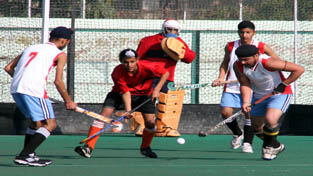
Players battling to get hold of the ball during a semifinal match of the Shaheed Bhagat Singh Memorial Hockey Tournament at Jammu on Friday. -Excelsior/ Rakesh
Three dead as Cambodian police open fire on protesters
PHNOM PENH, Jan 3: Cambodian police opened fire on protesting garment workers today, leaving at least three people dead, as the kingdom’s strongman premier faced growing public anger on the streets of the capital.
Workers armed with sticks, rocks and Molotov cocktails clashed with rifle-wielding police in the Veng Sreng factory district of Phnom Penh, according to a media photographer.
Police fired warning shots in the air and then fired at the protesters, the photographer saw.
“Three people died and two were injured,” Phnom Penh deputy police commissioner Chuon Narin told media.
One blood-soaked worker was seen lying on the ground while another was rushed away by motorcycle after what was the latest in a series of violent clashes between security forces and textile workers demanding higher wages.
Prime Minister Hun Sen faces a growing challenge to his nearly three-decade rule from protesting garment workers and opposition supporters demanding that he step down and call a new election because of alleged vote fraud.
Opposition leader Sam Rainsy denounced the crackdown.
“It’s an unacceptable attempt to break not only a worker strike but the whole worker movement as well as the democratic movement which is developing in Cambodia following the July elections,” he told media.
Rights activist Chan Soveth of local rights group Adhoc, who was at the site, said as many as 10 strikers were badly injured.
Security forces “used rifles and other things to crack down on the strikers,” he said. “They beat them on their heads.”
Military police spokesman Kheng Tito said the crackdown came after nine policemen were injured by stones and slingshots.
He said two protesters were arrested.
“We were afraid about the security so we had to crack down on them,” said Kheng Tito.
“If we allow them to continue the strike it will become anarchy.”
Disputes over wages and safety conditions are common in Cambodia’s multi-billion dollar garment industry which supplies brands like Gap, Nike and H&M.
The sector employs about 650,000 people and is a key source of foreign income for the impoverished country.
The workers are demanding a minimum wage of USD 160 per month. The latest clash came a day after a special military unit was deployed against garment workers, leaving several injured in a move described by rights activists as a “disturbing new tactic” by the authorities. (AGENCIES)