

TRIPOLI, Jan 3: A Libyan security official says military troops have detained two Americans in the restive eastern city of Benghazi.
The official says the two Americans are college basketball players and members of the al-Helal team of the Benghazi University.
The official says they were detained early today inside the campus. He did not give their names and spoke on condition of anonymity in line with regulations.
It was not clear why the two were detained. There was no immediate comment from the US Embassy in the Libyan capital, Tripoli.
Last month, four US military personnel were briefly taken into custody at a checkpoint in northwestern Libya and later released.
In September 2012, militants attacked the US diplomatic mission in Benghazi, killing US Ambassador Chris Stevens and three other Americans. (AGENCIES)
Libyan troops detain 2 Americans in eastern city
The year of unpredictability ?
Kalyani Shankar
What does the crystal ball say about the year 2014? It looks to be unpredictable and one of political shocks and economic shifts. Broadly speaking, the past few months have seen many political and macro economic developments, which will be unveiled further in the current year.
Politically, the biggest event of the year is the general election in May. Elections to some states including Andhra Pradesh, Haryana, Odisha, Arunachal Pradesh, Sikkim and Maharashtra will also be held. Crystal gazing shows that it is difficult to predict whether it will be a BJP led Government or the Congress led Government or a third front led Government. Whichever party or combination is elected, it has to fix a lot of issues that India is currently facing.
The year 2014 is also crucial to the future of many leaders. Prime Minister Manmohan Singh may bow out after his two successive terms but what about the other senior leaders? Sharad Pawar (NCP) is talking of not contesting while Advani (BJP) wants to continue. Karunanidhi (DMK) too may have his final innings in 2014 in Tamil Nadu. Will Mayawati (BSP) be up or down? Will Mulayam Singh be relevant? The polls will also decide the fortunes of Lalu Yadav (RJD), Mehbooba Mufti (PDP), Jagan Reddy (YSRC), Chandrababu Naidu (TDP), and the Thackeray cousins.
It will be an anti climax if Modi is unable to deliver after such hype; but if he wins, he will be the man of the year 2014. Modi began his campaign much ahead of others with his massive rallies and impressive oratory. The atmosphere became favorable to the BJP after the recent Assembly polls where it not only retained Madhya Pradesh and Chhattisgarh but also snatched Rajasthan from the Congress. The game was heading Modi’s way till recently, but the new entrant Aam Aadmi Party in Delhi has upset all calculations. The success of AAP should be an eye opener for not only the Congress but also the other political parties.
As for the Congress vice president Rahul Gandhi the year 2014 will be a test of his vote catching capacity and his ability to continue the dynastic rule. The Congress may face the problem of the anti -incumbency, as the people are vexed with corruption and scams. Although Rahul has a clean slate, his baggage of the UPA government would be huge burden on him.
The year 2014 can also be described as the beginning of a new kind of politics after the installation of the Kejriwal government promising a corruption free rule. The AAP is already inside the corridors of power in Delhi and that itself is the biggest achievement. The AAP is now a serious contender for saffron party’s votes not only in Delhi but also in other metros. There are more than 200 urban seats where the AAP could cut into the BJP votes.
There could be third front but this might become a reality only after the elections as almost all the regional satraps like Mamata, Jayalalithaa, Naveen Patnaik and Nitish Kumar are keeping their options open and targeting to win the maximum number of seats in their respective states so that they could be in a bargaining position.
As for the Assembly polls, Congress is presently ruling in Haryana, Andhra Pradesh, Maharashtra, and Arunachal Pradesh. The anti incumbency is starting in its face where people are looking for an alternative. The Congress has made a mess in handling of the Andhra Pradesh by promising to bifurcate it. If separate Telengana is not created, the Congress will lose miserably in both Andhra and Telengana.
Indian economy has been affected by global factors as well as political inaction. It has been on the downslide in 2013. Goldman Sachs in its November 28 report has predicted that 2014 will be a transition year. It all depends mainly on the formation of a stable government. A hung Parliament is a single biggest risk for the stock markets. Analysts also expect the banking and financial sectors might do well as well as telecom sector. The healthcare and pharmaceutical sectors may not perform well while Information technology could be looking up.
After a decade of stable foreign policy, the year 2014 brings uncertainty. The two pillars of Dr Singh’s foreign policy are to see a marked improvement in Indo – US ties and take trust building efforts with Pakistan to a new level. Singh’s foreign policy seems to be tatters on both counts. The year 2013 ended with the Devyani case souring the Indo – US relations. As far Pakistan hopes are being expressed about resuming Secretary level talks but it may suffer if BJP comes to power.
The year begins with the improved Indo-Japan ties. Soon after the Emperor’s visit, its prime minister will be the chief guest in the Republic Day parade this year.
The Indo-Sri Lankan ties will be put under test once again in March when the UN Human Rights council meets. New Delhi also has to decide its Afghanistan policy after the US pulls out. Bangladesh election results will decide about our future ties. Nepal too is going through a difficult time.
The Sino Indian relations ended in 2013 with a more positive than negative tone. China’s new leadership exhibited positive vibes towards the Indian counterpart, which was missing since the 1950’s bonhomie. It is for the new government to build on this.
Altogether, the future course depends entirely on the new government for its domestic, economic and foreign policy and whether there will be a new shift. (IPA)
Minister for Forest and Environment, Mian Altaf Ahmed chairing a meeting on Friday.
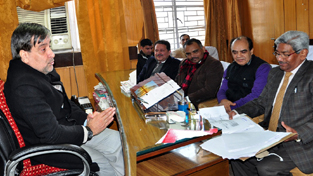
Minister for Forest and Environment, Mian Altaf Ahmed chairing a meeting on Friday.
Belarus jails two for spying for Lithuania
MINSK, Jan 3: Belarus said today that its main military court had jailed two Belarussians to eight and 10 years for spying for the neighbouring Baltic State of Lithuania.
The Belarussian security service — still known as the KGB — said in a statement that a military tribunal had found two men identified as A. Fenzelyau and Ye. Kochura guilty of treason.
The statement said the two were detained by March 2012 and that an investigation had found “incontrovertible proof of their criminal activity”.
The ex-Soviet nation’s KGB in July 2012 reported the arrest of a Lithuanian military intelligence agent and several informants as they traded secret information concerning Belarussian security.
The KGB did not give details on the number of informants or their nationality and it was not immediately clear if the two cases were linked.
The Minsk authorities in 2012 only identified the arrested Lithuanian as “citizen F”.
The Interfax news agency said today that Fenzelyau — jailed for 10 years — moved to Lithuania after retiring from service in the Belarussian armed forces in 2002.
EU member Lithuania has been more friendly toward its isolated neighbour than most other Western countries and has advised against economic sanctions against Belarus in response to President Alexander Lukashenko’s crackdown on the opposition. (AGENCIES)
UN warns South Sudan’s warring rivals must protect civilians
JUBA, Jan 3: The top UN aid official in South Sudan warned today that soldiers and rebels must protect civilians and aid workers, or risk worsening a conflict feared to have already left thousands of people dead.
“All parties to the conflict have a responsibility to make sure that civilians are spared from the fighting, do everything possible to restore calm, and ensure that law and order prevails,” said Toby Lanzer, the United Nations humanitarian coordinator.
“We call on all parties to facilitate aid agencies’ access to civilians, and to protect and respect humanitarian activities, workers and property at all times.”
Almost three weeks of violence has forced around 200,000 people to flee their homes and “affected many hundreds of thousands of people indirectly”, Lanzer said in a statement.
Some 57,000 are seeking refuge with badly overstretched UN peacekeepers.
The UN peacekeeping force said this week “atrocities are continuing to occur” across the country, which won independence from Sudan in 2011 after decades of civil war.
It reported “extra-judicial killings of civilians and captured soldiers” and the “discovery of large numbers of bodies” in the capital Juba as well as in the towns of Bor and Malakal.
The largest single site of civilians in need is in Awerial in Lakes state, where some 76,000 people have gathered, many fleeing the heavy fighting in neighbouring Jonglei state.
Oxfam, which like other aid agencies is deploying special teams to cope with the huge demand of people fleeing the fighting, said it “strongly condemns the use of violent force against civilians”.
European Union foreign policy chief Catherine Ashton also demanded “the protection of all civilians must be respected,” in a statement released today.
“I have noted disturbing reports of human rights abuse… any perpetrators of systematic or targeted abuses of human rights will be held accountable for their actions.” (AGENCIES)
Ram Lal and Avinash Rai Khanna at BJP workers meet at Jammu on Friday. —Excelsior/ Rakesh
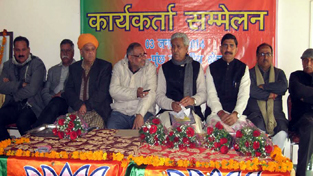
Ram Lal and Avinash Rai Khanna at BJP workers meet at Jammu on Friday. —Excelsior/ Rakesh
Relief at Antarctic rescue turns to fear for Chinese ship
SYDNEY, Jan 3: Australian authorities expressed relief today after 52 passengers were safely evacuated by helicopter from a Russian ship stranded in Antarctica, but then raised concern for a Chinese rescue vessel caught in heavy ice.
Officials tasked with freeing the scientific expedition on the Akademik Shokalskiy, which has been stuck since December 24, succeeded in flying them out yesterday in an on-off rescue operation.
A helicopter from Chinese icebreaker Xue Long used a makeshift landing pad next to the marooned ship and ferried the scientists, tourists and journalists to an Australian Government supply vessel, the Aurora Australis.
But it emerged later today that the Chinese ship, which has not moved much for several days, may itself be trapped by thick ice, the Australian Maritime Safety Authority (AMSA) said.
“Xue Long notified AMSA at 1pm AEDT (0200 GMT) this afternoon it has concerns about their ability to move through heavy ice in the area,” it said.
“The Aurora Australis has been placed on standby by the Australian Maritime Safety Authority’s Rescue Coordination Centre Australia to remain in open water in the area as a precautionary measure.”
AMSA said the Chinese ship would attempt to manoeuvre through the ice when tidal conditions are most suitable during the early hours tomorrow, adding there was no immediate danger to those onboard.
The rescue mission has been beset by extreme conditions from the start, with the Xue Long and Aurora Australis both unable to break through the ice to free to stranded Russian ship, despite several attempts.
Rain, snow and wind had also delayed the helicopter flights to the vessel ice-bound 100 nautical miles east of the French base Dumont d’Urville.
“This one was quite difficult to do,” said John Young, general manager of the Australian Maritime Safety Authority’s emergency response division, of the rescue.
“All Antarctic operations are difficult just because of the nature of the place and in this particular case the movement of the ice and the changing of the weather introduced their own complications.
“The protracted nature of operations in Antarctica and the difficulty of getting good weather windows, and getting the right ice conditions, really make life very difficult.”
Passengers on the stranded Russia ship were transferred to the Aurora Australis — the Australian Antarctic Division’s supply ship — and had been heading slowly to Casey station.
They were transferred, using the Chinese icebreaker Xue Long’s helicopter, from the Russian ship to an ice floe near the Aurora Australis over four flights across about 14 nautical miles yesterday. (AGENCIES)
Revamping of Agri-marketing
G. Srinivasan
In the 2014 run-up to the Lok Sabha Election, the ruling UPA coalition headed by the Prime Minister Dr. Manmohan Singh is left clueless as to how to get back to the slender majority it managed in 2009 to capture popular vote of the people, more so the aam aadmi. After the travesty of its own but unpatented slogan by a new political party in the name of aam aadmi in the Delhi Assembly elections, the century-old party Congress is desperately looking for strategies to erase the sullenness and sulking of the poor people across the nation, for whom the rise in food inflation to 20 per cent in 2013 is a rankling sore that put paid to all their hope of having even half a square meal a day. The UPA government no doubt enacted a raft of welfare legislations such as guaranteed employment and food security and in some cases old age pensions to destitute but they paled into insignificance in the face of an inexorable rise in prices of basic commodities of mass consumption.
No wonder the scion of the Nehru dynasty and the Vice President of the Congress Party Rahul Gandhi has reportedly directed party chief ministers to exempt fruits and vegetables that had been the principal villain of the piece to the unrelenting spurt in food inflation in recent months from the ambit and remit of the Agricultural Produce Marketing Committee (APMC) Act. It needs to be noted that the APMC provisions had wreaked havoc on the free movement of agricultural goods through the transparent tack of trade by restricting farm produce trade within the boundaries of the state-regulated mandis.
Barring farmers, anyone requires a license to trade in agricultural commodities. But, it is altogether another sordid saga that traders down the decades had cartelized their operations, fixing prices of the farm produce through manipulative procurement techniques that passes the wit of innocent farmers who are not deft enough to see through the murky methods of the mandis. It may be noted that wholesale trading is in the hands of market functionaries like wholesale traders and commission agents.
A recent query in Parliament on this showed that as in 2011-12, the latest available, number of licensed wholesale traders across the country were 6, 66,938 while the number of wholesale commission agents were 2, 77, 58, Though there is no licensing system for retail traders of vegetables and fruits, retail traders procure their produce only from wholesale traders after giving them all the costs in the procurement chain! When it gets into the hands of the ordinary consumers which are the end of the value chain, the value of the produce gets magnified with the original growers not even sharing a quarter slice of the price!
A decade ago, the Centre tried to reform this structure by a model APMC Act circulated in 2013 though it panned out nothing substantive or substantial because basically agricultural marketing is a state subject under the Constitution. The reason is not far too seek as the vested interests manifest in traders who are averse to any move that threaten their stranglehold and the state agricultural marketing boards who could ill-afford to upset the apple cart of entrenched mandis that invariably add to their revenue kitty. All the sanctimonious suggestions from the various Central Ministers right from the Prime Minister over the years did not melt any State seriously to cut the mandis hold on fruits and vegetables, though a few did come forward to implement the reform proposals to the APMC on the lines of the model Act. But these few and far between remain a work in progress in perpetuity.
It is an open secret that most of the traders at mandis have their own warehouses partly for hoarding purposes to maximize gains at the miseries of the hapless consumers, lay and lower-middle class alike. While oligopolistic understanding enables the traders to fix prices at will, mandi tax and cognate taxes in the name of development compound the final cost to the gullible consumers. It is also interesting to note that the fledgling Competition Commission of India (CCI) which is mandated to deal with massive corporate frauds or cartel type of behavior among firms to take the users for a ride, took suo-moto cognizance of increase in prices of onion in 2011, though such flare-up in onion prices did take place just before the winter in 2013 across the nation!
In a written reply to a query in the Lok Sabha by Dr. Murli Manohar Joshi and others on December 17, the Minister of Agriculture and Food Processing Mr Tariq Anwar said that based on ‘investigation report’, the CCI closed the matter on April 10, 2012 under sec 26(6) of the Competition Commission Act, 2002, as the “findings in the report do not mention hoarding as a reason for increase in the price of onion”. It requires no rocket science to note that the latest spurt in onion prices the country witnessed in the festival season till early December 2013 was widely attributed to hoarding of onion by the marketing cooperatives in the principal onion producing States with Maharashtra in particular.
Though some States such as Tamil Nadu did try to institute farmers’ markets to cut the intermediary and enable them to sell their produce direct to the consumers, the reach of the farmers is limited to these state-sponsored fares. Since most of these fares are set up away from the city or in the periphery of the villages, the consumers in general do not make a trek to these markets with gusto.
In fine, what is needed is a clear understanding of the underlying causes that contribute to the system in which either the grower or the final consumer is happy but the middle rung consisting of traders in cahoots with political parties batten themselves on the toil of the farmer and the travails of the latter. It is time an earnest bid is made to ensure that the farmers of fruits and vegetables get the benefit of marketing through mission-mode extension services as the only recipe for success over the long haul. (IPA)
Philippine army says nine Muslim rebels slain in attacks
COTABATO (PHILIPPINES), Jan 3: Philippine troops repulsed a series of attacks by a breakaway Muslim insurgent group in the country’s south that left nine rebels dead and two soldiers wounded, the army said today.
The series of skirmishes occurred around several small military outposts near the rural town of Pikit between Tuesday and yesterday, local military spokesman Captain Antonio Bulao told reporters.
Nine members of the Bangsamoro Islamic Freedom Fighters were killed in the fighting, Bulao said, citing intelligence reports.
The rebel faction’s spokesman, Abu Misri, confirmed that its forces were involved in the fighting, but denied that it sustained casualties.
Bulao said two soldiers were wounded in the fighting.
The rebel faction split off from the main Muslim rebel group, the Moro Islamic Liberation Front, after the MILF entered into peace talks with the Government to end decades of conflict that have claimed 150,000 lives.
Bulao accused the renegade rebels of extorting from private contractors of a Government irrigation project, but Misri denied this.
Misri also said the latest flare-up of fighting was unrelated to the Government’s peace talks with the MILF.
“This has no relation to the peace talks. We will not sabotage them,” he told reporters.
He said the rebels attacked because soldiers allegedly harassed Muslim farmers in the area, which Bulao denies.
The 12,000-strong MILF has been fighting since the 1970s for a separate Muslim state in the south, but has agreed to a ceasefire and peace talks with the Government.
However the BIFF have refused to abide by the ceasefire, and have staged scattered attacks on civilians and the armed forces.
President Benigno Aquino has promised to end the insurgency by the conclusion of his six-year term in 2016.
The peace talks reached a crucial stage last month after the two sides hammered out the details of a power-sharing agreement within a proposed Muslim self-rule area in the south. (AGENCIES)
Governor, N N Vohra having a look at books which were gifted to Civil Services Institute Reasi on Friday.
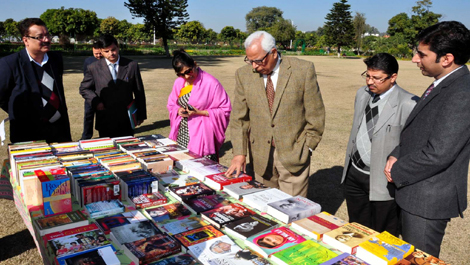
Governor, N N Vohra having a look at books which were gifted to Civil Services Institute Reasi on Friday.