

Sir,
It is of course a shocking story of apathy in West Bengal wherein a village panchayat sentenced a girl to be raped by 12 youth of the same village, a very shameful decision of its own kind. Panchayats are considered a type of village court which can solve the problems of local people of far flung rural areas, keep check on crime and help the poor for their development. But these type of so called Kangaroo panchayats in the country need to be tackled immediately.
How shameful is this that after raping, the culprits celebrated in the village. No one dared to stop them. Simultaneously in UP state also two real sisters were abducted and allegedly gang raped just making mockery of the law and order of the state. What has happened to this country one is puzzled. It seems total jungle raaj prevails in the country.
Nine rapes are reported in 48 hours in Bengal. Where is law and order? Is CM of west Bengal silent on law and order issue?
Stringent laws are to be incorporated in the constitution of india to curb this menace in the country so that girls and women folk can feel secure in this country.
Yours etc….
Kaushal Kotwal,
(SDAO retd)
Jammu
End Kangaroo courts
Matador menace
Sir,
We, the people of Jammu, are nowadays facing a major traffic problem in the city. The local matadors and mini-buses have become a menace hindering the normal movement of vehicular traffic. I feel abashed by the practice and would like to put forth my views.
Firstly, despite the order of the Government which states that all bus drivers and conductors need to be in their proper uniform, no driver is found obeying this rule and they wear whatever they like.
Another factor, concerning the security of the passengers, is that the matadors are found overloaded most of the times and the passengers are seen clinging on to the doors as well as the backs of the matadors. This indeed is a very dangerous practice. The matadors often keep waiting at the matador stops for more than 10 minutes, thus causing delay to many passengers. The main reason behind this is the absence of a proper schedule for the run timings of the matadors and due to the absence of a proper check mechanism.
Now, the most important part is the absence of proper matador stops. Matador drivers tend to stop their matadors wherever they want, be it in the middle of the road or at a junction where it becomes difficult for other vehicles to pass through, thus, causing unnecessary traffic jams. It is found that at many junctions’ matador drivers tend to overtake each other quite rashly, thus causing trouble for the oncoming vehicles.
These are some of the many drawbacks which need to be improved so that a proper, safe and a well organized local transport system can be made available to the people of Jammu and the easiest way of achieving this is to educate the drivers. The matador unions should help provide this education, rather than calling for bandhs and strikes every other day.
Yours etc……
Sugam Mahajan
on e-mail
65 years without Mahatmaji
O P Sharma
Mahatma Gandhi, the Father of the Nation, left us 65 years ago on January 30, 1948. He was the soul of the Indian freedom struggle on whose magic touch of non-violence, thousands followed him on the path of sacrifices and sufferings. By his unique Satyagrah Gandhiji was able to set the unarmed and non-violent Indian masses against the all powerful British rulers of the country and ultimately successfully led the nation to Independence in 1947.
For him the service of humanity was, in fact, service to God at the same time firmly believing in truth and universal brotherhood considering whole world like a family. ‘Bapu’ as he was affectionately called, did not preach only but he did live up to his teachings and gave spiritual as well as moral re-orientation to the politics. He had a vision of a new India with prosperity and justice: social, economic and political for all the citizens.
Gandhi’s Ideals
Gandhiji’s greatest concern was the rural masses and the disadvantaged sections of society and stood for casteless and classless society. His faith in non-violence and truth was unshakable. In fact, his political and social life is like a beacon-light shining star. He was the greatest son of India who throughout his life experimented with truth and subsequently made the supreme sacrifice after an assassin’s bullet struck him.
Born on October 2, 1869 in Rajkot region of Gujarat State where his father, Karan Chand Gandhi, was a Dewan. He was devoted to his parents, truth and God from early childhood. After passing the matriculation examination, Gandhiji qualified as a Barrister-at-law in England.
Model of Dedication
Subsequently in connection with a case he visited South Africa in 1893 and could not put up with injustice and discrimination of the resident Indians by the British rulers. He launched his struggle against discrimination in South Africa and thus got initiated into public life. In 1915 he returned to India and gave a new turn to political atmosphere.
His life from 1919 to 1947 is an open book of struggle and sacrifices for achievement of freedom. He infused a new spirit and direction by mobilizing the rural masses. His method was unique: non-violence and non-cooperation against the British rule in India. Under his inspiring leadership the entire nation stood as one man against the foreign exploitation.
Experiments with Truth
Gandhiji advocated use of Swadeshi goods and promotion of Khadi and Gram Udyog and pleaded that the villages must be made self-sufficient as the real India lives in her rural units. The economic Swarajya for the villages was his dream.
Gandhiji wanted to reform man and society through truth and non-violence. He was for change of heart by service, sacrifice and sufferings to bring about reforms. For him means were more important than the ends. Purity of means was a cardinal principal of his teachings. The Mahatma Gandhi had a vision of Indian in which there is no distinction between men and women, touchable and untouchables and also bridge the gap between the rich and the poor.
All Time Relevance
Mahatma Gandhi’s message is still relevant and has been acknowledged fully now across the globe. After the departure of Mahatmaji, the moral fabric has gone down considerably and he is “almost forgotten” and remembered only on very few occasions. How can the nation be galvanized now to hasten socio-economic transformation through Gandhian ways? A redeeming feature is that in the recent gang-rape case in New Delhi, the young boys and girls carried on protests peacefully across the country in true Gandhian spirit. This clearly shows that Gandhiji’s teachings are still relevant and are being followed by the people, especially the youth.
It is noteworthy that during Mahatma Gandhi’s historic visit to Jammu and Kashmir on August 1-4, 1947, Bapu had “seen a ray of light” for peace and communal harmony in this sensitive and strategic State. The people are still highly influenced by Gandhiji’s life and message.
Clean Politics Only
Gandhi’s philosophy is mainly focused on points like: “Wealth without work”, “Knowledge without character”, “Politics without morality” “Commerce without ethics”, “Science without humanity”, “Religion without sacrifice”. Can any nation survive and surge forward without having consideration to these important factors?
The vigilant public opinion has to assert and spread Gandhi’s teachings for ushering in socio-economic justice, harmony, gender sensitivity, peace and rapid progress in all spheres of life. It is time that the people rededicate themselves to the cause of the common masses for whom our great leaders suffered numerous hardships and made supreme sacrifices.
Total Commitment
Had Gandhiji been alive today he would have certainly wondered about the doings of our leadership. The crisis of character and confidence has set in and needs to be effectively dealt with the truth in politics and purity of means as insisted by Gandhiji.
On January 30, the nation pays homage to Mahatma Gandhi’s Samadhi at Rajghat, New Delhi. At numerous places in India, the people particularly the young generation pledge to dedicate themselves for building a New India of Gandhiji’s dreams and ideals.
(Starline Syndicate Service)
AAP survival
Col J P Singh, Retd
Am Admi Party registered an impressive win in Delhi election denting NaMo wave in the national capital otherwise sweeping North India. It surfaced as an unprecedented phenomenon in Indian Politics and its anchoring in Delhi an unexpected miracle. The event, rare in Indian politics, upset Congress and BJP’s applecart for 2014 general election. Hithertofore yours and mine role finished after we had voted. The elected representatives assumed the role of feudal lords. They became self styled rulers. Overtime they became landlords, stinking rich, arrogant and almighty. They enforced mai-baap culture occasionally opening charity shops for public. Growing middle class could not tolerate the humiliation from those whom they gave such position. This politics was to be given a befitting burial. Hence erupted what is known as Anna movement. And out of Anna movement was born what is today widely debated and discredited Am Admi Party. Nation was seeking change since the days of Jayapraksh Narayan which was once again blowing across India. Kejriwal, an anti corruption crusader sensed that nation was fed up with feudalistic maai-baap culture. During Anna and Nirbhay agitations, he sensed the mood of the nation which was looking for a messiah. He saw Delhi was ripe for plucking and jumped into the fray. He formed a political party and easily won the war. But the day to day battles are becoming difficult and embarrassing as seen in the two days botched up street protest led by him on an issue of vigilantism of his law minister.
On the pretext of busting of an unconfirmed ‘drug and sex racket’ in Khirki locality, Somnath Bharti led an unruly mid-night mob to raid and humiliate women of foreign nationality. However a police officer defied his instructions to uphold their dignity despite being bullied in public. The fact that African women were to be raided, lends racist and controversial angle to the entire episode causing sustained criticism. Kejriwal demanded suspension of three SHOs. When that was not conceded, he undertook a dharna falling on the heels of 65th Republic Day, few hundred meters away from the site of celebrations. This unconstitutional initiative stirred the conscious of the nation. Chief minster’s ill considered utterances and law minister’s racist and bitchy comments came under severe criticism. When called anarchist; Kejriwal owned the compliment to the annoyance of every one. He resounded, ‘yes I am anarchist’. His justification was, when there is no way left for achieving political objectives through constitutional means, such unconstitutional methods are the only way out. His justification seems to be great deal right because none of the political parties follow constitutional methods when it comes to fighting elections and forming govts. Still being a chief minister, an anarchist and chief protester is not a tenable position in any democracy.
On the eve of Republic Day address, the President of India, without naming AAP warned that winning election does not give one licence to flirt with illusions. Populist anarchy he said, is no substitute to governance and added that govts are not charity shops and making false promises breed disillusionment which further breed rage targeted at those in power. He exhorted voters to vote with responsibility and elect a govt which can provide stability. He warned that a fractured mandate could be catastrophic. Most of the speech of the widely respected politician President was ‘rap on the knuckles’ of AAP and at the same time a wise counsel for all of us.
The flip side of the controversy is that none of the politician is known to have sacrificed his or her night sleeps for aam admi and none saw Delhi Police as corrupt. Had they followed such activism, deplorable crimes and corruption would have been lesser and Kejriwal unknown. We don’t blame them for ignoring civic activism. Then why discredit AAP for their vigilantism. Right or wrong, more wrong than right, they have spent sleepless nights to fulfil their promises. They are now facing nightmarish criticism even from middle class and intellectuals of their own party because they over did it. The entire episode probably was to grab the headlines. Hence self promotion was the motive and what happens to India was none of their concern.
Having formed the govt, there is no going back for Kejriwal from fulfilling his promises in the shortest possible time. Two of his minsters who pressurised the police officers to take action against alleged criminals, have been branded unruly chowkidars, law breakers and criminals. No matter what the compulsion is, a minister cannot behave like a rowdy chowkidar. Law and order is a serious issue in India. Mounting crimes, gang rapes and murders in national capital have shamed the nation. Women security is a cause of concern. The problem appears serious when Delhi govt has no control over Delhi Police. Still such vigilantism better be avoided because it provokes public to unruly mobocracy creating more law and order problems consequences of which can be as serious as the rise of Naxalism in the national capital. This needs to be curbed by Kejriwal although there is a dilemma before him. If he has to project himself as an icon of New India, he has to remain in the lime light and has to fulfil his promises. But do we need leaders like him? As of now AAP is basking in its limited success. Kejriwal is young. He has long way to go. In the hindsight, Delhi govt is crowd driven (mobocarcy). To be led by a crowd is certainly not a participative activism. The voice of might may not always be right. Hope Kejriwal will be able to draw a balance. Even if he is sincere about changing the concept of representative democracy, he can’t pass laws and frame policies in the streets for the world to watch and mock at Indian democracy.
AAP survival depends upon large public support. Both JP and VP movements spread country wide and attracted prominent opposition parties to make an impact at the national level. The AAP is alone and of course endemic but unlikely to make as much impact as JP and VP movements did country wide. In Delhi it is already in the reverse gear because of Binny and Bharti. It has no institutional party structure such as vice president, general secretary or treasurer to frame and follow AAP agenda. One man show in democracy is likely to flop. If AAP still enters national arena with same structure and agenda, it will certainly be biting more than it can swallow; not a palatable situation for 2014.
Potato futures up on pick-up in spot demand
NEW DELHI, Jan 29: Potato prices moved up by Rs 6.30 to Rs 1,097.10 per quintal in futures trade today on increased spot demand against restricted arrivals.
At the Multi Commodity Exchange, potato for delivery in April rose by Rs 6.30, or 0.57 per cent, to Rs 1,097.10 per quintal, with trading volume of 50 lots.
Potato for delivery in March also moved up by Rs 5.10, or 0.47 per cent, to Rs 1,068.20 per quintal with a trade volume of 67 lots.
Analysts said increased demand in the spot market against tight supplies from producing regions mainly pushed up potato prices at futures trade. (AGENCIES)
Crude oil futures down 1.14 pc on weak Asian cues
NEW DELHI, Jan 29: Crude oil futures prices today fell by 1.14 per cent to Rs 6,063 per barrel, as speculators trimmed positions amid a weakening trend in the Asian trade.
At the Multi Commodity Exchange, crude oil for delivery in February fell by Rs 70, or 1.14 per cent, to Rs 6,063 per barrel in 7,880 lots.
Similarly, the oil for March delivery moved down by Rs 63, or 1.03 per cent, to Rs 6,077 per barrel in 398 lots.
The sentiment turned weak at futures trade after crude oil prices declined in Asian trade on expectations of an increase in US inventories and as traders await a Federal Reserve decision on the future of stimulus programme, analysts said.
Meanwhile, crude oil for March delivery shed 23 cents to USD 97.18 a barrel on the New York Mercantile Exchange. (AGENCIES)
Silver futures down 0.60 pc on global cues, weak spot demand
NEW DELHI, Jan 29: Silver prices fell by 0.60 per cent to Rs 43,902 per kg in futures trade today, taking weak cues from the global market amid subdued domestic demand.
At the Multi Commodity Exchange, silver for delivery in March fell by Rs 277, or 0.60 per cent, to Rs 43,902 per kg in business turnover of 2,524 lots.
In a similar fashion, the white metal for delivery in May declined by Rs 156, or 0.57 per cent, to Rs 44,846 per kg in business volume of 78 lots.
Market analysts said besides weak demand at domestic spot markets, a subdued trend in the global markets amid expectations that stimulus will be cut further as the US Federal Reserve decides on monetary policy, attributed fall in silver prices at futures trade here.
In the international market, silver fell 0.10 per cent to USD 19.56 an ounce in Singapore, dropping for the fourth day in the longest losing streak since November. (AGENCIES)
Gold futures down on global cues
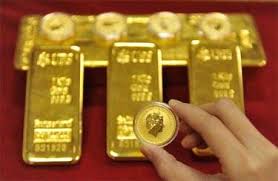
NEW DELHI, Jan 29: Gold prices moved down by 0.70 per cent to Rs 28,700 per 10 grams in futures trade today after participants off-loaded positions, taking weak cues from the global market.
At the Multi Commodity Exchange, gold for delivery in April declined by Rs 203, or 0.70 per cent, to Rs 28,700 per 10 grams in business turnover of 452 lots.
Likewise, the metal for delivery in February shed Rs 133, or 0.48 per cent, to Rs 29,378 per 10 grams in 1,672 lots.
Market analysts said a weak trend in the overseas markets amid expectations that stimulus will be cut further as the US Federal Reserve decides on monetary policy, mainly put pressure on the gold prices at futures trade here.
Globally, gold lost 0.6 per cent to USD 1,248.90 an ounce in Singapore. (AGENCIES)
Aluminium futures fall 0.97 pc on global cues
NEW DELHI, Jan 29: Aluminium prices fell by 0.97 per cent to Rs 106.65 per kg in futures trading today after speculators trimmed their exposures amid a weak global trend.
At the Multi Commodity Exchange, aluminium for delivery in January declined by Rs 1.05, or 0.97 per cent to Rs 106.65 per kg in business turnover of 505 lots.
Similarly, the metal for delivery in February traded lower by Rs 1.05, or 0.96 per cent to Rs 106.85 per kg in 183 lots.
Market analysts said the fall in aluminium futures was mostly in tune with a weakening trend at the London Metal Exchange ahead of the outcome of US Federal Reserve’s meeting today.
Meanwhile, aluminium for delivery in three months fell 0.20 per cent to USD 1,754.50 a tonne on the London Metal Exchange. (AGENCIES)
Zinc futures down 0.92 pc on global cues
NEW DELHI, Jan 29: Zinc futures prices today fell by 0.92 per cent to Rs 123.90 per kg as participants reduced their positions largely in line with a weakening trend overseas and subdued domestic spot demand.
At the Multi Commodity Exchange, zinc for delivery in January traded lower by Rs 1.15, or 0.92 per cent, to Rs 123.90 per kg, with a business turnover of 782 lots.
The metal for delivery in February fell by Rs 1.15, or 0.91 per cent to Rs 124.85 per kg in a turnover of 182 lots.
Globally, zinc prices fell 0.40 per cent to USD 2,004 per tonne at the London Metal Exchange.
Marketmen said the fall in zinc prices at futures trade was mostly in line with a weak overseas as investors awaited outcome of the Federal Reserve’s meeting today and subdued demand at the spot markets. (AGENCIES)