

MUMBAI, Feb 3: The rupee inched up by seven paise to 62.61 against the American currency in late morning trade today on mild selling of dollars by banks.
The Indian unit resumed lower at 62.70 per dollar as against last weekend’s level of 62.68 at the Interbank Foreign Exchange (Forex) Market.
It moved in a range of 62.56-62.72 per dollar before quoting at 62.61 per dollar at 1045 hours.
Initially, there was dollar demand from banks and importers in view of strong US currency in overseas market.
In New York, the US dollar gained against the euro and British pound on last Friday, but fell against the yen as investors focused on the emerging-markets fears spreading across the globe.
Concerns about slowing global growth and reduction of monetary stimulus from the Federal Reserve, combined with country-oriented issues such as political turmoil, have made investors wary of riskier assets such as stocks in recent sessions, according to experts.
Meanwhile, the Indian benchmark BSE-30 share index Sensex dropped 81.70 points or 0.40 per cent to 20,432.15 at 1045 hours. (AGENCIES)
Rupee edges up 7 paise Vs dollar in late morning deals
Cardamom futures climb 2.38% on strong spot demand
NEW DELHI, Feb 3: Cardamom prices climbed 2.38 per cent to 774.50 per kg in futures trading today after speculators created huge positions, supported strong domestic as well as export demand.
At the Multi Commodity Exchange, cardamom for delivery in February shot up by Rs 18.00, or 2.38 per cent to Rs 774.50 per kg in business turnover of 425 lots.
Similarly, the spice for delivery in March gained Rs 18.70, or 2.38 per cent to Rs 804.30 per kg in 369 lots.
Analysts said fresh positions built-up by speculators after upsurge in domestic and export demand in the spot market mainly pushed up cardamom prices at futures trade. (AGENCIES)
Nepal President calls on parties to form majority government
KATHMANDU, Feb 3:A day after the expiry of the deadline for forming a consensus government, President Ram Baran Yadav today called on Nepal’s political parties to initiate the process of establishing a majority government.
The office of the President, in a statement sent to the Legislative Parliament, asked parties to begin the process in line with Article 38(2) of the Interim Constitution.
Yadav did not give any timeframe for forming the majority government.
The deadline set by the President for setting up a consensus government ended yesterday with political parties unable to reach agreement on a candidate for the post of Prime Minister.
As the deadline under Article 38(1) of the Interim Constitution had passed, it became necessary to issue the notice for forming a majority government, the President said in the statement.
Nepal went to the polls on November 19 to choose a new Constituent Assembly that will draft a new Constitution aimed at ending years of political unrest.
Despite multiple rounds of talks in the past two months, political parties were unable to forge consensus.
The Nepali Congress emerged the largest party in the 601-member Constituent Assembly by securing 194 seats. However, it cannot form government on its own without the support of other parties.
After electing party president Sushil Koirala as its Parliamentary Party leader, the Nepali Congress held consultations with other parties, including CPN-UML, the second largest party in the Constituent Assembly, the Unified CPN-Maoist, the third largest party, and Madhesi parties.
The CPN-UML had asked the Nepali Congress to come up with a clear roadmap for power-sharing before any agreement on forming the government.
It has also been pressing for elections for the posts of President and Vice President, saying people had given a fresh mandate to political parties through the Constituent Assembly polls. (PTI)
Mentha oil futures rise 0.11 pc as demand picks up
NEW DELHI, Feb 3: Mentha oil prices rose 0.11 per cent to Rs 817.90 per kg in futures market today as speculators created fresh positions, driven by pick-up in demand from consuming industries in the spot market.
Tight stocks position in the physical market due to less arrivals from producing region also supported the uptrend.
At the Multi Commodity Exchange, mentha oil for delivery in February traded higher by 90 paise, or 0.11 per cent to Rs 817.90 per kg in business turnover of 263 lots.
Similarly, the oil for delivery in March edged up by 50 paise, or 0.06 per cent to Rs 827.70 per kg in 36 lots.
Marketmen said fresh positions created by speculators on pick up in demand from consuming industries in the spot market against less arrivals from Chandausi in Uttar Pradesh, mainly helped mentha oil prices to trade higher at futures trade. (AGENCIES)
Hollywood mourns sudden demise of Philip Seymour Hoffman
LOS ANGELES, Feb 3: Hollywood stars like Tom Hanks, George Clooney and Robert De Niro have called the sudden death of Oscar-winner Philip Seymour Hoffman as “untimely” and “devastating”.
Hoffman, 46, who won an Oscar for his role in blockbuster ‘Capote’, was found dead in his New York City apartment of an apparent drug overdose on February 2.
Hoffman, considered one of the finest actors of his generation, is best known for his performances in ‘The Scent of a Woman’, ‘The Master’, ‘Moneyball’ and ‘The Hunger Games: Catching Fire’ among others.
Hanks, who starred with him in Charlie Wilson’s War’, said it was a horrible day for those who worked with Hoffman.
“This is a horrible day for those who worked with Philip. He was a giant talent. Our hearts are open for his family,” Hanks told E! News in a statement.
Clooney, who worked with Hoffman in ‘The Ides of March’, said: “There are no words. It’s just terrible.”
Veteran actor De Niro said this should not have happened.
“I’m very, very saddened by the passing of Phil. He was a wonderful actor. This is one of those times where you say ‘this just shouldn’t be. He was so young and gifted and had so much going, so much to live for’. My family and I send our deepest condolences to his family,” De Niro said.
Susan Sarandon remembered the actor as “a genius, brave and sweet” man.
Oscar-winner Jeff Bridges said the industry has lost a treasure after the death of his ‘The Big Lebowski’ co-star.
“I’m so shocked, and so sad hearing of Philip Seymour Hoffman’s death. I enjoyed playing with him on ‘The Big Lebowski’. He was such a wonderful guy, and so damn talented, a real treasure. My thoughts and prayers are with his family.”
Hoffman, who played the role of chief Gamesmaker Plutarch Heavensbee in the final two ‘Hunger Games’ films, was mourned by the cast.
“Words cannot convey the devastating loss we are all feeling right now,” said a statement from Francis Lawrence, Suzanne Collins, Nina Jacobson, Jon Kilik and Jennifer Lawrence on behalf of the ‘Hunger Games’ cast and crew.
“Philip was a wonderful person and an exceptional talent, and our hearts are breaking. Our deepest thoughts and condolences go out to his family.” (PTI)
^^^^
ssembly polls. (PTI)
Kunchoth festival celebrated in Bhaderwah, Doda
Excelsior Correspondent
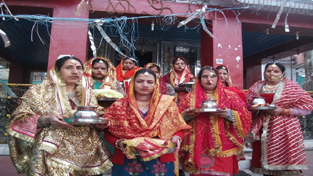
BHADERWAH, Feb 3: Like Karvachouth in other parts of the country, Kunchoth a local festival was celebrated with enthusiasm and religious fervur in Doda and Bhaderwah area of Jammu region.
As many families from the district have migrated to Jammu, the people here also celebrated the festival with great fervour. The festival envisages a message for the union of two souls and the sustainability of respect and honour for each other. The women keep fast for their husbands and offer special prayer for their good health, long and healthy life.
As symbol of festivities and celebrations, the wives dedicate themselves by undergoing fast for the entire day on the name of their husbands, visit the temples to perform special Pooja, clad in traditional marriage dress and wearing ornaments and looking like newly-wed. They move in large groups jointly to the temples of Lord Shiva and Parvati and offer special Pooja carrying Pooja items in pots (Thali).
Moreover, the fraternity performs the same activity by adding an ethical mark of `Charanbandana’ in lieu of which coconut is gifted to the `bower’ (wife). Over all, the magnitude of this festival, makes the society to understand the respect honour and dignity between husband and wife and the cultural discipline among the families.
Populist measures and inflation
Shiban Khaibri
Slew of populist measures in the run up to the elections just a few weeks away, to woe voters by the government, are undoubtedly going to be at the cost of the health of the country’s economy. This type of apparent politics having a sway over the fundamentals of economy and growth of the country, should bother each one of us and not make us feel happy, going by the small gains harvested in the short run. Does the decision lack economic sagacity even the timing of the decision notwithstanding? In Sept 2012 when the cap of 6 subsidized cylinders per household per annum was announced by the government, this writer through these very columns had expressed apprehensions of politics going to be played in capping of subsidized LPG cylinders in immediate future. The limit of just six cylinders was imposed by the government citing the reasons and the need of ridding the economy of an overwhelming amount of subsidy paid to offset the cost burden on the people. That is what we were told were measures of economic reforms which were cardinal for a healthy economy and all arguments in its favour were being put forth by its protagonists. What has happened now, what quantum of rapid and high GDP growth have we attained and no further, so called, economic reform measures needed, that it would be all in the interests of the health of the economy to get reverted to subsidies in a big way so as to put a burden of Rs.80,000 crores on the economy annually by raising the cap on LPG cylinders from 6 to 9 and now to 12. Why was the decision of fixing the limit of the subsidized cylinders taken earlier and what happened to the much hyped Aadhar connected subsidy transfer scheme which the UPA2 boasted of being a “game changer”? Has it been consequently put on hold or just thought to be redundant and a wasteful exercise?
It may be recalled that on Jan30, the UPA2 government took a decision and announced that it had raised the cap on subsidized LPG cylinders from 9 to 12 per household per year from April onwards this year. Reserve Bank of India governor R. Rajan criticized the government move and called it “misdirected subsidies” on the premise that the decision was going only to benefit those who could afford to pay the actual market price. He further said that the things very important on which the government must spend are not being spent on. It is ludicrous that the government took such a sensitive decision in an economic environ of high inflation, slow economic growth and a struggle for a paltry 4 to 4.5% GDP growth. The Union Finance Minister, P. Chidambaram on the other hand, is readying for massive spending cuts and deferring major spending projects even in sensitive areas like Defence and populist measures like the one under reference prove perilous humps in the way. Food inflation has adversely hit and broken a common citizen for the last 9 years. Name any item, even vegetables which in the winter season usually are comparatively softer in prices if not cheaper, do not show any signs of stabilizing and the common people do find it hard to manage sustenance. It is ironic that the government could realize the problems faced by the people on account of LPG capping only when strongly “conveyed” by Congress vice – President Rahul Gandhi now belatedly resulting in his increasingly “urging” Prime Minister Manmohan Singh to “raise” the cap from 9 to 12 at the AICC session earlier in January this year.
The move comes in close heels of and in utter poor response to the President’s address to the nation on Republic Day that no one should think and treat the government to be a “charity shop”. As Finance Minister of the country, Pranab Mukherjee had tried hard and to a larger extent succeeded as well, in keeping at bay such tendencies and the economic scenario then, was not as dismal as it is now. He further very aptly said that “elections do not give license to flirt with illusions, those who seek the trust from the voters should promise only what is possible.” Emboldened with the flip flop of the government, the Samajwadi Supremo Mulayam Singh Yadav while reacting to the “pro – people decision” demanded that the limit should be raised to 24 and the poor sections should get it free of cost. The government with our taxes was paying subsidy at the rate of Rs.800 per cylinder per annum. The subsidy on cheapest, if not virtually free of cost , items of food grains under Food Security provisions was going to put an additional burden of Rs.158000 crores per year. The whooping amount being spent on another ambitious scheme proven as game changer for the UPA in 2004 and to a larger extent in 2009 called as MGNREGA, could have been cobbled together in a planned way and used to create economic development, employment, increased production in core sectors especially agriculture and sincerely run PDP outlets, which in turn could have resulted in improvement in per capita income, raised the purchasing power of the poor and of the middle level income brackets. Have our policy planners in matters of economic development thought only to provide freebies and releasing and withdrawing subsidies at individual will of political leaders, which in veiled form, Rashtrapati Mukherjee referred to in his address to the nation on Republic day this year? The reasons of gradual plummeting from a 9% GDP growth to this year’s projected 4 to 4.3 per cent should concern us all and put on hold dolling subsidies. Our industrial and even services sectors are performing below the average and are facing demand crisis. Chinese goods are flooding our markets in almost all spheres and domestic industries mainly small, middle and cottage are facing problems of all hues creating a spurt in unemployment.
The question is that if the government delivers subsidies especially on occasions of elections without taking into consideration economic factors, who pays for it? It will come from the pockets of those people who were getting subsidized gas. Now who and how the poor shall get benefited or inversely the benefit which could have accrued to the poor shall be shared by the affluent,why? Just on Jan2 this year Petroleum Minister Veerapa Molly had ruled out and rejected the proposal of raising the cap. The Prime Minister in strict economic language only a year and a half back had categorically made it clear that “money does not grow on trees” but it seems that Rahul Gandhi with an eye to do a hat trick in 2014 for his party has rejected that golden saying of the PM like he did with the cabinet decision of the ordinance regarding tainted politicians, yet he speaks of decentralization of power. When the move of imposing limit on the number of cylinders was criticized and there was hue and cry all round even by the main supporters of UPA2, the SP and the BSP, the government did not roll back the decision citing fiscal constraints and wastage of scarce resources but the Congress President Smt. Sonia Ji “suggested” that Congress ruled states would allow 9 cylinders and it was implemented immediately benefiting those who had gone with the Congress Party.
Economists rue decisions like these being antagonistic to economic principles but our politicians appear to be comfortable as these political pushes have prospects of yielding rich dividends for them and their political parties. Who cares for the country?
Thai oppn to seek Constitution Court ruling to invalidate poll
BANGKOK, Feb 3: Anti-Government protesters in Thailand today said they will seek a Constitution Court ruling to invalidate the snap polls and vowed to ao ahead with street rallies aimed at ousting Prime Minister Yingluck Shinawatra.
Main opposition Democrat Party’s deputy leader Ong art Klampaiboon said they were collecting evidence to seek the Constitution Court ruling to invalidate the polls and would lodge a petition to the court soon through various channels.
Thailand voted yesterday under heavy security in violence-plagued snap election boycotted by the opposition.
Despite anti-government protesters blocking voting at several places, officials said the exercise was relatively peaceful and 89.2 per cent of polling stations operated normally. Election Commission chairman Supachai Phucharoen said voting was reported from 83,813 of 93,532 stations.
Despite the Yingluck Government’s claim of “victory” after the voting, the polls could end up being declared void because of factors like boycott and protests.
Election Commission members will meet today to discuss ways to solve the election-related problems.
An estimated 12 million people, or 25 per cent of all 48.7 million eligible voters, failed to cast ballots – two million during advance voting on January 26 and another 10 million yesterday, according to an EC official.
However, an official later said between 8 and 10 million eligible voters have been unable to cast their votes in more than 10,000 polling stations where voting was disrupted.
Hundreds of anti-Government protesters today besieged the office of General Niphat Thonglek, a senior defence ministry official, demanding that he should not allow caretaker Prime Minister Yingluck to use the building as her temporary office.
A low voter turnout was reported in many provinces, even in part of the North and Northeast where the ruling Pheu Thai Party enjoys support.
In southern provinces, the stronghold of the opposition, voter turnout was estimated at 20 to 30 per cent, much lower than previous elections.
There were reports of a high number of “no votes” in many provinces, as eligible voters ticked the box at the bottom of the ballot paper to vote for “none of the above”.
Caretaker Prime Minister Yingluck thanked voters for “helping to maintain democracy”.
Anti-Government protest leader Suthep Thaugsuban said that it was the “first time to have so many eligible voters boycotting an election”.
Protesters have been holding rallies across Bangkok and have blocked major intersections for the past three months calling for Yingluck’s Government to quit, an unelected people’s Council to be formed and the polls to be scrapped.
The protesters accuse Yingluck of acting as a proxy for her fugitive brother, ex-premier Thaksin Shinawatra who was ousted in a coup in 2006. He lives in self-imposed exile in Dubai to escape a jail term on a corruption conviction. (PTI)
Student kills teacher, policeman in Moscow school
MOSCOW, Feb 3: An armed teenager burst into his Moscow school today and killed a teacher and policeman before being taken into custody, investigators said.
None of the children who were in School No 263 were hurt, said Karina Sabitova, a police spokeswoman at the scene.
The student also wounded a second police officer who had responded to an alarm from the school, she said.
A spokesman for Russia’s main investigative agency said the student showed up at the school with a gun and a school security guard tried to stop him.
The guard was able to hit an alarm button before following the student to a 10th-grade biology class.
The student fatally shot a teacher and opened fire on police officers who responded to the alarm, Vladimir Markin, spokesman for the Investigative Committee, said in a statement. (AGENCIES)
Sachin, Prof C N R Rao to get Bharat Ratna tomorrow
NEW DELHI : Legendary cricketer Sachin Tendulkar and eminent scientist Prof C N R Rao will be conferred with the country’s highest civilian honour Bharat Ratna by President Pranab Mukherjee at a function here tomorrow.
Master batsman Tendulkar, who retired from international cricket on November 16 last year, will be the first sportsman to be bestowed with the honour by the President at a function to be held in ‘Durbar Hall’ of Rashtrapati Bahavan.
Tendulkar (40) and Rao (79), both of whom are recipients of Padma Vibhushan — the country’s second highest civilian honour, will join a list of 41 eminent personalities who have been conferred with the award that is given in recognition of exceptional service of the highest order since it was instituted in 1954.
In a fitting finale to a record-breaking career spanning 24 years, Tendulkar, a former India Captain, was chosen for the prestigious award, after his farewell 200th Test against the West Indies in Mumbai on November 16, 2013.
An official statement had said Tendulkar has been a true Ambassador of India in the world of sports and his achievements in cricket are unparallelled, the records set by him unmatched, and the spirit of sportsmanship displayed by him exemplary.
“That he has been honoured with several awards is testimony to his extraordinary brilliance as a sportsman,” it said, noting that Tendulkar has played cricket across the world and won laurels for the country during the last 24 years since a young age of 16.
An outspoken scientist, Prof Chintamani Nagesa Ramachandra Rao is a well recognized international authority on solid state and materials chemistry who has published over 1,400 research papers and 45 books.
He is the third scientist after C V Raman and former President A P J Abdul Kalam to be conferred with the Bharat Ratna.
Prof Rao’s contributions have been recognized by most major scientific academies around the world through conferment of memberships and fellowships and has been honoured with several national and international awards, the official announcement said.
He currently serves as the Head of the Scientific Advisory Council to the Prime Minister of India.
There have been continuous demands for a long time for Tendulkar to be conferred the top honour and the eligibility criteria for it was revised last year to accommodate sportspersons as well.
Tendulkar is also the first active sportsperson to become a Rajya Sabha member last year.
The Bharat Ratna was announced after a gap of four years with Hindustani music doyen Bhimsen Joshi being the last recipient in 2009.
Incidently, Union Home Ministry today came out with guidelines about Bharat Ratna saying the award cannot be used as a prefix or suffix to the recipient’s name under the Constitution.
However, the award winner can use mention as ‘Awarded Bharat Ratna by the President’ or ‘Recipient of Bharat Ratna Award’ in their bio-datas, letter head or visiting cards.
The recipient receives a Sanad (certificate) signed by the President and a medallion. It does not carry any monetary grant. (AGENCIES)