

Er Neeraj Dubey
The mobile phone industry has been one of the fastest growing industries in modern history. At present, India has 875.48 million mobile phone users and nearly 7,36,654 towers which emit electromagnetic radiations. By the end of 2014, this proportion is bound to grow as the access and affordability of mobile phones continues to increase. In the years ahead, an ever-increasing number of people will be exposed for long periods of time to radiation from mobile phones. Mobile phones, by various bio-physical mechanisms, may be responsible for a wide variety of health hazards. This article attempts to present the basic bio-physics of these devices and explain the health hazards of electromagnetic radiation exposure in terms of thermal and non-thermal effects. Wireless telephones are two-way radio transmitters. When a call is made, voice (sound energy) is converted to radiofrequency (RF) waves (electromagnetic energy). Radio waves travel through the atmosphere to the nearest base station and, at the call receiver’s end, waves travel from the base station to the receiver’s wireless phone. The receiving instrument re-converts radio frequency waves to sound energy and the receiver hears this as voice in the ear piece. In mobile phone technology, there are two main transmission protocols. The Global System for Mobile Communication (GSM) was established in 1987 and is the dominant protocol used in India and most European countries. Another protocol, founded by Qualcomm (a USA-based mobile service provider), is the Code Division Multiple Access (CDMA) standard. It is the major protocol used North America and was introduced in India a few years ago. In India, GSM phones use transmission frequencies in the frequency ranges of 890-915 MHz or 1710-1785 MHz for uplink (handset to base station) and 935-960 MHz or 1805-1880 MHz for downlink (base station to handset). The CDMA phones use frequencies of 824-849 MHz for uplink and 869- 889 MHz for downlink. Additional frequency ranges may be opened in the near future, to accommodate technologies such as the 3G (third generation) protocol. Radio waves are a form of electromagnetic radiation. Like gamma rays, X-rays or visible light, they form a part of the electromagnetic spectrum. These waves are generated by the movement of electrical charges in a conductive metal object (such as a transmitting antenna). Similarly, the waves can also be intercepted, i.e. by a receiving antenna. Each type of radiation has a specific frequency and wavelength, which decides the identity of the waveform. The wavelength (? ) is the distance covered by the wave in one second and the frequency is the number of waves formed per second. The electromagnetic energy absorbed by a unit mass of tissue is known as the specific absorption rate (SAR) and is expressed in watts per kilogram (W/kg) or milli-watts per gram (mW/g). In addition to mobile phones, electromagnetic radiation emission occurs from numerous devices that are frequently encountered by people. These include microwave ovens, radars, industrial heaters, cardiac pacemakers, televisions (especially plasma screens), refrigerators and washing machines, to name a few. The identified whole-body threshold level of exposure in terms of Specific Absorption Rate (SAR) is 4 watts per kilogram (4 W/kg). The whole-body human absorption of RF energy varies with the frequency of the RF signal. The most restrictive limits on whole-body exposure are in the frequency range of 30-300 MHz where the human body absorbs RF energy most efficiently. For exposure of the general public to mobile phone radiation, the US FCC (Federal Comm. Commission) limits RF absorption (in terms of SAR) to 1.6 W/kg, averaged over one gram of tissue. The Government of India Department of Tele-communications (DoT) adopted the guidelines set by the International Commission on Non-Ionising Radiation Protection (ICNIRP) and released a set of draft guidelines. The salient points from these guidelines are: – 1). It will now be mandatory for handset manufacturers to display the radiation levels on mobile phones through the menu options, making it easier for consumers to know the exact RF levels for each mobile device before purchase. These proposals are being framed by the Telecom Engineering Centre (TEC), which is the technical arm of the DoT. 2). The draft guidelines also propose that children under 16 years of age be discouraged from using mobile phones, while adding that setting up telecom base stations within the premises of schools and hospitals may be avoided because children and patients are more susceptible to electromagnetic fields. 3). Thus, all wireless phones sold in India will have to follow safety guidelines. Each agency has the authority to take action if a wireless phone produces hazardous levels of RF energy. This implies that Base Station operators will have to conduct an audit and provide certification that they are meeting the prescribed standards. At a later stage TEC may also set up a conformity assessment body (CAB) to measure radiations and provide certifications. Unfortunately, the Cellular Operators Association of India (COAI) has opposed the regulation demanding display of SAR values emitted by the handset. Most mobile phone providers give information about the SAR values on the batteries of these phones. Further information can be obtained from their websites, which mention SAR values according to the mobile phone models. People with pacemakers should take some simple precautions to be sure that their cellular phones do not cause a problem. For example, holding the phone to the ear opposite the side of the body where the pacemaker is implanted will add some extra distance between the pacemaker and the phone. And since cellular phones transmit electromagnetic energy whenever they are “on” (even when they are not being used), pacemaker wearers should avoid placing a switched-on phone in close proximity to the pacemaker (i.e. in a shirt pocket). Practicing safe mobile phone usage habits and avoiding excessive use will go a long way in minimizing biological hazards from these devices.
Now a day’s mobile towers of different phone companies are seen in every nook and crannies of our country. Almost all use mobile phones. But how many of us know about the adverse impact of mobile phone and mobile towers on our body and environment. Many scientists after carrying out lot of researches have found that mobile towers emits a lot of electromagnetic radiation which causes different types of diseases like heart disease, leukemia, hypertension, brain tumor, brain cancer. It affects those badly who are living within one kilometer from the tower. Children are the worst victims of this harmful radiation. Even the birds, insects and trees will also be affected. What is more worrying is that almost all the towers have been installed near public places such as schools , colleges, clinics, hospitals and residential apartments by directly violating the rules and norms of the govt. The Govt. should formulate innovative policies for handling this threat and strictly deal with the phone companies for the sake of people’s health & environment.
(The author is Asstt Professor GCET, Jammu)
Health Hazards of mobile phones & towers
All is not well in UP
Prof Javed Mughal
In politics, now-a-days, one general perception is flashing across the minds of almost one and all that the young blood must be given a chance to come forward to uphold the snaffle of the governance in the country all over. This perception is mainly supported by the reasons that the young blood is free from the diseases of corruption and other anathemas like nepotism, regionalism, favoritism, communalism, and corruptionism and thereby possesses an enlightened mind, broad vision and a formative approach to look at the affairs. But the recent disheartening role of Mr Akhilesh Yadav the youngest Chief Minister of UP has dashed all the hopes to the ground which the innocent masses had reposed in him, and has left a big question mark on image of the entire young political generation in the country. UP has set the worst instance of law and order derailment in the country. Killing of A former SP legislator in Azamgarh, Yashvir Singh in Ghaziabad last February, Dharmendra Singh in Bareilly, Chaman Lal Bhati in Noida and Badri Yadav in Mau, Bhola Singh in Auraiyya,, Miraz-ul-Haq in Gorakhpur, Arvind Yadav, and killing and lynching of other policemen, apart from thrashing and beating the doctors and recent violent attacks on toll plaza staff in Faizabad sends across a photographic representation of the inside plight of law and order in Utter Pradesh calling the competence of Akhilesh Government there. What can one expect from this Government when their own leaders and workers are not safe, asked Swamy Prasad Maurya, leader of the Opposition in the Vidhan Sabha and senior Bahujan Samaj Party (BSP) leader.
What happened in Muzaffarnagar is the worst of its kind in the regime of so-called energetic, honest and clear-hearted custodian of UP state. Otherwise too, I have a natural aversion to the politicians simply because the politicians of some caliber are yet to prevail in the country and the politicians ruling this ill-fated nation are no more the leaders of any body’s choice. When the entire Muzaffarnagar was afire and the Hindus and Muslims were daggers drawn with one another; when the spine-chilling cold was claiming the lives of the make-shift campers and nothing was safe in Muzaffar Nagar, a foreign junket of MLAs and some MPs from Uttar Pradesh and Karnataka were on the study tours abroad instead of staying back and playing their role to lighten the situation in Uttar Pradesh. Had the Karnataka MLAs, instead of going abroad to study at this crumbling stage of life, come to UP to study the plight of Muzaffar Nagar victims, it would have been of much more significance. This is the height of inclemency. On the other hand the utter callousness of the Uttar Pradesh Chief Minister, Akhilesh Yadav who chose to spend time enjoying the ‘tamasha’ by Bollywood stars in Saifai, UP, ignoring the trauma of the riot-sufferers who were dying of the cold in makeshift camps, sent a galvanic shock through the spine of one and all in the country. Such insouciance from the ruling class is reminiscent of Louis XVI on the eve of the French Revolution. It is a recent phenomenon that MLAs and MPs would take off for cooler climes abroad to avoid the harsh Indian summers and to warmer foreign locales during the winters.
Hence the Karnataka MPs traveled to New Zealand and Australia which are enjoying their summers now, because of their location in the southern hemisphere. These junkets have been given the honorable nomenclature of “study tours,” when the journey is more touristic than about study. Why would Indian legislators have to travel to foreign countries to learn about democracy and governance? Should they not be traveling to the Maoist hit areas to better understand the situation in their own country? Why do they choose attractive locales such as Australia, New Zealand, the UK, Netherlands, Rome, the US and even Middle Eastern countries like Egypt, Dubai, Turkey etc, that don’t have any semblance of democracy? Why don’t they travel to South Sudan to see the complexities of statecraft and anarchy because that is where India seems to be heading? However, when the Prime Minister of the country is himself known as the most widely traveled head of state (to foreign countries, 67 times in 9 years) others can only follow his footprints. In a system where no accountability is sought from those who spend such public money recklessly, it is natural that such junkets become de jure and get an official stamp. Thankfully the media has brought this obnoxious practice to the public domain. On the issue of politics and Bollywood, the two have become synonymous now, with the Rajya Sabha looking like a star-studded arena. When the serial blasts happened in Patna on 26 October last year, Union Home Minister Sushil Kumar Shinde rushed to Mumbai, instead to, attend a Bollywood programme and even apologized for reaching there late. Such lack of concern for the ruled, by a Home Minister of the country can only be called abominable! Can India afford to be ruled by such men and women who are no longer in sync with the travails of the people?
Crude oil futures down on weak Asian cues
NEW DELHI, Feb 3: Crude oil futures prices today fell by 0.76 per cent to Rs 6,122 per barrel after speculators indulged in reducing positions triggered by weak Chinese data.
The trading sentiment weakened at futures trade after crude oil prices declined in Asian trade as data showing weak Chinese manufacturing activity fuelled concerns over energy demand in the world’s second largest economy, marketmen said.
At the Multi Commodity Exchange, crude oil for delivery in February fell Rs 47, or 0.76 per cent, to Rs 6,122 per barrel in 1,749 lots.
Similarly, the oil for March delivery moved down by Rs 39, or 0.63 per cent, to Rs 6,120 per barrel in 140 lots.
Meanwhile, crude oil for March delivery eased 51 cents at USD 96.98 a barrel on the New York Mercantile Exchange in mid-morning trade today. (AGENCIES)
Zinc futures down 0.56% on subdued demand
NEW DELHI, Feb 3: Zinc futures prices today fell 0.56 per cent to Rs 124.20 per kg, taking weak cues from the global markets amid low demand at domestic spot markets.
At the Multi Commodity Exchange, zinc for delivery in March traded lower by 70 paise, or 0.56 per cent, to Rs 124.20 per kg with a business turnover of 4 lots.
The metal for delivery in February fell by 35 paise, or 0.28 per cent, to trade at Rs 123.45 per kg in a turnover of 55 lots.
Marketmen said besides low demand at domestic spot markets, a weak trend in base metals at the London Metal Exchange after manufacturing slowed in China, the world’s largest user of base metals, put pressure on zinc futures prices here. (AGENCIES)
Copper weakens in futures trade on global cues
NEW DELHI, Feb 3: Copper futures prices today fell marginally to Rs 444.70 per kg, as speculators trimmed positions amid a weak trend in the global markets on slowing manufacturing in China.
At the Multi Commodity Exchange, copper for delivery in February declined by 25, or 0.06 per cent, to Rs 444.70 per kg in business turnover of 392 lots.
The metal for delivery in April fell by a similar margin to Rs 451.10 per kg in 7 lots.
Analysts attributed the decline to a subdued trend at the London Metal Exchange (LME) as manufacturing in China, the world’s largest user of base metals.
Meanwhile, copper for delivery in three-months traded 0.40 per cent lower at USD 7,035 per tonne on the LME. (AGENCIES)
Nickel futures drop on sluggish demand, global cues
NEW DELHI, Feb 3: Nickel prices dropped 0.83 per cent to Rs 875 per kg in futures trade today as speculators reduced their holdings on sluggish demand from alloy-maker in the spot market and a weak trend overseas.
At the Multi Commodity Exchange, nickel for delivery in February dropped by Rs 7.30, or 0.83 per cent to Rs 875 per kg in a business turnover of 196 lots.
Similarly, metal for delivery in March lost Rs 6.30, or 0.71 per cent, to Rs 883.20 per kg in six lots.
Analysts said speculators reduced positions due to sluggish demand from alloy-makers in the spot market amid a weak global trend after manufacturing slowed in China, the world’s largest user of base metals, mainly pulled down nickel prices at futures trade. (AGENCIES)
Chana futures down 0.70 pc on increased supply, weak demand
NEW DELHI, Feb 3: Chana prices moved down by 0.70 per cent to Rs 2,835 per quintal in futures trade today as participants trimmed positions amid weak demand in the spot market against increased supplies from producing regions.
At the National Commodity and Derivative Exchange, chana for delivery in February fell by Rs 20, or 0.70 per cent, to Rs 2,835 per quintal with an open interest of 54,700 lots.
Similarly, the commodity for delivery in March lost Rs 18, or 0.60 per cent, to Rs 2,994 per quintal in 71,430 lots.
Analysts said participants trimmed positions, driven by a weak demand in the spot market against increased supplies from producing regions mainly kept pressure on chana prices at futures trade. (AGENCIES)
Sugar futures gain 0.49% on spot demand
NEW DELHI, Feb 3: Sugar prices rose 0.49 per cent to Rs 2,662 per quintal in futures trading today as speculators built up fresh positions after pick up in demand in the spot market supported by ongoing wedding season.
However, ample supplies in the physical market limited the gains.
At the National Commodity and Derivatives Exchange, sugar for delivery in March rose by Rs 13, or 0.49 per cent, to Rs 2,662 per quintal with an open interest of 22,320 lots.
Similarly, the sweetener for delivery in February traded higher by Rs 4, or 0.15 per cent, to Rs 2,647 per quintal in 14,740 lots.
Analysts said the rise in sugar prices was mostly attributed to pick up demand in the spot markets supported by ongoing wedding season but ample supply, restricted the gains. (AGENCIES)
Bajaj Auto motorcycle sales dip 7% in Jan
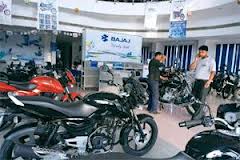
MUMBAI, Feb 3: Pune-based auto maker Bajaj Auto today reported a 7 per cent decline in motorcycle sales at 2,81,390 units in January 2014.
The company had sold 3,01,361 bikes in January 2013, Bajaj Auto Limited said in a release here.
The overall domestic sales including commercial vehicles also fell by 8 per cent during January 2014, it said.
Bajaj Auto sold 3,18,177 vehicles in the reporting month as against 3,47,624 units sold a year ago, the company said.
Exports, however, surged by 7 per cent to 1,37,644 units as against 1,28,482 vehicles in the corresponding period of 2013, it said. (AGENCIES)
Potato futures fall 0.83% on subdued demand, higher supply
NEW DELHI, Feb 3: Potato prices fell by 0.83 per cent to Rs 1,076.50 per quintal in futures trading today as speculators offloaded their positions following sluggish demand in spot markets against increased supplies.
At the Multi Commodity Exchange, potato for delivery in far-month fell by Rs 9, or 0.83 per cent, to Rs 1,076.50 per quintal in business turnover of 26 lots.
Likewise, the potato for delivery in March traded lower by Rs 5.40, or 0.51 per cent to Rs 1,045.50 per quintal in 69 lots.
Market analysts said speculators offloaded their positions due to sluggish demand in the spot market against increased supplies from producing regions mainly influenced potato prices at futures trade. (AGENCIES)