

Sir,
Recently numerous masters and teachers of various streams were elevated as I/C Lecturers. It is a welcome step of the Government But stepmotherly injustice is done with the subject of sociology which is deemed to be an important subject nowadays. This subject has not been introduced in 90 percent of institutions in our State. Children from every nook and corner of society are eager to have this subject.
But they are unable to do so. An example can be cited. In district Budgam Sociology subject has been introduced only in Govt. Hr. Sec. Budgam while other institutions are run without this subject. I think this should be an eye opener for educational faternity and common masses. Here it is worth while to mention that sociology is an important subject in K.A.S. and MBBS. There are hundreds of masters who have PG in sociology. They can help to solve this problem. But in present situation they have a meager chance to get promotion. This subject should be started from the primary level in our curriculum.
It is requested that this subject should be started in all 10+2 institutions of our State so that all concerned people will get benefits and it will help us to lead on the path of progress.
Yours etc…
R.L. Bhat
Durga Nagar, Jammu
Introduce Sociology in schools
Implement the agreement
Sir,
Notwithstanding the fact that the Government of J&K through its Sub-Cabinet Committee and the EJAC/JCC reached an agreement with regard to just and genuine demands of the Government employees which interalia include the implementation of the 6th Pay Commission vis-a-vis increasing the retirement age from 58 to 60, removal of pay anomalies of various cadres, payment of 6th pay commission arrears and regularization of daily wagers and contingency paid employees of all the departments etc but unfortunately the Government has not implemented the said agreements in toto till today.
As a consequence of it, the employees under the banner of EJAC/JCC staged peaceful dharnas and demonstrations, submitted a number of memoranda to the Government to implement the agreement agreed and signed by both the sides. But again, it seems that the Government seems to be a mute spectator by way of not implementing the agreement which consists of just and genuine demands of four lakh employees of the State.
The employees do not want to take the agitational path or any kinds of confrontation but are ready to resolve the problem of the employees in light of the agreement.
Therefore, in this context, a fervent appeal is made to the Government, Sub Cabinet Committee and the pay Anomoly Committee to kindly implement the agreement in full and as such there would be no confrontation for greater good of the employees and the Government as well
Yours etc…..
Ashok K Lalpuri
Ajeet Colony Gole Gujral, Jammu
Compensation for PoK refugees
Sir,
The issue of compensation for inestimable losses of men and material in those bloody days of 1947 scratches the wounds and refreshes the memoirs when millions were forced to leave their hearth and home pennilessly and in a most dreadful situations. Even after crossing the PoK, these refugees had to undergo indescribable miseries to keep their body and soul together. Both Centre and State Govts.perhaps weren’t in position than to rehabilitate them and pay the compensation of the losses they suffered and consequently, they still are under unsatisfactory life conditions.
The State Govts proposal of recommending Rs 7000 crore for final settlement of displaced persons of 1947, 65 and 1971 is indeed a welcome step as it builds a bridge of hope. But 67 years period since their displacement and awaiting for claims etc. give rise to many questions and apprehensions whether even their fourth generation would be fortunate to have compensation claims realized. To fulfil state obligations towards these displaced persons, it is highly becoming on the State Govt to project the proposal forcefully and justifiably so that long back distressed people as these are, aren’t made to suffer any longer.
Yours etc…
Keshwa Nand Sharma
Salehri (Sunderbani)
India-China Border Talks Challenges to consensus building
Prof Arvind Kumar
The last six and half decades of India-China relationship have seen more of mutual mistrust and suspicion than friendliness and cordial atmosphere. Such mistrust and suspicion only grew over the years and both India and China have been making modest attempts in a number of ways to improve their understanding. The bilateral border talks are a case in point. Undoubtedly, India-China relations are expanding and deepening despite several divergences on many pertinent issues impacting the bilateral relations.
The deepening of relations was reflected when the two countries established the Strategic and Cooperative Partnership for Peace and prosperity in 2005 and also signed a Shared Vision for 21st century in 2008. More recently, both India and China have signed the Border Defence Cooperation Agreement (BDCA) in 2013. The BDCA was nothing new but old wine in new bottle. It was some sort of a reiteration of India-China Peace and Tranquility agreement signed way back in 1996.
The major challenge confronting the two nations’ relations has been to build mutual trust and confidence. The trust deficit created by both the sides has decimated the robustness of bilateral relationships. The element of trust is an essential component in forging a sustained cooperation. Somehow, the lack of trust and confidence has created lot of misunderstanding on a number of issues.
The Sino-Indian border row remains an irritant. It seems there are no immediate solutions to it. The creation of a Joint Working Group (JWG) by both India and China in 1988 ice melting visit of India’s Prime Minister Rajiv Gandhi to China had at least seen a beginning in bilateral talks. The mandate of JWG has been to find a solution to the border row. Its larger objective was to articulate each other’s concerns and analyse the options available before both the countries. At the same time, the objective was also to ensure the maintenance of peace and tranquility across the border during the negotiations process.
Since the creation of the JWG, 17 rounds of border talks have been held so far both in Beijing and New Delhi. The more recent one was held in New Delhi this month. But, unfortunately, nothing concrete has happened in terms of resolving the border issue. The JWG gave a framework to build the bilateral momentum without any great significance and impact.
More recently, both India and China held their 17th round of border talks in New Delhi and stressed on peace and tranquility on their 4,000-km disputed boundary. It was mainly an adherence to the ongoing commitment. Whether Beijing really takes such commitment seriously has been a part of the debate among the strategic and academic community. China, most of the time, seems to be inconsistent in terms of its rhetoric and actions.
The special representatives of both India and China led by National Security Adviser of India Shivshankar Menon and Chinese State Councillor and top diplomat Yang Jiechi deliberated on the boundary question. However, the outcome has not been made public and hence it is generally believed among the academic and strategic community that it was a ‘talk for sake of talks’. China still seems to be adamant on its position of holding its occupation of Indian Territory. The talks at the special representatives level symbolises only the intent that both India and China have agreed to the settlement of the boundary question.
There is no progress made with sincere and genuine commitment on part of China to evolve the “framework for resolution of the boundary question”. Such relevant discussion has been lingering for the past eight years. The challenges mainly lie in the establishment of the bilateral framework. Once, that is agreed by both sides then only such talks will move forward to resolving the boundary question.
The other requirement from both sides will also be to have a bilateral consensus built on the most complex element of demarcating maps and finally a delineation on the ground. There is no serious move on the bilateral exchange of maps so that both the countries can state their positions and then only it will lead to certain useful and significant talks at the level of special representatives.
The bilateral meetings among the officials of both the countries were also held mainly to consult and coordinate the probable mechanism on India-China border affairs. The review and assessment on the recent developments especially in the Western Sector also could not build the larger understanding from both sides.
Moreover, India and China also elaborated on the additional confidence building measures in addition to the talks on the boundary question. The need for the early implementation of the Border Defence Cooperation Agreement inked last year during Prime Minister Manmohan Singh’s visit to Beijing was also felt. The meeting of the special representatives was also the first meeting of senior officials after the visits by their two Prime Ministers to each other’s country.
A number of other issues were discussed at the bilateral level during the special representatives meeting. Both New Delhi and Beijing discussed a number of international security issues including Afghanistan, East Asia Summit, counter-terrorism, disarmament, maritime affairs, trade, finance and climate change. After the discussion, China, however, demonstrated its naval exercises again to send signals that it has been pursuing a rigorous path of acquiring blue water navy.
What has happened in the past over two-and-half-decades is that both the countries have been talking routinely not only on border issues but also exploring the mechanisms by which economic and cultural engagement takes a robust shape and that the bilateral relationship is given a broader shape.
If the Centre of gravity is really shifting from the West to East, then it is quite certain that China and India will have to work together and shoulder the responsibility of leading the world affairs. China would need to accommodate India’s interests and vice-versa. The international community seems to be very cautiously watching the evolving contours and challenges between the two.
China needs to expedite and explore a mechanism to resolve the border row. If it can settle its border disputes with 10 other countries, it is certain that the border row with India can also be resolved, provided there is willingness from both sides. India would require keeping its options open and if the opportunity arises may go for a quid pro quo and see that national interests remain paramount. The very fact that both New Delhi and Beijing have agreed to the proposal of holding Annual Defence Dialogue shows that there will be remarkable progress on dispelling all the misunderstandings. The foreseeable future in Sino-Indian relations depends mostly on the behavioural patterns, intent and the fundamental goals of both sides. —INFA
Potato futures fall for third day on higher supply
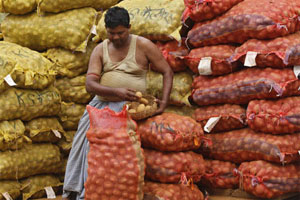
NEW DELHI, Feb 14: Continuing its losing streak for the third straight day, potato futures declined 0.24 per cent to Rs 1,157.30 per quintal today as speculators offloaded positions due to higher supplies from producing regions.
At the Multi Commodity Exchange, potato for delivery in April declined by Rs 2.80, or 0.24 per cent, to Rs 1,157.30 per quintal in a business turnover of 45 lots.
Potato for delivery in March also shed Rs 2.30, or 0.21 per cent, to Rs 1,115.50 per quintal in 247 lots.
Market analysts said offloading of positions by speculators, driven by higher supplies in mandies from producing regions, mainly kept pressure on potato prices to surrendered ground at futures trade. (AGENCIES)
Chana futures remain up on rising demand
NEW DELHI, Feb 14: Amid rising domestic demand, chana prices rose for the third-straight day by adding 0.51 per cent to Rs 2,981 per quintal in futures trade today.
Besides, reports of lower estimate of output also influenced chana prices.
At the National Commodity and Derivative Exchange, chana for delivery in February increased by Rs 15, or 0.51 per cent, to Rs 2,981 per quintal with an open interest of 18,510 lots.
Similarly, the commodity for delivery in April added Rs 8, or 0.26 per cent, to Rs 3,062 per quintal in 92,020 lots.
Analysts attributed the continued rise in chana futures to rising demand at spot market and fall in arrivals from producing regions. (AGENCIES)
Devotees during the Nirwan Diwas function of Bhagat Kabir on Friday.
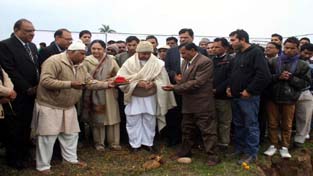
Devotees during the Nirwan Diwas function of Bhagat Kabir on Friday.
IOC shares down 2.5% on sluggish December quarter earnings
MUMBAI, Feb 14: Shares of Indian Oil Corp today fell 2.5 per cent after the company reported a net loss of Rs 961.45 crore in the December quarter.
After a weak opening, the scrip of the country’s largest oil firm lost 2.39 per cent to Rs 238.25 on the BSE.
At the NSE, the stock fell 2.49 per cent to Rs 238.40.
Indian Oil Corp had yesterday reported a net loss of Rs 961.45 crore in the December quarter after the government paid less than half of the due oil subsidy, negating gains made from foreign exchange.
IOC had posted a net profit of Rs 3,331.96 crore in the same period a year ago.
The company posted losses “mainly on account of higher absorption of under recoveries on sale of sensitive petroleum products,” IOC Chairman R S Butola had said.
Meanwhile, the Government is likely to sell its 10 per cent stake in IOC through an off-market deal to state-owned ONGC and OIL at a discount of 10 per cent over the current market price. (AGENCIES)
Minister for PHE Sham Lal Sharma and MP Madan Lal Sharma addressing gathering of Panchs and Sarpanchs at Akhnoor on Friday.
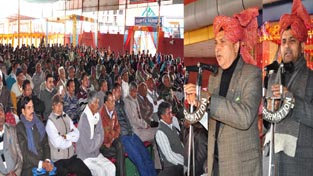
Minister for PHE Sham Lal Sharma and MP Madan Lal Sharma addressing gathering of Panchs and Sarpanchs at Akhnoor on Friday.
The AAP adventurism
Arun Jitley
Federalism is part of the basic structure of India’s constitution. Federal principles are unamendable. The jurisdiction of the Centre and the State is clearly demarcated. There is no scope for any grey area. Ordinarily, when we perceive threats to federalism, it is suspected that encroachment of federal principles is by the Centre. The Centre, through its agencies, cannot usually investigate what happens in the States. It is only in extreme cases that it issues an advisory or where there is breakdown of constitutional machinery, it can invoke powers under Articles 356. The CBI’s powers to investigate public servants of the State is restricted to cases where the States specifically consent to the investigating agency or where the High Courts or the Supreme Court issues a direction to the CBI to so investigate.
What happened in Delhi a couple of days ago, therefore, merits a comment. My comment is not concerned with the fairness or otherwise of the fixation of prices of natural gas. Aggrieved persons are entitled to raise the issue in Parliament and even seek an investigation directly from the Centre or through a court process. The issue is: can the State Government, through its Anti-Corruption Branch, investigate a decision taken by the Central Government?
Delhi is a Union Territory with a State assembly. Legislative and Executive jurisdiction of Delhi is circumscribed by Article 239AA. Entries 1, 2 and 18 of the State List under the Seventh Schedule are not applicable to Delhi. Entry 1 deals with public order, Entry 2 with police and Entry 18 with land. Thus powers to regulate public order and police are currently not with the Legislative Assembly of Delhi. Executive powers are co-extensive with legislative powers. The Delhi Government has, therefore, no police powers. What thus is the function of the Anti-Corruption Branch of the Delhi Government? The Anti-Corruption Branch is part of the Vigilance Directorate of the Delhi Government. In pith and substance, it is the function related to vigilance and not to the police powers. In relation to the vigilance it has all the powers to deal with erring public servants and departments of the Delhi Government. Thus for the Vigilance Directorate of Delhi Government or the Anti-Corruption Branch under it, to possess unlimited powers of the police within the geographical territory of Delhi would imply that Entry 2 of the State list is made applicable to Delhi. This has been specifically prohibited by Article 239AA of the Constitution. This would further imply a parallel jurisdiction in relation to the functioning of the Central Government located in the National Capital. The Central Government, would parallelly be both under its own Vigilance jurisdiction and that of the Delhi Government’s Vigilance jurisdiction. This would imply, that from the Prime Minister to the Cabinet Secretary to all public servants would be susceptible to the jurisdiction of the State Government. The existence of these police powers itself is doubtful. To put the Central Government under the police jurisdiction of the State Government would be a constitutional monstrosity. It would be violation of federal principles in reverse. Compliance with the letter and spirit of the Constitution requires restraint and statesmanship. Constitutional institutions cannot be preserved by acts of adventurism. I seriously doubt the correctness of the judicial opinion which holds otherwise.
The ‘single-point directive’ applicable to the Public Servants of the rank of Joint Secretary and above states that before investigating officers falling under it, consent of the Central Government is required. The Supreme Court had struck down this directive on the ground that it had no statutory backing. The statutory backing was enacted, which has since then been challenged before the Supreme Court. One of the rationales behind the controversial ‘single-point directive’ was that law and order and policing are State subjects. What if a Sub-Inspector of Police in a State were to summon the Prime Minister or the Cabinet Secretary for investigation? This power could also be misused for political reasons. The opinion expressed was that before such an investigation is undertaken, prior permission of Central Government is required. The ‘single- point directive’ has been criticized. The action of the Delhi Government in wanting to investigate the decision of the Central Government has underscored the rationale behind the ‘single-point directive’. The AAP Government must realize that enthusiasm and adventurism may not set the best of constitutional precedents.
(The author is Leader of Opposition in Rajya Sabha)