

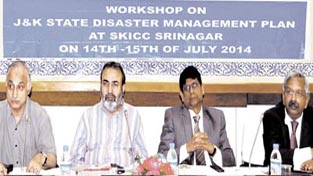
Chief Secretary, Mohammad Iqbal Khandey chairing inaugural session of workshop at SKICC.
Chief Secretary, Mohammad Iqbal Khandey chairing inaugural session of workshop at SKICC.
Minister for PHE, Sham Lal Sharma addressing public gathering on Monday.

Minister for PHE, Sham Lal Sharma addressing public gathering on Monday.
Minister for Labour, Ajay Sadhotra chairing a meeting at Jammu on Monday.

Minister for Labour, Ajay Sadhotra chairing a meeting at Jammu on Monday.
People protesting over death of road accident victim at Bakshi Nagar on Monday. -Excelsior/Rakesh
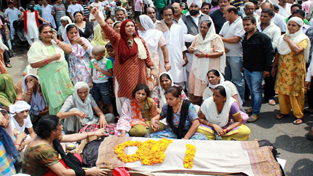
People protesting over death of road accident victim at Bakshi Nagar on Monday. -Excelsior/Rakesh
Cong leader Abdul Gani Vakil addressing party workers at Sopore on Monday.
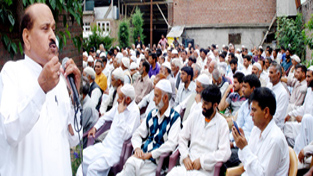
Cong leader Abdul Gani Vakil addressing party workers at Sopore on Monday.
Dental surgeons raising slogans during protest rally at Jammu on Monday.
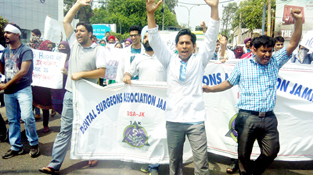
Dental surgeons raising slogans during protest rally at Jammu on Monday.
Helen Mirren credits husband for her belief in relationships
LOS ANGELES, July 14: Actress Helen Mirren has revealed that her director husband Taylor Hackford helped her to change her perspective on relationships.
The happily married director and 68-year-old actress got together in their late 30s and waited 13 years to wed on New Year’s Eve 1997, reported People magazine.
“Before I met Taylor, all my relationships took second place to my work. If I had to go to Africa, it was ‘Bye-bye, I’m off to Africa.’ And then he came into my life, and I started thinking, ‘Maybe it’s time to have a different attitude – and to say that my relationship is at least as important as my work.’ To give it the time,” she said.
The ‘Queen’ star said she often used to complain to her husband for not meeting her in life earlier.
“I used to say to Taylor, ‘I wish we’d met earlier on. We’ve missed so much time together’. And he’d say, ‘We’d never be together now if we met earlier,’ ” she said.
“And I think he’s actually right because we were both on a trajectory of work and ambition and, of course, to a certain extent, wanting to resolve ourselves as ourselves,” she added. (PTI)
Tribute to a martyrRavi Rohmetra Late Brig. Mohd. Usman stands as a personification of the secular traditions of the Indian Army. He made supreme sacrifice in the Battle of Jhangar on 3rd July, 1948. Brig. Usman was born on 15th July, 1912 at Bibipur which is a part of today’s Azamgarh district in Uttar Pradesh. Usman was educated at Harish Chander Bhai School in Varanasi. Despite intense competition, Usman succeeded in gaining admission to the prestigious Royal Military Academy at Sandhurst. Upon completion of his training, he was commissioned in Baluch Regiment and it was as a Baluch Officer that Usman had to face the cruel specter of partition in 1947. Despite intense pressure from the Pakistani leadership to join the Army of the new nation, Brig. Usman remained committed to the ideals of his motherland. The ultimate bait of becoming the Pakistan Army Chief also proved unsuccessful in tempting him and he remained steadfast in his resolve the serve the land of his birth. When the Baluch Regiment was allotted to Pakistan, Brig. Usman was transferred to Dogra Regiment. But war had already been thrust upon India when Pakistan sent tribal irregulars and its soldiers into Jammu and Kashmir. Even as the situation in the Kashmir Valley was stabilized the threat continued to be serious in the Jammu region. Brig. Usman Commander of 77 Para Brigade was side stepped to command 50 Para Brigade, deployed at Jhangar in December 1947. However, with odds heavily against him, Jhangar was wrested by the Pakistanis on 25th December, 1947. The Brigadier vowed to recapture Jhangar – a feat he accomplished three months later. With the fall of Jhangar, the emboldened Pakistanis seized Naushera and the situation looked grim indeed. Naushera was defended despite heavy odds and a numerically superior enemy was defeated. This proved to be the turning point in the campaign that earned Brig. Usman two titles of endearment – “Hero of Naushera” and “Savior of Naushera”. Jhangar, however, loomed large in his mind and the liberation of which became his obsession. After a month’s planning, he was able to put into motion his operation to free Jhangar and on 18th March, the Para Brigade achieved its objective. Jhangar was once again in Indian hands. But it was Jhangar that cost Brig. Usman’s life on 3rd July, during a lull in shelling. In a moving ceremony, Brig.Mohd. Usman was given a state funeral and a posthumous Mahavir Chakra. The enormity of his achievements from the nation’s point of view, can be gauged from the fact that on his being martyred on 3rd July 1948, he was given a state funeral in New Delhi by a grateful nation’s leadership. It is note-worthy that Brig. Mohd. Usman, MVC remains India’s only military commander to have been given this singular honour with the nation’s eminent leaders who include the then Prime Minister Pandit Jawahar Lal Nehru, Sheikh Abdullah, the then Defence Minister Sardar Baldev Singh, Maulana Abdul Kalam Azad and then CAOs Lt. Gen. (Late Fd Marhal) attending his funeral, before he was buried in the Jamia Milia Islamia at Delhi. It is also note-worthy that Brig. Mohd. Usman MVC remains India’s highest ranking military commander till date, to have made the supreme sacrifice on the battle field itself, while leading his men in action, in the face of the enemy.
Ravi Rohmetra
Late Brig. Mohd. Usman stands as a personification of the secular traditions of the Indian Army. He made supreme sacrifice in the Battle of Jhangar on 3rd July, 1948. Brig. Usman was born on 15th July, 1912 at Bibipur which is a part of today’s Azamgarh district in Uttar Pradesh. Usman was educated at Harish Chander Bhai School in Varanasi. Despite intense competition, Usman succeeded in gaining admission to the prestigious Royal Military Academy at Sandhurst. Upon completion of his training, he was commissioned in Baluch Regiment and it was as a Baluch Officer that Usman had to face the cruel specter of partition in 1947. Despite intense pressure from the Pakistani leadership to join the Army of the new nation, Brig. Usman remained committed to the ideals of his motherland.
The ultimate bait of becoming the Pakistan Army Chief also proved unsuccessful in tempting him and he remained steadfast in his resolve the serve the land of his birth. When the Baluch Regiment was allotted to Pakistan, Brig. Usman was transferred to Dogra Regiment. But war had already been thrust upon India when Pakistan sent tribal irregulars and its soldiers into Jammu and Kashmir. Even as the situation in the Kashmir Valley was stabilized the threat continued to be serious in the Jammu region. Brig. Usman Commander of 77 Para Brigade was side stepped to command 50 Para Brigade, deployed at Jhangar in December 1947. However, with odds heavily against him, Jhangar was wrested by the Pakistanis on 25th December, 1947. The Brigadier vowed to recapture Jhangar – a feat he accomplished three months later. With the fall of Jhangar, the emboldened Pakistanis seized Naushera and the situation looked grim indeed. Naushera was defended despite heavy odds and a numerically superior enemy was defeated. This proved to be the turning point in the campaign that earned Brig. Usman two titles of endearment – “Hero of Naushera” and “Savior of Naushera”. Jhangar, however, loomed large in his mind and the liberation of which became his obsession. After a month’s planning, he was able to put into motion his operation to free Jhangar and on 18th March, the Para Brigade achieved its objective. Jhangar was once again in Indian hands.
But it was Jhangar that cost Brig. Usman’s life on 3rd July, during a lull in shelling. In a moving ceremony, Brig.Mohd. Usman was given a state funeral and a posthumous Mahavir Chakra. The enormity of his achievements from the nation’s point of view, can be gauged from the fact that on his being martyred on 3rd July 1948, he was given a state funeral in New Delhi by a grateful nation’s leadership. It is note-worthy that Brig. Mohd. Usman, MVC remains India’s only military commander to have been given this singular honour with the nation’s eminent leaders who include the then Prime Minister Pandit Jawahar Lal Nehru, Sheikh Abdullah, the then Defence Minister Sardar Baldev Singh, Maulana Abdul Kalam Azad and then CAOs Lt. Gen. (Late Fd Marhal) attending his funeral, before he was buried in the Jamia Milia Islamia at Delhi. It is also note-worthy that Brig. Mohd. Usman MVC remains India’s highest ranking military commander till date, to have made the supreme sacrifice on the battle field itself, while leading his men in action, in the face of the enemy.
Germany’s players posing for a photograph while celebrating World Cup victory against Argentina.

Germany’s players posing for a photograph while celebrating World Cup victory against Argentina.
Environment protection
Pooja P. Vardhan
The constitution of India is not an inert but a living document which evolves and grows with time. The specific provisions on environment protection in the constitution are also result of this evolving nature and growth potential of the fundamental law of the land. The preamble to our constitution ensures socialist pattern of the society and dignity of the individual. Decent standard of living and pollution free environment is inherent in this. The Environment (Protection) Act, 1986 defines environment as “environment includes water, air and land and the interrelationship which exists among and between air, water and land and human beings, other living creatures, plants, micro-organism and property”.
The chapter on fundamental duties of the Indian Constitution clearly imposes duty on every citizen to protect environment. Article 51-A (g), says that “It shall be duty of every citizen of India to protect and improve the natural environment including forests, lakes, rivers and wild life and to have compassion for living creatures.”
The Directive principles under the Indian constitution directed towards ideals of building welfare state. Healthy environment is also one of the elements of welfare state. Article 47 provides that the State shall regard the raising of the level of nutrition and the standard of living of its people and the improvement of public health as among its primary duties. The improvement of public health also includes the protection and improvement of environment without which public health cannot be assured. Article 48 deals with organization of agriculture and animal husbandry. It directs the State to take steps to organize agriculture and animal husbandry on modern and scientific lines. In particular, it should take steps for preserving and improving the breeds and prohibiting the slaughter of cows and calves and other milch and draught cattle. Article 48 -A of the constitution says that “the state shall endeavor to protect and improve the environment and to safeguard the forests and wild life of the country”.
The Constitution of India under part III guarantees fundamental rights which are essential for the development of every individual and to which a person is inherently entitled by virtue of being human alone. Right to environment is also a right without which development of individual and realisation of his or her full potential shall not be possible. Articles 21, 14 and 19 of this part have been used for environmental protection.
According to Article 21 of the constitution, “no person shall be deprived of his life or personal liberty except according to procedure established by law”. Article 21 has received liberal interpretation from time to time after the decision of the Supreme Court in Maneka Gandhi vs. Union of India, (AIR 1978 SC 597). Article 21 guarantees fundamental right to life. Right to environment, free of danger of disease and infection is inherent in it. Right to healthy environment is important attribute of right to live with human dignity. The right to live in a healthy environment as part of Article 21 of the Constitution was first recognized in the case of Rural Litigation and Entitlement Kendra vs. State, AIR 1988 SC 2187 (Popularly known as Dehradun Quarrying Case). It is the first case of this kind in India, involving issues relating to environment and ecological balance in which Supreme Court directed to stop the excavation (illegal mining) under the Environment (Protection) Act, 1986. In M.C. Mehta vs. Union of India, AIR 1987 SC 1086 the Supreme Court treated the right to live in pollution free environment as a part of fundamental right to life under Article 21 of the Constitution.
Excessive noise creates pollution in the society. The constitution of India under Article 19 (1) (a) read with Article 21 of the constitution guarantees right to decent environment and right to live peacefully. In PA Jacob vs. The Superintendent of Police Kottayam, AIR 1993 Ker 1, the Kerala High Court held that freedom of speech under article 19 (1)(a) does not include freedom to use loud speakers or sound amplifiers. Thus, noise pollution caused by the loud speakers can be controlled under article 19 (1) (a) of the constitution.
Article 19 (1) (g) of the Indian constitution confers fundamental right on every citizen to practice any profession or to carry on any occupation, trade or business. This is subject to reasonable restrictions. A citizen cannot carry on business activity, if it is health hazards to the society or general public. Thus safeguards for environment protection are inherent in this. The Supreme Court, while deciding the matter relating to carrying on trade of liquor in Cooverjee B. Bharucha Vs Excise commissioner, Ajmer (1954, SC 220) observed that, if there is clash between environmental protection and right to freedom of trade and occupation, the courts have to balance environmental interests with the fundamental rights to carry on any occupations.
Public Interest Litigation under Article 32 and 226 of the constitution of India resulted in a wave of environmental litigation. The leading environmental cases decided by the Supreme Court includes case of closure of limestone quarries in the Dehradun region (Dehradun Quarrying case, AIR 1985 SC 652), the installation of safeguard at a chlorine plant in Delhi (M.C. Mehta V. Union of India, AIR 1988 SC 1037) etc. In Vellore Citizens Welfare Forum vs. Union of India (1996) 5 SCC 647, the Court observed that “the Precautionary Principle” and “the Polluter Pays Principle” are essential features of “Sustainable Development.”
At local and village level also, Panchayats have been empowered under the constitution to take measures such as soil conservation, water management, forestry and protection of the environment and promotion of ecological aspect.
Environment protection is part of our cultural values and traditions. In Atharvaveda, it has been said that “Man’s paradise is on earth; this living world is the beloved place of all; It has the blessings of nature’s bounties; live in a lovely spirit”. Earth is our paradise and it is our duty to protect our paradise. The constitution of India embodies the framework of protection and preservation of nature without which life cannot be enjoyed. The knowledge of constitutional provisions regarding environment protection is need of the day to bring greater public participation, environmental awareness, environmental education and sensitize the people to preserve ecology and environment.